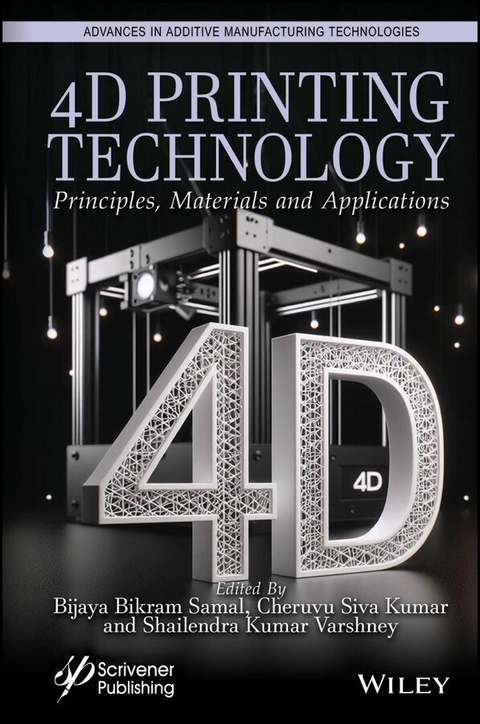
4D Printing Technology (eBook)
549 Seiten
Wiley-Scrivener (Verlag)
978-1-394-21377-1 (ISBN)
The book serves as a comprehensive guide to 4D printing technology, exploring its principles, materials, and applications while offering valuable insights for researchers, engineers, and innovators in additive manufacturing.
4D Printing Technology: Principles, Materials and Applications is a detailed exploration of 4D printing technology, offering readers a comprehensive understanding of how smart materials and additive manufacturing processes come together to create dynamic, responsive structures. Starting with the foundations of additive manufacturing, this volume introduces readers to the rise of smart materials and the evolution from static 3D printing to adaptive 4D printing. It covers a wide range of topics, including 4D printing at the micro and nano scale, the use of polymers and reinforced materials, and advanced applications in photonics. The volume delves into complex programming of 4D printed materials, discussing various stimuli (thermal, magnetic, light-based) that enable shape-shifting behavior. Each chapter focuses on practical applications, including healthcare innovations like adaptive implants, aerospace components that morph based on environmental conditions, and novel photonic devices. Finally, the book discusses key characterization techniques necessary for analyzing the performance and durability of 4D printed parts. 4D Printing Technology: Principles, Materials and Applications serves as a comprehensive reference and an inspiration for future innovations in this rapidly evolving field.
Readers will find the book
- Comprehensively covers 4D printing technologies, from foundational principles to advanced applications in photonics, robotics, and micro/nano devices;
- Includes contributions from international experts in smart materials, advanced manufacturing techniques, and application-specific innovations;
- Covers important research developments in this field from the last decade;
- Provides detailed discussions on materials, shape programming, and characterization techniques for 4D printed structures;
- Examines various applications, future directions, and innovations in 4D printing, smart materials, and additive manufacturing technologies.
Audience
Manufacturing engineers, materials scientists, additive manufacturing specialists in all industries, academics, and researchers in advanced materials, biomedical engineering, photonics, and nanotechnology.
Bijaya Bikram Samal, PhD, is a pioneering researcher in 4D printing at the Indian Institute of Technology, Kharagpur. He was the first in India to initiate groundbreaking research in 4D printing technology and gained international recognition for creating the world's strongest 4D printed part. He is a fellow of the Bose Science Society, chartered engineer for the Institute of Engineers, and a life member of the Indian Society for Technical Education.
Cheruvu Siva Kumar, PhD, is a professor of the Mechanical Engineering Department at the Indian Institute of Technology, Kharagpur. His post-doctoral research was conducted as a Japan Society for the Promotion of Science at the National Institute of Advanced Industrial Science and Technology. He has over 100 publications, ten patents, and serves as an expert panelist for government projects. His research interests include additive manufacturing, robotics, and computer networks.
Shailendra Kumar Varshney, PhD, is a professor in the Department of Electronics and Electrical Communication Engineering at the Indian Institute of Technology, Kharagpur. He has received numerous prestigious fellowships, including a University Grant Commission Council of Scientific and Industrial Research fellowship from India, a Monbukagakusho and Japan Society for the Promotion of Science fellowship from Japan, and the Alexander von Humboldt fellowship from Germany. His research focuses on on-chip photonic components, nonlinear photonics, and quantum photonics.
1
Importance of Additive Manufacturing in the Era of Industry 4.0
Bijaya Bikram Samal1*, Abhishek Kumar2, Anita Jena1, Debadutta Mishra3, Shailendra Kumar Varshney4, Ashish Kumar Nath2 and Cheruvu Siva Kumar2
1Advanced Technology Development Centre, Indian Institute of Technology, Kharagpur, West Bengal, India
2Department of Mechanical Engineering, Indian Institute of Technology, Kharagpur, West Bengal, India
3Department of Production Engineering, Veer Surendra Sai University of Technology, Burla, Sambalpur, Odisha, India
4Department of Electronics and Electrical Communication, Indian Institute of Technology, Kharagpur, West Bengal, India
Abstract
The Industrial Revolution has undoubtedly shaped human history, with its continual development since the eighteenth century leading to four major transformations, and potentially a fifth yet to come. At the forefront of this revolution is Industry 4.0, embodying extensive digitization, interconnections, and data analytics. Within this modern industrial movement, Additive Manufacturing (AM) plays a crucial role, facilitating decentralized production, customization, and sustainability. This integration is made possible by a variety of technological enablers, including the Internet of Things (IoT), big data analytics, cloud computing, and artificial intelligence. With its ability to create intricate structures and designs layer by layer, AM perfectly aligns with the core principles of Industry 4.0. This chapter delves into the dynamic synergy between AM and digital innovations, exploring how it is changing the face of modern manufacturing. By incorporating AM alongside digital twins and simulation technologies, manufacturing efficiency is significantly improved with the ability for live monitoring and proactive maintenance.
Keywords: Additive manufacturing, 3D printing, Industry 4.0, digital twin, machine learning, big data, Industry 5.0, 4D printing
1.1 Introduction
The Industrial Revolution refers to the transformative shift from a handicraft-based economy to a mechanized manufacturing industry driven by advancements in technology. This monumental shift began in the 18th century, spanning the years 1760 to 1840, and ushered in significant changes in economies around the world [1]. Prior to this revolution, economies primarily relied on simple handicrafts and agriculture. However, with the advent of the industrial revolution, economies were propelled forward by the emergence of factory systems, large-scale industries, and mechanized production [2]. The development of new industries showcased advanced power sources, cutting-edge machinery, and innovative methods for organizing departments within these industries. The Industrial Revolution has gone through four stages, each enhancing into a better, modern, and more innovative stage [3]. The industrial revolution began in the 18th century and was started by the introduction of mechanical production facilities powered by steam engines. The second industrial revolution began in the late 19th century and was characterized by the introduction of mass production facilities powered by electricity. The third industrial revolution began in the late 20th century and was characterized by the introduction of computerized production facilities. The industrial revolution also known as Industry 4.0, began in the early 21st century and is characterized by extensive interconnections, digitization, advanced analytics, and data collection [4]. Apart from this there is also a speculation of the fifth industrial revolution called Industry 5.0 [5], which is still in its infancy, but it is expected to be characterized by the integration of humans and machines [6], with a focus on human-centered production systems and also sustainability [7]. Evolution of industrial revolution from Industry 1.0 to Industry 5.0 has been depicted in Figure 1.1.
Additive manufacturing (AM), three-dimensional (3D) printing, rapid prototyping (RP), all these are the technological terms that involve manufacturing of a product through the addition of various layers of materials according to the geometrical data provided by the computer aided designs (CAD) [8]. AM is a technology that has revolutionized the manufacturing industry. It has brought about a paradigm shift in the way products are designed, developed, and manufactured. The technology has enabled industries and manufacturers to create complex geometries and structures that were previously impossible to produce using traditional, conventional manufacturing processes [9]. AM has also enabled manufacturers to produce customized products that meet the specific needs of customers [9]. This has helped manufacturers to differentiate their products from those of their competitors and gain a competitive advantage in the market. Therefore, AM is a key technology in the era of industry 4.0, as it allows for mass customization, reduces waste generation, on demand manufacturing, low manufacturing lead time, promotes faster business digitalization, etc. [10]. The present AM technology requires continuous and effective links between the machine, software, generated data, monitoring, and analytics, etc., that is only possible with high level of digitalization of the manufacturing industries, enabled by industry 4.0. The realization of Industry 4.0 relies on several crucial factors, which drive the transformation of traditional manufacturing into a more intelligent, interlinked, and efficient system [11]. These enablers as shown in Figure 1.2, are essential in achieving this evolution:
Figure 1.1 Evolution of industrial revolution from Industry 1.0 to Industry 5.0.
- Internet of Things (IoT), Industrial IoT (IIoT): IoT is a web of connected devices that are equipped with sensors and communication features. These devices have the ability to gather and share data, as well as initiate actuations, ultimately leading to a smarter and more adaptive environment. The complex network of smart devices, equipped with sensors and communication modules, facilitates the seamless exchange of real-time data. This interconnectedness extends from the factory floor to machinery and even the products themselves, creating a constantly evolving industrial ecosystem [11]. At the center of industry 4.0, the IoT plays a crucial role in driving data-driven decision-making. The abundance of data generated by these interconnected devices becomes a valuable resource for decision-makers. Through advanced analytics and machine learning algorithms, this data is carefully analyzed, providing valuable insights into production processes, equipment performance, and supply chain dynamics. This data-centric approach not only improves overall efficiency but also enables predictive maintenance [12].
Figure 1.2 Major enablers of Industry 4.0.
- Big Data and Analytics: The vast amount of data produced by IoT devices in Industry 4.0 is effectively utilized through big data analytics. With the help of advanced analytics tools and algorithms, this data is processed and analyzed, providing valuable insights and enabling informed decision-making [13].
- Cloud Fog Computing: Cloud computing plays a vital role in providing adaptable access to computing resources. Its capabilities extend to facilitating the storage and processing of large amounts of data from IoT devices, promoting real-time collaboration, and facilitating the distribution of software and applications in a variety of industrial settings [14].
- Artificial Intelligence (AI) and Machine Learning (ML): They are revolutionizing industrial processes. These cutting-edge technologies empower machines to analyze data, make intelligent decisions, and adapt to dynamic situations. Industry 4.0 harnesses the power of AI and ML for predictive analytics, autonomous decision-making, and optimizing processes to improve industrial efficiency. By constantly learning from data and deriving valuable insights, these technologies elevate performance and drive progress in industrial systems [15].
- Cyber-Physical Systems: These are innovative systems that combine computing, communication, and physical processes [16]. By leveraging sensors and actuators, these systems seamlessly bridge the gap between the digital and physical worlds [17]. This integration is crucial for effectively controlling and monitoring industrial processes in real-time [18].
- Augmented Reality (AR) and Virtual Reality (VR): These are game-changing technologies that elevate human-machine interaction [19]. With AR, digital information is superimposed onto the physical world, giving workers realtime insights. On the other hand, VR immerses users in virtual environments, providing a powerful tool for training, maintenance, and collaborative decision-making. These technologies greatly improve efficiency and decrease errors in industrial settings [20].
- Additive Manufacturing: Revolutionary manufacturing process known as AM has emerged as a game-changing technology [21]. Its ability to produce intricate and tailor-made components in a layered manner is in line with the fundamental principles of Industry 4.0 [22]. This breakthrough flexibility enables swift prototyping, decentralized production, and personalization of various goods [23].
- Blockchain technology: Its reputation for providing a secure and transparent platform...
| Erscheint lt. Verlag | 22.5.2025 |
|---|---|
| Reihe/Serie | Advances in Additive Manufacturing Technologies |
| Sprache | englisch |
| Themenwelt | Naturwissenschaften ► Chemie |
| ISBN-10 | 1-394-21377-8 / 1394213778 |
| ISBN-13 | 978-1-394-21377-1 / 9781394213771 |
| Informationen gemäß Produktsicherheitsverordnung (GPSR) | |
| Haben Sie eine Frage zum Produkt? |
 EPUB (Adobe DRM)
Kopierschutz: Adobe-DRM
Adobe-DRM ist ein Kopierschutz, der das eBook vor Mißbrauch schützen soll. Dabei wird das eBook bereits beim Download auf Ihre persönliche Adobe-ID autorisiert. Lesen können Sie das eBook dann nur auf den Geräten, welche ebenfalls auf Ihre Adobe-ID registriert sind.
Details zum Adobe-DRM
Dateiformat: EPUB (Electronic Publication)
EPUB ist ein offener Standard für eBooks und eignet sich besonders zur Darstellung von Belletristik und Sachbüchern. Der Fließtext wird dynamisch an die Display- und Schriftgröße angepasst. Auch für mobile Lesegeräte ist EPUB daher gut geeignet.
Systemvoraussetzungen:
PC/Mac: Mit einem PC oder Mac können Sie dieses eBook lesen. Sie benötigen eine
eReader: Dieses eBook kann mit (fast) allen eBook-Readern gelesen werden. Mit dem amazon-Kindle ist es aber nicht kompatibel.
Smartphone/Tablet: Egal ob Apple oder Android, dieses eBook können Sie lesen. Sie benötigen eine
Geräteliste und zusätzliche Hinweise
Buying eBooks from abroad
For tax law reasons we can sell eBooks just within Germany and Switzerland. Regrettably we cannot fulfill eBook-orders from other countries.
aus dem Bereich