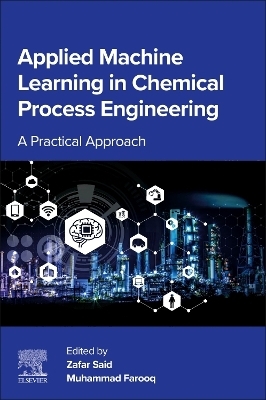
Applied Machine Learning in Chemical Process Engineering
Elsevier - Health Sciences Division (Verlag)
978-0-443-33943-1 (ISBN)
- Noch nicht erschienen (ca. Juni 2026)
- Versandkostenfrei
- Auch auf Rechnung
- Artikel merken
Dr. Zafar Said is currently working as a Distinguished Associate Professor in the Department of Mechanical and Aerospace Engineering at the United Arab Emirates University, UAE. He received his doctoral degree in Mechanical Engineering from the University of Malaya, Malaysia, and completed his postdoctoral research at Khalifa University, UAE. Dr. Said is a recognized leader in energy technology, nanofluids, and sustainable energy. His major areas of interest include heat transfer, solar energy systems, and advanced thermofluids. His research focuses on battery thermal management, enhancement of solar collectors using nanofluids and turbulators, and the development of stable nanorefrigerants and nanolubricants. He also applies artificial intelligence and machine learning to predict thermophysical properties and optimize energy systems. He is the recipient of several prestigious awards, including the Khalifa Award for Education as Distinguished University Professor (2025), the Future Pioneer Award in Sustainability (2025), and Best Academic Research at the 13th Dubai Award for Sustainable Transport (2024). He has also received the Research and Innovation Award from the UAE Ministry of Energy and Infrastructure (2022) and First Place in Scientific Research at the Excellence and Creative Engineering Award (2023) by the Society of Engineers, UAE. In recognition of his contributions, he has been consistently ranked among the world’s top 2% of scientists in the field of energy by Elsevier BV and Stanford University. In addition to his academic duties, he actively serves in editorial roles for several international journals and is a frequent keynote speaker at global conferences. Professor Muhammad Farooq is an experienced professional with more than 17 years of blended experience in research, teaching, training, industry, and project management across the globe and has visited over 25 countries for various professional activities including USA, UK, European countries, China, Pakistan, Turkey and the Gulf region. He holds PhD in Mechanical Engineering degree from Heriot-Watt University Edinburgh, United Kingdom. Dr. Farooq is the author of over 150 leading international research articles and his work has been cited more than 3,700 times. He is recognized among the top 2% scientists worldwide, according to the list issued by Stanford University, USA, and Elsevier/Scopus. He is a strong advocate for net-zero and carbon-neutral initiatives for sustainable environmental applications through SDGs and collaborating with more than 20 countries for various professional engagements related to research and development. As an Editor, Dr. Farooq has handled more than 500 research articles for renowned journals and international conferences, including Journal of Carbon Research (Q1), npj Thermal Science and Engineering (Springer Nature), Discover Sustainability (springer nature-Q2), The Journal of King Saud University – Engineering Sciences (Elsevier-Q1), Frontiers in Bioengineering and Biotechnology (Q1), Frontiers in Energy Research Journal (Q2), Sustainability Journal (MDPI-Q1), ChemEngineering Journal (MDPI- Q2), Chemistry Journal (MDPI- Q2), Energies Journal (MDPI-Q1), Processes Journal (MDPI-Q2), Journal of Agriculture (MDPI-Q1), Journal of Energy and Environment (SAGE- Q2), and the Pakistan Journal of Engineering and Applied Sciences. He has served as a volunteer and recognized reviewer for leading international journals and top-notch conferences, having reviewed over 1,000 research papers and received recognition awards from prestigious publishers such as Elsevier, Springer, SAGE Publishing, MDPI, and the Taylor & Francis Group. Dr. Farooq has received numerous highly competitive international grants and awards including Faculty Research Grant, NRPU HEC Research Project Award, UK Alumni Award by British Council, Best Paper Award by Institute of Engineers Pakistan, British Council Pak-UK Education Gateway Award for faculty exchange, Neilson Research Award, EU-CO2-TRIP Project funded by Marie Curie for Clean Coal Energy Generation, UK ADNET Research Grant, UK BBSRC and Faculty Development Scholarship. He has conducted various international training sessions as a resource person and frequently serves as a chair of technical sessions, conference secretary, member of technical committees, organizer, and invited keynote speaker at world-renowned international conferences, summer schools, and professional meetings related to energy systems.
1. Introduction to Machine Learning for Chemical Engineers
2. Data Handling and Preprocessing in Chemical Datasets
3. Predictive Modeling for Chemical Processes
4. Unsupervised Learning and Pattern Recognition in Chemical Data
5. Process Optimization and Control using Machine Learning
6. Molecular Simulations and Deep Learning
7. Reinforcement Learning in Process Design
8. Challenges and Ethical Considerations in Implementing ML
9. Case Studies: Breakthroughs at the Intersection of ML and Chemical Engineering
10. Physics-Informed Neural Networks in Chemical Engineering
11. Explainable AI and Sustainable Computing in Machine Learning
12. Future of AI in Chemical and Process Engineering Scope: Future trends and technologies in ML for chemical engineering
| Erscheint lt. Verlag | 1.6.2026 |
|---|---|
| Verlagsort | Philadelphia |
| Sprache | englisch |
| Maße | 152 x 229 mm |
| Themenwelt | Informatik ► Theorie / Studium ► Künstliche Intelligenz / Robotik |
| Naturwissenschaften ► Chemie ► Technische Chemie | |
| Technik | |
| ISBN-10 | 0-443-33943-0 / 0443339430 |
| ISBN-13 | 978-0-443-33943-1 / 9780443339431 |
| Zustand | Neuware |
| Informationen gemäß Produktsicherheitsverordnung (GPSR) | |
| Haben Sie eine Frage zum Produkt? |
aus dem Bereich