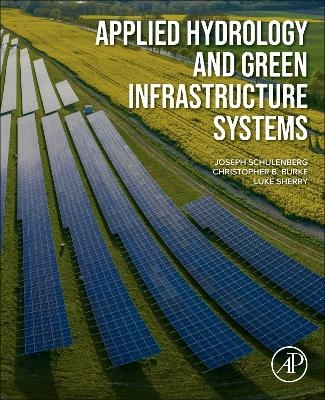
Applied Hydrology and Green Infrastructure Systems
Academic Press Inc (Verlag)
978-0-443-26763-5 (ISBN)
- Noch nicht erschienen (ca. Januar 2026)
- Versandkostenfrei
- Auch auf Rechnung
- Artikel merken
The book is divided into three parts. Part One offers a deep exploration of groundwater dynamics and describes saturated and unsaturated flow principles. It then explores steady-state and transient well hydraulics, flow nets, and strategies for ensuring sustainable groundwater availability. Part Two largely focuses on hydrology, diving into surface runoff processes, unit hydrographs, and the application of NRCS unit hydrograph methodology. Probability and statistics in hydrology are introduced followed by hydrologic frequency analyses. Lastly, Part Three describes sewer design, green infrastructure, and water transmission. The principles of sewer system design with an emphasis on sustainability and the integration of green infrastructure are discussed.
Applied Hydrology and Green Infrastructure Systems is a valuable resource for upper-level undergraduate students in environmental sciences studying engineering hydrology, hydraulics and hydrology. It is also useful for engineers, urban planners, and consultants who are looking for practical guidance to incorporate green infrastructure into urban design and development. This textbook contains case studies, self-assessments, spreadsheet shells, and a solutions manual as additional resources for students and instructors.
Joseph Schulenberg is a Clinical Associate Professor at The University of Illinois Chicago. He has a Ph.D. in Geotechnical Engineering from Northwestern University (1999) and an M.S. in Geotechnical Engineering from Michigan State University (1995). His teaching philosophy includes liberal use of real-world examples, focus on competency, use of multiple tools to arrive at a solution, active use of technology, acknowledgement of all learners, opportunities for group work, and permeation of presentation with ethical principles. His research interests include analysing large datasets and developing screening technologies, addressing urban infrastructure and environmental justice, slope stability, and geotechnical investigations. In addition to his academic position, he also leverages his unique background as an active professional engineer working with the U.S. Army Corps of Engineers, and a researcher with expertise in water resources engineering, geotechnical engineering, and numerical modelling in his research and teaching. Dr. Burke is a Professor of Practice at the Civil, Materials, and Environmental Engineering faculty at the University of Illinois, Chicago. He is a practicing Civil Engineer who specializes in water resources, and municipal engineering focusing on the Midwest. He has taught water resources related courses at UIC since 2001. His firm Christopher B. Burke Engineering includes a staff of about 250 located in Illinois and Indiana. The Burke Group of Companies was recently cited by the Engineering News Record as 167 in the Top 500 design firms in the United States. Luke J. Sherry, PE, CFM graduated with a Bachelor’s degree in Civil Engineering from Purdue University in 2004. Since then, he has worked at Christopher B. Burke Engineering, Ltd. in Rosemont, Illinois, where he is responsible for water resources engineering project analysis and design. With over 20 years of experience, Luke has worked on numerous watershed studies, municipal flood-reduction projects, floodplain/floodway determinations, stormwater detention and compensatory storage analyses, and the development of language for stormwater ordinances and technical guidance manuals. Luke is a licensed Professional Engineer and Certified Floodplain Manager and teaches the HEC-HMS and HEC-RAS computer programs nationally for the American Society of Civil Engineers.
Part I Groundwater
Chapter 1 Saturated and Unsaturated Flow
Chapter 2 Steady-State Well Hydraulics
Chapter 3 Transient Well Hydraulics
Chapter 4 Flow Nets
Chapter 5 Meeting Groundwater Demand
Part II Hydrology
Chapter 6 Probability and Statistics and Hydrologic Frequency Analyses
Chapter 7 Surface Runoff
Chapter 8 Unit Hydrographs and the NRCS (SCS) Unit Hydrograph
Chapter 9 Stormwater Storage
Chapter 10 Green Infrastructure
Chapter 11 Solar Hydrology
Part III Sewer Design and Water Transmission
Chapter 12 Sewer Design
Chapter 13 Applied Water Transmission
| Erscheint lt. Verlag | 23.1.2026 |
|---|---|
| Verlagsort | San Diego |
| Sprache | englisch |
| Maße | 191 x 235 mm |
| Gewicht | 450 g |
| Themenwelt | Naturwissenschaften ► Geowissenschaften ► Hydrologie / Ozeanografie |
| ISBN-10 | 0-443-26763-4 / 0443267634 |
| ISBN-13 | 978-0-443-26763-5 / 9780443267635 |
| Zustand | Neuware |
| Informationen gemäß Produktsicherheitsverordnung (GPSR) | |
| Haben Sie eine Frage zum Produkt? |
aus dem Bereich