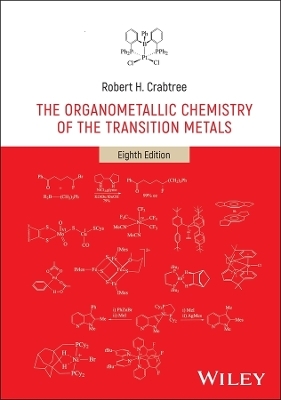
The Organometallic Chemistry of the Transition Metals
John Wiley & Sons Inc (Verlag)
978-1-119-87851-3 (ISBN)
- Noch nicht erschienen (ca. April 2026)
- Versandkostenfrei
- Auch auf Rechnung
- Artikel merken
Fully updated to reflect recent advances, the 8th edition of The Organometallic Chemistry of the Transition Metals provides readers with a comprehensive introduction to the principles and general properties of organometallic compounds as well as practical information on reaction mechanisms and detailed descriptions of contemporary applications. Maintaining the style from prior editions, the author replaces older or dated citations with current ones and changes coverage of the subject to keep the material up to date.
The new edition emphasizes such growing topics as organic applications, nanoclusters, electro- and photo-catalysis, computational studies, radical pathways, spin state effects, molecular electronics, proton coupled electron transfer, and alternative energy applications. It also adds new X-ray techniques and computational aspects that can help students design more detailed experiments.
The book includes select problems as an online ancillary, available via a companion site for adopting professors, to help instructors create exam problem sets for their students.
Sample topics covered in The Organometallic Chemistry of the Transition Metals include:
Werner complexes, the trans effect, soft versus hard ligands and metals, the crystal and ligand fields, and choice of metals
The 18 Electron Rule, bridging ligands, electron counting in reactions, Z ligands and the oxidation state concept and its limitations
Structure, bonding, synthesis, and reactivity of metal carbenes
Dissociative, associative, and photochemical substitution
Radical and ionic mechanisms, reductive elimination, and oxidative coupling
A long-time bestseller, this new edition of The Organometallic Chemistry of the Transition Metals continues to be the leading textbook on the subject for advanced undergraduate and graduate students in organic chemistry, organometallic chemistry, inorganic chemistry, and bioinorganic chemistry and practicing chemists in related fields.
Robert H. Crabtree, F.R.S., is a Research professor in the Department of Chemistry at Yale University. He has served on the editorial boards of Chemical Reviews and Organometallics and has received numerous awards for his research accomplishments including the Centenary Prize of the Royal Society of Chemistry (2014) and election to the National Academy of Sciences (2017).
Preface xi
List of Abbreviations xiii
1 Introduction 1
1.1 Why Study Organometallic Chemistry?, 2
1.2 Coordination Chemistry, 3
1.3 Werner Complexes, 5
1.4 The Trans Effect, 9
1.5 Soft Versus Hard Ligands and Metals, 11
1.6 The Crystal Field, 13
1.7 The Ligand Field, 24
1.8 Two-Electron, Three-Center Bonding, 26
1.9 Back Bonding, 26
1.10 Choice of Metals, 30
1.11 The sdn Model and Hypervalent Bonding, 32
References, 37
Problems, 39
2 Making Sense of Organometallics 41
2.1 Valence Electron Counting, 41
2.2 The 18-Electron “Rule”, 44
2.3 Electron Counting for Common Ligands, 45
2.4 Bridging Ligands, 49
2.5 Zero-Electron Ligands, 51
2.6 Limitations of the 18-Electron Rule, 54
2.7 Electron Counting in Reactions, 57
2.8 The Oxidation State Concept and its Limitations, 59
2.9 Coordination Number and Geometry, 65
2.10 Effects of Complexation on Ligands, 67
2.11 Differences between Metals, 71
2.12 Ligand Types, 76
2.13 Noninnocent Ligands and Ambiguous Oxidation States, 83
References, 85
Problems, 87
3 Alkyls, Aryls, and Hydrides 89
3.1 Stability of Alkyls and Aryls, 89
3.2 Making Alkyls and Aryls, 98
3.3 Other σ-Bonded Ligands, 106
3.4 Metal Hydrides, 108
3.5 Sigma Complexes, 111
3.6 Metal-Ligand Bond Strengths, 115
References, 118
Problems, 121
4 Ligands and Substitution 123
4.1 Metal Carbonyls: Structure and Bonding, 123
4.2 Metal Carbonyls: Synthesis and Reactivity, 127
4.3 Bridging Carbonyls and Co Analogues, 130
4.4 NITROSYLS∙, 132
4.5 Phosphines and Related P-Donor Ligands, 135
4.6 N-Heterocyclic Carbenes (NHCs), 139
4.7 Dissociative Substitution, 140
4.8 Associative Substitution, 145
4.9 Redox Effects and Interchange Substitution, 147
4.10 Photochemical Substitution, 149
4.11 Other Factors in Substitution, 152
4.12 Metal-Ligand Cooperativity, 154
References, 155
Problems, 157
5 PI-Complexes 159
5.1 Alkene and Alkyne Complexes, 159
5.2 Allyl Complexes, 166
5.3 Diene Complexes, 170
5.4 Cyclopentadienyl Complexes, 172
5.5 Arenes and Related Ligands, 180
5.6 Metallacycles, 183
5.7 Polyene versus Polyenyl Complexes, 184
5.8 The Isolobal Analogy, 184
References, 185
Problems, 186
6 Oxidative Addition and Reductive Elimination 189
6.1 General Principles, 189
6.2 Concerted Additions, 192
6.3 SN2 Pathways, 195
6.4 Radical Mechanisms, 197
6.5 Ionic Mechanisms, 200
6.6 Reductive Elimination, 202
6.7 Some Catalytic Applications of OA/RE Sequences, 208
6.8 Sigma Bond Metathesis, 212
6.9 Oxidative Coupling, 213
6.10 Ligand-Assisted 1,2-Additions and Eliminations, 214
References, 215
Problems, 216
7 Insertion and Elimination 219
7.1 Introduction, 219
7.2 1,1-Insertion, 221
7.3 1,2-Insertion, 226
7.4 Outer Sphere Insertions, 229
7.5 Beta Elimination and Related Processes, 231
7.6 Alkene Isomerization Catalysis, 233
7.7 Dehydrogenative Oxidation and Hydrogen Borrowing Catalysis, 236
References, 239
Problems, 240
8 Addition and Abstraction 243
8.1 Types of Reaction, 243
8.2 Nucleophilic Addition to CO, 246
8.3 Nucleophilic Addition to Polyenes and Polyenyls, 248
8.4 The Wacker Process, 252
8.5 Nucleophilic Abstraction and Deprotonation, 254
8.6 Electrophilic Addition and Abstraction, 256
8.7 Electron Transfer and Radical Pathways, 259
8.8 Proton-coupled Electron Transfer, 260
References, 263
Problems, 264
9 Homogeneous Catalysis 267
9.1 Catalytic Cycles, 268
9.2 Catalytic Hydrogenation, 275
9.3 Alkene Hydroformylation, 284
9.4 Alkene Hydrocyanation, 286
9.5 Alkene Hydrosilylation, 287
9.6 Cross-Coupling Reactions, 288
9.7 Oxidation Catalysis, 292
9.8 Electrocatalysis, 294
9.9 Photoredox Catalysis, 295
9.10 Catalyst Decomposition and Deactivation, 298
References, 299
Problems, 303
10 Physical Methods 307
10.1 Mechanism, 307
10.2 1H and 2H NMR Spectroscopy, 309
10.3 13C NMR Spectroscopy, 315
10.4 31P NMR Spectroscopy, 315
10.5 Dynamic NMR, 318
10.6 Electron Paramagnetic Resonance Spectroscopy, 320
10.7 IR Spectroscopy, 323
10.8 Structure Determination, 327
10.9 Electrochemistry, 329
10.10 Computation, 330
10.11 Big Data, Artificial Intelligence, and Machine Learning, 331
10.12 Other Methods, 332
References, 334
Problems, 337
11 Carbenes, Carbynes, and M–L Multiple Bonding 339
11.1 Carbenes, 339
11.2 Carbynes, 350
11.3 Bridging Carbenes and Carbynes, 352
11.4 N-Heterocyclic Carbenes, 353
11.5 Carbide and Carbone Complexes, 357
11.6 Multiple Bonds to Heteroatoms, 358
References, 361
Problems, 362
12 Metathesis, Polymerization, and Bond Activation 365
12.1 Alkene Metathesis, 365
12.2 Alkene Dimerization, Oligomerization, and Polymerization, 372
12.3 Activation of CO and CO2, 380
12.4 C–H Activation and Functionalization, 384
References, 390
Problems, 391
13 Green, Energy & Materials Applications 395
13.1 Green Chemistry, 395
13.2 Organometallics for an Alternative Energy Future, 401
13.3 Metal–Metal Bonds and Clusters, 404
13.4 Nanoparticles, 407
13.5 Organometallic Materials, 409
13.6 Supported Organometallics, 415
References, 417
Problems, 420
14 Organic Applications 423
14.1 Carbon–Carbon and Carbon-heteroatom Coupling, 424
14.2 C–H Activation and Late-stage Functionalization, 431
14.3 Metathesis of C==C Bonds, 436
14.4 Carbenes in Cyclopropanation and C–H Insertion, 439
14.5 Hydrogenation, 441
14.6 Oxidation, 443
14.7 Carbonylation, 445
14.8 Photoredox Catalysis, 446
14.9 Alkyne and Aryne Chemistry, 449
14.10 Radical Chemistry, 451
14.11 Hydroboration, 451
14.12 Electrosynthesis, 452
14.13 Isotope Exchange, 453
References, 454
Problems, 458
15 High Oxidation States, Magnetism, and the f-Block 461
15.1 High Oxidation States, 461
15.2 Magnetism and Spin States, 463
15.3 Cyclopentadienyl Complexes, 472
15.4 The f-block, 475
References, 484
Problems, 485
16 Bioorganometallic Chemistry 487
16.1 Introduction, 488
16.2 Coenzyme B12, 495
16.3 Iron-sulfur Clusters, 501
16.4 Nitrogen Fixation, 504
16.5 Nickel Enzymes, 511
16.6 Applications to Chemical Biology, 516
16.7 Biomedical and Biocatalytic Applications, 517
References, 521
Problems, 524
Appendix A: Useful Texts on Allied Topics 527
Appendix B: Major Reaction Types 529
Answers 531
Index 549
| Erscheint lt. Verlag | 29.4.2026 |
|---|---|
| Verlagsort | New York |
| Sprache | englisch |
| Themenwelt | Naturwissenschaften ► Chemie ► Anorganische Chemie |
| Naturwissenschaften ► Chemie ► Organische Chemie | |
| Naturwissenschaften ► Chemie ► Physikalische Chemie | |
| ISBN-10 | 1-119-87851-9 / 1119878519 |
| ISBN-13 | 978-1-119-87851-3 / 9781119878513 |
| Zustand | Neuware |
| Informationen gemäß Produktsicherheitsverordnung (GPSR) | |
| Haben Sie eine Frage zum Produkt? |
aus dem Bereich