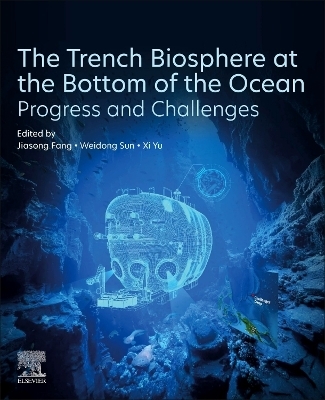
The Trench Biosphere at the Bottom of the Ocean
Elsevier - Health Sciences Division (Verlag)
978-0-443-27610-1 (ISBN)
- Noch nicht erschienen (ca. Mai 2026)
- Versandkostenfrei
- Auch auf Rechnung
- Artikel merken
Dr. Fang has been trained in multiple disciplines, including a bachelor’s degree in Geology from Yangtze University, a master’s degree in Biogeochemistry from Louisiana State University, Baton Rouge, Louisiana, and a doctoral degree in Chemical Oceanography from Texas A&M University, College Station, Texas, USA. He then completed his postdoctoral training in Microbiology at Miami University in Oxford, Ohio. Currently he is a Chair Professor at College of Oceanography and Ecological Sciences, and Director of Shanghai Engineering Research Center of Hadal Science and Technology, Shanghai Ocean University in Shanghai, China. His primary research interest is marine microbiology and biogeochemistry, focusing on studying microbial mediated cycling of nutrient elements, particularly carbon and phosphorus, in the deep ocean. He has authored over 160 peer-reviewed publications in renowned journals including Microbiome, Genome Biology, Trends in Microbiology, etc. Dr. Sun obtained his BSc and MSc at the University of Science and Technology of China, Hefei, China and Ph.D. in geochemistry at the Australian National University, Canberra, Australia. He served on the Integrated Ocean Drilling Program (IODP, 2011-2013) and the International Ocean Discovery Program (IODP, 2013-2015); Goldschmidt Medal Evaluation Panel (2013-2015), Board of Directors (2015-2018) of the Geochemical Society. He is currently the editor of Solid Earth Sciences, and an Associate Editors of Geochimica et Cosmochimica Acta, Chinese Journal of Geochemistry, Journal of Oceanology and Limnology. He works in the field of marine geology, with speciality and research interests that include the subduction factory and mineralization; plate geodynamics and climate change. He published more than 400 peer reviewed papers with a citation of more than 18,000. Xi Yu is a professor at College of Oceanography and Ecological Science of Shanghai Ocean University in Shanghai, China. She holds a bachelor’s degree in pharmaceutics from Northwest A&F University and a PhD in microbiology from Nankai University, China, which included joint training at Yale University. Following postdoctoral research at the Karlsruhe Institute of Technology in Germany, she joined Shanghai Ocean University. Professor Yu’s research focuses on marine microbiology, particularly unique microbial resources and life processes in extreme marine environments. She has led national research projects and contributed to the UN Ocean Decade programme “DOME (Deep Ocean Microbiomes and Ecosystems). Her work on deep-sea fungal natural products has significantly advanced the field of deep-sea biological resources.
1. The trench biosphere at the bottom of the ocean: Issues and challenges
2. Geological, Physical, and Chemical Limits to the Trench Biosphere Trenches, serpentinization, and origin of life
3. Research progress on ocean circulation and its dynamics in hadal trenches
4. On the edge of the trench biosphere? Molecular evolution mechanisms of multicellular organisms adapting to the trench environment
5. Microbial life processes and adaptation strategies
6. Microbial biofilms at the bottom of the ocean
7. Microbial adaptation to hydrostatic pressure: A transcriptomic analysis
8. Microbial Diversity and Biogeochemical Processes Identification of functional microorganisms in the Mariana Trench
9. Archaea diversity in the sediment of the Mariana and Mussau Trenches
10. Geochemical characterization of organic matter in hadal trench sediments: Insights into the food sources for hadal microorganisms
11. Carbon source, distribution and burial flux in global hadal trenches
12. Environmental Pollutants Emerging environmental pollutants in the trench biosphere and anthropogenic impacts
13. Legacy and emerging environmental pollutants in hadal trenches
14. Halogenated organic compounds in hadal trenches and microbial mediated coupled-cycling of carbon and halogens in the ocean
15. Microbial Synthesis of Secondary Metabolites Microbial production of secondary metabolites by Mariana Trench sediment fungi
16. Natural products from hadal microorganisms
17. Innovative Sampling and Measurement Technologies and Devices, and Data Platforms Pressure-retaining sampling and transfer devices
18. Microbial ectoenzyme activities measured under in-situ conditions reveals varied microbial activities with depth in the water column of the Challenger Deep
19. Basic theory and key technologies for deep-sea observation and exploration equipment and facilities
20. HADAL, a platform for curating and discovering microbiological and genetic resources and analyzing omics and environmental data of the ocean
21. Future Directions Studying the trench biosphere: Scientific and technological advances and applications
| Erscheint lt. Verlag | 1.5.2026 |
|---|---|
| Verlagsort | Philadelphia |
| Sprache | englisch |
| Maße | 191 x 235 mm |
| Gewicht | 450 g |
| Themenwelt | Naturwissenschaften ► Geowissenschaften ► Hydrologie / Ozeanografie |
| ISBN-10 | 0-443-27610-2 / 0443276102 |
| ISBN-13 | 978-0-443-27610-1 / 9780443276101 |
| Zustand | Neuware |
| Informationen gemäß Produktsicherheitsverordnung (GPSR) | |
| Haben Sie eine Frage zum Produkt? |
aus dem Bereich