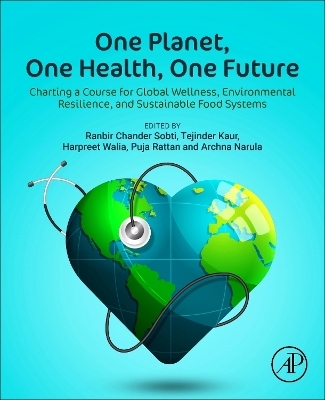
One Planet, One Health, One Future
Academic Press Inc (Verlag)
978-0-443-38325-0 (ISBN)
Dr. Ranbir Chander (RC) Sobti is Emeritus Professor at Punjab University, Chandigarh, and Honorary Scientist at the Indian National Science Academy. He started his career as a cytogeneticist and progressed to molecular biology and disease processes of cancer, COPD, AIDS, metabolic syndrome, and kidney diseases. He is a Fellow of the Third World Academy of Sciences, National Academy of Sciences India, Indian National Science Academy, National Academy of Medical Sciences, National Academy of Agricultural Sciences, Canadian Academy of Cardiovascular Diseases Royal Society of biology and international Association of Cancer Research. Dr. Sobti has participated in several book projects, including Elsevier’s Advances in Animal Experimentation and Modeling; Biomarkers in Cancer Detection and Monitoring of Therapeutics; Molecular Medicine and Biomedical Research in the Era of Precision Medicine; One Planet, One Health, One Future; Probiotics; and Public and Environmental Health. Dr. Tejinder Kaur is a highly accomplished academician, with a Ph.D. in Zoology from Panjab University, Chandigarh. She currently serves as an Assistant Professor and Coordinator in the Department of Zoology at DAV University, Jalandhar. With over a decade of teaching experience, her expertise spans a diverse range of subjects, including Developmental Biology, Parasitology, and Human Physiology. Her strong academic background is complemented by her supervision of numerous M.Sc. dissertations and guidance of 5 Ph.D. students in their research pursuits. Boasting an impressive research profile, Dr. Kaur has authored 30 published papers and book chapters, showcasing her significant contributions to developmental biology, particularly in the analysis of gene enhancers in Drosophila and Tribolium embryos. Her commitment to excellence is evident in her continuous pursuit of knowledge, reinforced by professional training teaching pedagogy. Dr. Kaur's multifaceted expertise makes her a valuable asset in advancing the realms of Zoology and developmental biology. Dr. Harpreet Walia was the Coordinator in the Department of Environmental Studies at DAV University, Jalandhar from 2013-2016. With over 15 years of research experience, she specializes in the field of Environmental toxicology, Natural Plant Products, Solid Waste Management, Antioxidative and Antimutagenic activities of medicinal plants. She is a gold Medalist in Post-graduation with 12 years of teaching experience. She has published more than 25 research papers and review articles in national and international journals. She has contributed in various community engagement programmes and conducted various activities in waste management and waste recycling. Dr. Puja Rattan, currently an Associate Professor at Division of Vegetable Science, Faculty of Horticulture, Shere-Kashmir University of Agricultural Sciences and Technology, Jammu., possesses 16 years of extensive experience in research and teaching. Noteworthy projects under her purview include 'Androgenesis Mediated Introgression of Fruit and Shoot Borer Resistant Genes into Eggplant' funded by the Department of Biotechnology and 'Alien Introgression of Yellow Vein Mosaic Virus Resistance Genes in Okra' funded by the Department of Science and Technology. She also contributed as co-breeder for several crop varieties released for cultivation in Jammu region. With 83 publications to her credit, including research papers, abstracts, technical bulletins, and book chapters, her expertise spans the interface of traditional Indian beliefs and modern science. Dr. Archna Narula is an accomplished academic and researcher with over three decades of experience in chemical engineering. She currently serves as Registrar–Academics and Professor at the Department of Chemical Engineering at M.S. Ramaiah Institute of Technology (MSRIT), Bangalore. With a Ph.D., M.E., and B.E. from Panjab University, she brings deep expertise in environmental engineering and catalyst development for biomass conversion. Dr. Narula has guided numerous undergraduate, postgraduate, and Ph.D. students and has also served as a guest lecturer, conference chair, and reviewer for international journals. Beyond teaching and research, she actively contributes to academic leadership, curriculum development, and industry-academia initiatives. She is a life member of several professional bodies including IIChE, ISTE, and is a Fellow of the Institution of Engineers. Her work continues to influence both the academic and practical dimensions of sustainable chemical engineering.
Part 1
1. Sustainable development goal for good health: Strategies for combating diseases through the development of newer technologies for diagnosis, therapeutics, and nutritional impacts
Section 1: Biodiversity, ecology, and public health
2. Ecological interactions and their impact on human health
3. Biodiversity and public health
4. Human–animal health interactions: A complex and vital relationship
5. Health and aging: Navigating through the golden years
Section 2: Nutrition, biotechnology, and sustainable health
6. Preventive health: Building resilience and promoting wellness
7. Precision public health: Leveraging data science in epidemic management
8. Influence of nutraceuticals in health promotion and disease prevention
Section 3: Health policy, innovations, and disease prevention
9. Governance and policy in global health: Challenges and future directions
10. Innovations in medical (imaging) technologies
Part 2: Environmental resilience: Sustaining the web of life
11. The path to sustainability: Building a resilient planet
Section 1: Ecosystems and biodiversity conservation
12. Leveraging artificial intelligence and biotechnology for sustainable environment and planetary health
Section 2: Climate change, sustainability, and renewable energy
13. Understanding the climate change Mosandl: Scientific opinion and public perspectives
14. Next-generation biofuels: Possibilities and challenges
15. Renewable energy insights: Unlocking the potential of clean energy for a sustainable world
16. Biomass energy: The potential, future prospects, and challenges in the path toward environmental sustainability in clean energy
Section 3: Environmental biotechnology and waste management
17. Biotechnologies for environmental sustainability: Advancing clean energy, biodiversity, water security, and climate resilience
18. Clustered regularly interspaced short palindromic repeats associated protein systems in environmental biotechnology: Applications in pollution management
19. Artificial intelligence for environmental sustainability
20. Hybrid biological processes for agro and food industry waste management
21. Innovative approaches in wastewater treatment—The role of ferrite nanomaterials
Part 3: Sustainable food systems
Section 1: Sustainable and resilient agricultural practices
22. Climate-resilient agriculture: Strategies for nutritious food for all
23. Agroecology: A pathway to sustainable agriculture and food system resilience
24. Farm to table: Sustainable food chains
25. Toward a resilient food system
26. Ethics of food production
Section 2: Technology and biotechnology in agriculture
27. Biotechnological innovations for improving soil health and crop yield
28. Artificial intelligence in agriculture
29. Genetically engineered crops for climate resilient agriculture
30. Innovative biotechnological solutions: Empowering agriculture for sustainable food production
31. Role of genetically modified crops in eradicating hunger and acceptance in society
32. Cultured meat: Current status, challenges, and strategic prospects
33. Alternative proteins: An introduction to emerging sources and applications
Way ahead for one planet, one health, one future
| Erscheinungsdatum | 13.12.2025 |
|---|---|
| Verlagsort | San Diego |
| Sprache | englisch |
| Maße | 216 x 276 mm |
| Gewicht | 450 g |
| Themenwelt | Naturwissenschaften ► Biologie ► Ökologie / Naturschutz |
| ISBN-10 | 0-443-38325-1 / 0443383251 |
| ISBN-13 | 978-0-443-38325-0 / 9780443383250 |
| Zustand | Neuware |
| Informationen gemäß Produktsicherheitsverordnung (GPSR) | |
| Haben Sie eine Frage zum Produkt? |
aus dem Bereich