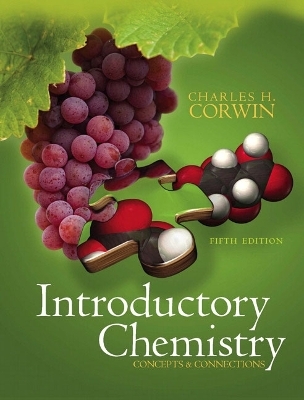
Introductory Chemistry
Pearson
978-0-13-232148-8 (ISBN)
- Titel erscheint in neuer Auflage
- Artikel merken
This text is carefully crafted to help students learn chemical skills and concepts more effectively. Corwin covers math and problem-solving early in the text; he builds student confidence and skills through innovative problem-solving pedagogy and technology formulated to meet student needs.
1 Introduction to Chemistry
1.1 Evolution of Chemistry
CRITICAL THINKING Rise and Fall of a Theory
1.2 Modern Chemistry
CHEMISTRY CONNECTION Alchemy
1.3 Learning Chemistry
Summary • Key Concepts
Key Terms • Exercises • Self-Test
2 Scientific Measurements
2.1 Uncertainty in Measurements
2.2 Significant Digits
2.3 Rounding Off Nonsignificant Digits
2.4 Adding and Subtracting Measurements
2.5 Multiplying and Dividing Measurements
2.6 Exponential Numbers
2.7 Scientific Notation
CHEMISTRY CONNECTION A Student Success Story
2.8 Unit Equations and Unit Factors
2.9 Unit Analysis Problem Solving
CRITICAL THINKING World Trade Center
2.10 The Percent Concept
CHEMISTRY CONNECTION The Coinage Metals
Summary
Problem Solving Organizer • Key Concepts
Key Terms • Exercises • Self-Test
3 The Metric System
3.1 Basic Units and Symbols
CHEMISTRY CONNECTION International System (SI)
3.2 Metric Conversion Factors
3.3 Metric—Metric Conversions
3.4 Metric—English Conversions
CHEMISTRY CONNECTION The Olympics
3.5 Volume by Calculation
3.6 Volume by Displacement
3.7 The Density Concept
CRITICAL THINKING Lower Gasoline Bills
3.8 Temperature
3.9 Heat and Specific Heat
Summary
Problem Solving Organizer • Key Concepts
Key Terms • Exercises • Self-Test
4 Matter and Energy
4.1 Physical States of Matter
4.2 Elements, Compounds, and Mixtures
4.3 Names and Symbols of the Elements
CRITICAL THINKING Aluminum or Aluminium?
4.4 Metals, Nonmetals, and Semimetals
CHEMISTRY CONNECTION Elements 104 and Beyond
4.5 Compounds and Chemical Formulas
4.6 Physical and Chemical Properties
4.7 Physical and Chemical Changes
4.8 Conservation of Mass
4.9 Potential and Kinetic Energy
4.10 Conservation of Energy
CHEMISTRY CONNECTION Recycling Aluminum
Summary • Key Concepts
Key Terms • Exercises • Self-Test
5 Models of the Atom
5.1 Dalton Model of the Atom
CHEMISTRY CONNECTION John Dalton
5.2 Thomson Model of the Atom
5.3 Rutherford Model of the Atom
5.4 Atomic Notation
5.5 Atomic Mass
CRITICAL THINKING Heavy Water
5.6 The Wave Nature of Light
5.7 The Quantum Concept
5.8 Bohr Model of the Atom
CHEMISTRY CONNECTION Neon Lights
5.9 Energy Levels and Sublevels
5.10 Electron Configuration
5.11 Quantum Mechanical Model of the Atom
Summary • Key Concepts
Key Terms • Exercises • Self-Test
6 The Periodic Table
6.1 Classification of Elements
CHEMISTRY CONNECTION Dmitri Mendeleev
6.2 The Periodic Law Concept
6.3 Groups and Periods of Elements
CRITICAL THINKING IUPAC Group Numbers
6.4 Periodic Trends
6.5 Properties of Elements
6.6 Blocks of Elements
6.7 Valence Electrons
6.8 Electron Dot Formulas
6.9 Ionization Energy
6.10 Ionic Charges
Summary • Key Concepts
Key Terms • Exercises • Self-Test
7 Language of Chemistry
7.1 Classification of Compounds
CHEMISTRY CONNECTION Antoine and Marie Lavoisier
7.2 Monoatomic Ions
7.3 Polyatomic Ions
7.4 Writing Chemical Formulas
CRITICAL THINKING Nutritional Potassium
7.5 Binary Ionic Compounds
7.6 Ternary Ionic Compounds
7.7 Binary Molecular Compounds
7.8 Binary Acids
7.9 Ternary Oxyacids
CHEMISTRY CONNECTION IUPAC Nomenclature
Summary
Nomenclature Organizer • Key Concepts
Key Terms • Exercises • Self-Test
8 Chemical Reactions
8.1 Evidence for Chemical Reactions
CHEMISTRY CONNECTION Fireworks
8.2 Writing Chemical Equations
8.3 Balancing Chemical Equations
8.4 Classifying Chemical Reactions
8.5 Combination Reactions
8.6 Decomposition Reactions
8.7 The Activity Series Concept
8.8 Single-Replacement Reactions
8.9 Solubility Rules
8.10 Double-Replacement Reactions
8.11 Neutralization Reactions
CRITICAL THINKING Household Chemicals
Summary • Key Concepts
Key Terms • Exercises • Self-Test
9 The Mole Concept
9.1 Avogadro’s Number
CHEMISTRY CONNECTION Analogies for Avogadro’s Number
9.2 Mole Calculations I
9.3 Molar Mass
9.4 Mole Calculations II
9.5 Molar Volume
9.6 Mole Calculations III
9.7 Percent Composition
9.8 Empirical Formula
9.9 Molecular Formula
CRITICAL THINKING Avogadro’s Number
Summary
Problem Solving Organizer • Key Concepts
Key Terms • Exercises • Self-Test
10 Chemical Equation Calculations
10.1 Interpreting a Chemical Equation
10.2 Mole—Mole Relationships
CRITICAL THINKING Understanding Steelmaking
10.3 Types of Stoichiometry Problems
10.4 Mass—Mass Problems
10.5 Mass—Volume Problems
10.6 Volume—Volume Problems
CHEMISTRY CONNECTION Manufacturing Ammonia
10.7 The Limiting Reactant Concept
10.8 Limiting Reactant Problems
10.9 Percent Yield
Summary
Problem Solving Organizer • Key Concepts
Key Terms • Exercises • Self-Test
11 The Gaseous State
11.1 Properties of Gases
CHEMISTRY CONNECTION The Greenhouse Effect
11.2 Atmospheric Pressure
11.3 Variables Affecting Gas Pressure
11.4 Boyle’s Law: Pressure—Volume Relationships
CHEMISTRY CONNECTION Robert Boyle
11.5 Charles’s Law: Volume—Temperature Relationships
11.6 Gay—Lussac’s Law: Pressure—Temperature Relationships
11.7 Combined Gas Law
11.8 The Vapor Pressure Concept
11.9 Dalton’s Law of Partial Pressures
11.10 Ideal Gas Behavior
11.11 Ideal Gas Law
CRITICAL THINKING Conceptualizing Gases
Summary
Problem Solving Organizer • Key Concepts
Key Terms • Exercises • Self-Test
12 Chemical Bonding
12.1 The Chemical Bond Concept
12.2 Ionic Bonds
12.3 Covalent Bonds
12.4 Electron Dot Formulas of Molecules
12.5 Electron Dot Formulas of Polyatomic Ions
12.6 Polar Covalent Bonds
CHEMISTRY CONNECTION Linus Pauling
12.7 Nonpolar Covalent Bonds
12.8 Coordinate Covalent Bonds
12.9 Hydrogen Bonds
12.10 Shapes of Molecules
CRITICAL THINKING Diamond vs. Graphite
Summary • Key Concepts
Key Terms • Exercises • Self-Test
13 Liquids and Solids
13.1 Properties of Liquids
13.2 The Intermolecular Bond Concept
13.3 Vapor Pressure, Boiling Point, Viscosity,
Surface Tension
13.4 Properties of Solids
13.5 Crystalline Solids
13.6 Changes of Physical State
13.7 Structure of Water
CHEMISTRY CONNECTION Water Purification
13.8 Physical Properties of Water
13.9 Chemical Properties of Water
13.10 Hydrates
CRITICAL THINKING Bottled Water
Summary • Key Concepts
Key Terms • Exercises • Self-Test
14 Solutions
14.1 Gases in Solution
14.2 Liquids in Solution
14.3 Solids in Solution
14.4 The Dissolving Process
CHEMISTRY CONNECTION Colloids
14.5 Rate of Dissolving
14.6 Solubility and Temperature
14.7 Unsaturated, Saturated, and Supersaturated Solutions
14.8 Mass/Mass Percent Concentration
14.9 Molar Concentration
CRITICAL THINKING Water Fluoridation
14.10 Dilution of a Solution
14.11 Solution Stoichiometry
Summary
Problem Solving Organizer • Key Concepts
Key Terms • Exercises • Self-Test
15 Acids and Bases
15.1 Properties of Acids and Bases
15.2 Arrhenius Acids and Bases
CHEMISTRY CONNECTION Svante Arrhenius
15.3 Brønsted—Lowry Acids and Bases
15.4 Acid—Base Indicators
15.5 Acid—Base Titrations
15.6 Acid—Base Standardization
15.7 Ionization of Water
15.8 The pH Concept
15.9 Advanced pH Calculations
CRITICAL THINKING Acid Rain
15.10 Strong and Weak Electrolytes
15.11 Net Ionic Equations
Summary
Problem Solving Organizer • Key Concepts
Key Terms • Exercises • Self-Test
16 Chemical Equilibrium
16.1 Collision Theory
16.2 Energy Profiles of Chemical Reactions
16.3 The Chemical Equilibrium Concept
CHEMISTRY CONNECTION The Ozone Hole
16.4 General Equilibrium Constant, Keq
16.5 Equilibria Shifts for Gases
16.6 Ionization Equilibrium Constant, Ki
16.7 Equilibria Shifts for Weak Acids and Bases
16.8 Solubility Product Equilibrium Constant, Ksp
16.9 Equilibria Shifts for Slightly Soluble Compounds
Summary • Key Concepts
Key Terms • Exercises • Self-Test
17 Oxidation and Reduction
17.1 Oxidation Numbers
17.2 Oxidation—Reduction Reactions
17.3 Balancing Redox Equations:
Oxidation Number Method
17.4 Balancing Redox Equations:
Half—Reaction Method
17.5 Predicting Spontaneous Redox Reactions
17.6 Voltaic Cells
17.7 Electrolytic Cells
CHEMISTRY CONNECTION Hybrid Vehicles
Summary • Key Concepts
Key Terms • Exercises • Self-Test
18 Nuclear Chemistry
18.1 Natural Radioactivity
18.2 Nuclear Equations
18.3 Radioactive Decay Series
18.4 Radioactive Half—Life
18.5 Applications of Radionuclides
CRITICAL THINKING Nuclear Medicine
18.6 Induced Radioactivity
18.7 Nuclear Fission
CHEMISTRY CONNECTION Nuclear Power Plant
18.8 Nuclear Fusion
Summary • Key Concepts
Key Terms • Exercises • Self-Test
19 Organic Chemistry
19.1 Hydrocarbons
19.2 Alkanes
19.3 Alkenes and Alkynes
19.4 Arenes
19.5 Hydrocarbon Derivatives
19.6 Organic Halides
19.7 Alcohols, Phenols, and Ethers
19.8 Amines
19.9 Aldehydes and Ketones
19.10 Carboxylic Acids, Esters, and Amides
CHEMISTRY CONNECTION Giant Molecules
Summary • Key Concepts
Key Terms • Exercises • Self-Test
20 Biochemistry
20.1 Biological Compounds
20.2 Proteins
20.3 Enzymes
20.4 Carbohydrates
20.5 Lipids
CRITICAL THINKING Vitamins
20.6 Nucleic Acids
Summary • Key Concepts
Key Terms • Exercises • Self-Test
Appendices
A Weights and Measures
B Physical Constants
C Activity Series of Metals
D Solubility Rules for Ionic Compounds
E Vapor Pressure of Water
F Properties of Water
G Answers to Key Concept Exercises
H Answers to Key Term Exercises
I Answers to Odd-Numbered Exercises
J Answers to Chapter Self-Tests
Glossary
Photo Credits
Index
| Erscheint lt. Verlag | 16.7.2007 |
|---|---|
| Sprache | englisch |
| Maße | 215 x 282 mm |
| Gewicht | 1614 g |
| Themenwelt | Naturwissenschaften ► Chemie |
| ISBN-10 | 0-13-232148-3 / 0132321483 |
| ISBN-13 | 978-0-13-232148-8 / 9780132321488 |
| Zustand | Neuware |
| Informationen gemäß Produktsicherheitsverordnung (GPSR) | |
| Haben Sie eine Frage zum Produkt? |
aus dem Bereich