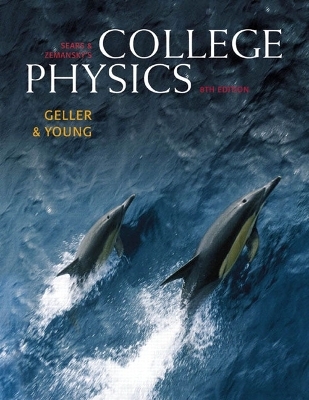
College Physics, Volume 2 (Chs. 17-30)
Addison-Wesley Educational Publishers Inc
978-0-8053-7823-8 (ISBN)
- Titel erscheint in neuer Auflage
- Artikel merken
A broad and thorough introduction to physics, this new edition carefully integrates many solutions from educational research to help students to develop greater confidence in solving problems, deeper conceptual understanding, and stronger quantitative-reasoning skills, while helping them connect what they learn with their other courses and the changing world around them.
Hugh D. Young is Professor of Physics at Carnegie Mellon University in Pittsburgh, PA. He attended Carnegie Mellon for both undergraduate and graduate study and earned his Ph.D. in fundamental particle theory under the direction of the late Richard Cutkosky. He joined the faculty of Carnegie Mellon in 1956, and has also spent two years as a visiting Professor at the University of California at Berkeley. Hugh's career has centered entirely around undergraduate education. He has written several undergraduate-level textbooks, and in 1973 he became a coauthor with Francis Sears and Mark Zemansky for their well-known introductory texts. In addition to his role on Sears and Zemansky's College Physics, he is currently a coauthor with Roger Freedman on Sears and Zemanksy's University Physics. Hugh is an enthusiastic skier, climber, and hiker. He also served for several years as Associate Organist at St. Paul's Cathedral in Pittsburgh, and has played numerous organ recitals in the Pittsburgh area. Prof. Young and his wife Alice usually travel extensively in the summer, especially in Europe and in the desert canyon country of southern Utah. Robert M. Geller teaches physics at the University of California, Santa Barbara, where he also obtained his Ph.D. under Robert Antonucci in observational cosmology. Currently, he is involved in two major research projects: a search for cosmological halos predicted by the Big Bang, and a search for the flares that are predicted to occur when a supermassive black hole consumes a star. Rob also has a strong focus on undergraduate education. In 2003, he received the Distinguished Teaching Award. He trains the graduate student teaching assistants on methods of physics education. He is also a frequent faculty leader for the UCSB Physics Circus, in which student volunteers perform exciting and thought-provoking physics demonstrations to elementary schools. Rob loves the outdoors. He and his wife Susanne enjoy backpacking along rivers and fly fishing, usually with rods she has build and flies she has tied. Their daughter Zoe loves fishing too, but her fish tend to be plastic, and float in the bathtub.
Chapter 17 Electric Charge and Electric Field
17.1 Electric charge
17.2 Conductors and Insulators
17.3 Conservation and Quantization of Charge
17.4 Coulomb’s Law
17.5 Electric Field and Electric Forces
17.6 Calculating Electric Fields
17.7 Electric Field Lines
*17.8 Gauss’s Law and Field Calculations
*17.9 Charges on Conductors
Chapter 18 Electric Potential and Capacitance
18.1 Electric Potential Energy
18.2 Potential
18.3 Equipotential Surfaces
18.4 The Millikan Oil-Drop Experiment
18.5 Capacitors
18.6 Capacitors in Series and in Parallel
18.7 Electric Field Energy
18.8 Dielectrics
*18.9 Molecular Model of Induced Charge
Chapter 19 Current, Resistance, and Direct-Current Circuits
19.1 Current
19.2 Resistance and Ohm's Law
19.3 Electromotive Force and Circuits
19.4 Energy and Power in Electric Circuits
19.5 Resistors in Series and Parallel
19.6 Kirchhoff's Rules
19.7 Electrical Measuring Instruments
19.8 Resistance-Capacitance Circuits
*19.9 Physiological Effects of Currents
*19.10 Power Distribution Systems
Chapter 20 Magnetic Field and Magnetic Forces
20.1 Magnetism
20.2 Magnetic Field and Magnetic Force
20.3 Motion of Charged Particles in a Magnetic Field
20.4 Mass Spectrometers
20.5 Magnetic Force on a Current-Carrying Conductor
20.6 Force and Torque on a Current Loop
20.7 Magnetic Field of a Long, Straight Conductor
20.8 Force between Parallel Conductors
20.9 Current Loops and Solenoids
*20.10 Magnetic Field Calculations
*20.11 Magnetic Materials
Chapter 21 Electromagnetic Induction
21.1 Induction Experiments
21.2 Magnetic Flux
21.3 Faraday’s Law
21.4 Lenz’s Law
21.5 Motional Electromotive Force
21.6 Eddy Currents
21.7 Mutual Inductance
21.8 Self-Inductance
21.9 Transformers
21.10 Magnetic Field Energy
21.11 The R—L Circuit
21.12 The L—C Circuit
Chapter 22 Alternating Current
22.1 Phasors and Alternating Currents
22.2 Resistance and Reactance
22.3 The Series R—L—C Circuit
22.4 Power in Alternating-Current Circuits
22.5 Series Resonance
*22.6 Parallel Resonance
Chapter 23 Electromagnetic Waves
23.1 Introduction to Electromagnetic Waves
23.2 Speed of an Electromagnetic Wave
23.3 The Electromagnetic Spectrum
23.4 Sinusoidal Waves
23.5 Energy in Electromagnetic Waves
23.6 Nature of Light
23.7 Reflection and Refraction
23.8 Total Internal Reflection
*23.9 Dispersion
23.10 Polarization
*23.11 Huygen’s Principle
*23.12 Scattering of Light
Chapter 24 Geometric Optics
24.1 Reflection at a Plane Surface
24.2 Reflection at a Spherical Surface
24.3 Graphical Methods for Mirrors
24.4 Refraction at a Spherical Surface
24.5 Thin Lenses
24.6 Graphical Methods for Lenses
Chapter 25 Optical Instruments
25.1 The Camera
25.2 The Projector
25.3 The Eye
25.4 The Magnifier
25.5 The Microscope
25.6 Telescopes
*25.7 Lens Aberrations
Chapter 26 Interference and Diffraction
26.1 Interference and Coherent Sources
26.2 Two-Source Interference of Light
26.3 Interference in Thin Films
26.4 Diffraction
26.5 Diffraction from a Single Slit
26.6 Multiple Slits and Diffraction Gratings
26.7 X-Ray Diffraction
26.8 Circular Apertures and Resolving Power
26.9 Holography
Chapter 27 Relativity
27.1 Invariance of Physical Laws
27.2 Relative Nature of Simultaneity
27.3 Relativity of Time
27.4 Relativity of Length
27.5 The Lorentz Transformation
27.6 Relativistic Momentum
27.7 Relativistic Work and Energy
27.8 Relativity and Newtonian Mechanics
Chapter 28 Photons, Electrons, and Atoms
28.1 The Photoelectric Effect
28.2 Line Spectra and Energy Levels
28.3 The Nuclear Atom and the Bohr Model
*28.4 The Laser
28.5 X-Ray Production and Scattering
28.6 The Wave Nature of Particles
*28.7 Wave—Particle Duality
*28.8 The Electron Microscope
Chapter 29 Atoms, Molecules, and Solids
29.1 Electrons in Atoms
29.2 Atomic Structure
29.3 Diatomic Molecules
29.4 Structure and Properties of Solids
29.5 Energy Bands
29.6 Semiconductors
29.7 Semiconductor Devices
29.8 Superconductivity
Chapter 30 Nuclear and High-Energy Physics
30.1 Properties of Nuclei
30.2 Nuclear Stability
30.3 Radioactivity
30.4 Radiation and the Life Sciences
30.5 Nuclear Reactions
30.6 Nuclear Fission
30.7 Nuclear Fusion
30.8 Fundamental Particles
30.9 High-Energy Physics
30.10 Cosmology
| Erscheint lt. Verlag | 19.12.2006 |
|---|---|
| Zusatzinfo | Illustrations |
| Verlagsort | New Jersey |
| Sprache | englisch |
| Gewicht | 1166 g |
| Themenwelt | Naturwissenschaften ► Physik / Astronomie |
| ISBN-10 | 0-8053-7823-5 / 0805378235 |
| ISBN-13 | 978-0-8053-7823-8 / 9780805378238 |
| Zustand | Neuware |
| Informationen gemäß Produktsicherheitsverordnung (GPSR) | |
| Haben Sie eine Frage zum Produkt? |
aus dem Bereich