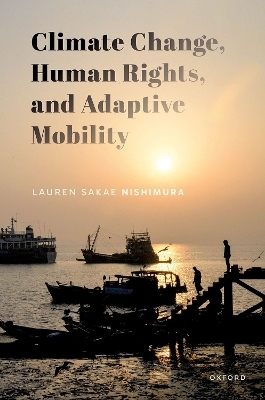
Climate Change, Human Rights, and Adaptive Mobility
Oxford University Press (Verlag)
978-0-19-893003-7 (ISBN)
The potential for climate change to cause vast human movement is a major global issue. Dominant approaches to climate-related migration take mobility as the starting point, exploring legal frameworks that tend to provide protection for migrants only after they move and overlooking measures that could help avoid forced movement in the first place. In contrast, Climate Change, Human Rights, and Adaptive Mobility provides a new conceptual and legal approach to human mobility in the context of climate change, one that seeks to compel and shape more proactive, anticipatory action.
The author anchors her arguments in the international climate change regime, turning to obligations on adaptation found in the United Nations Framework Convention on Climate Change and the Paris Agreement. These obligations, though understudied and underutilized, have the potential to be a powerful legal tool. The book therefore seeks to lend them concrete legal meaning. It draws on international climate change and human rights law to weave together doctrinal analysis that considers treaty interpretation, regime interaction, and principles of environmental law with case studies in Bangladesh, the Pacific Islands, and the Sahel.
At its core, the book argues that adaptation obligations require states to take measures to address foreseeable risks and ensure human rights. It further argues that developed countries that have contributed most to climate change have legal duties to support others in adapting to its effects, adding a collective dimension to the problem of climate change and mobility.
This is an open access title available under the terms of a CC BY-NC-ND 4.0 International licence. It is free to read on Oxford Scholarship Online and offered as a free PDF download from OUP and selected open access locations.
Lauren Sakae Nishimura is a lecturer at the University of Melbourne Law School. Her research explores how international obligations can contribute to efforts to adapt to climate change, including through anticipatory measures that account for human mobility. Dr Nishimura has more than a decade of experience as a litigator, advocate, and researcher in the United States, Southeast Asia, and with UN agencies and other international organizations. She received her DPhil in Law and an MSt in International Human Rights Law from the University of Oxford, a JD from Georgetown University Law Center, and a BA from Vassar College.
Introduction
1: Gaps in Protection: Climate Change, Human Mobility, and Current Approaches
2: A New Approach: Adaptation in the Climate Change Regime
3: Bringing Human Rights to Bear: Interpreting Adaptation Obligations
4: Shaping Adaptive Mobility: Integrating Substantive Human Rights
5: Participation and Anticipatory Action: Integrating Procedural Human Rights and the Precautionary Principle
6: Assistance and Cooperation: Strengthening Support for Adaptive Mobility
7: Low-lying Areas: Internal Mobility in Bangladesh
8: Small Island States: Choosing to Stay and Planning to Move in the Pacific
9: Drylands: International Mobility in the Sahel
Conclusion
| Erscheinungsdatum | 11.11.2025 |
|---|---|
| Verlagsort | Oxford |
| Sprache | englisch |
| Maße | 160 x 240 mm |
| Gewicht | 619 g |
| Themenwelt | Naturwissenschaften ► Biologie ► Ökologie / Naturschutz |
| Recht / Steuern ► EU / Internationales Recht | |
| Recht / Steuern ► Öffentliches Recht ► Völkerrecht | |
| ISBN-10 | 0-19-893003-8 / 0198930038 |
| ISBN-13 | 978-0-19-893003-7 / 9780198930037 |
| Zustand | Neuware |
| Informationen gemäß Produktsicherheitsverordnung (GPSR) | |
| Haben Sie eine Frage zum Produkt? |
aus dem Bereich