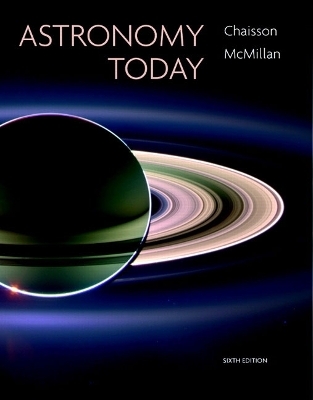
Astronomy Today
Pearson (Verlag)
978-0-13-240085-5 (ISBN)
- Titel erscheint in neuer Auflage
- Artikel merken
Alternate Versions
Astronomy Today, Volume 1: The Solar System, 5/e – Focuses primarily on planetary coverage for a 1-term course. Includes Chapters 1-16, 28.
Astronomy Today, Volume 2: Stars and Galaxies, 5/e – Focuses primarily on stars and stellar evolution for a 1-term course. Includes Chapters 1-5 and 16-28.
Eric Chaisson. Eric holds a doctorate in astrophysics from Harvard University, where he spent ten years on the Faculty of Arts and Sciences. For five years, Eric was a Senior Scientist and Director of Educational Programs at the Space Telescope Science Institute and Adjunct Professor of Physics at Johns Hopkins University. He then joined Tufts University, where he is now Professor of Physics, Professor of Education, and Director of the Wright Center for Innovative Science Education. He has written nine books on astronomy, which have received such literary awards as the Phi Beta Kappa Prize, two American Institute of Physics Awards, Harvard's Smith-Weld Prize for Literary Merit, and the Walter P. Kistler Book Award. He has published more than 100 scientific papers in professional journals, and has also received Harvard's Bok Prize for original contributions to astrophysics. Steve McMillan. Steve holds a bachelor's and master's degree in Mathematics from Cambridge University and a doctorate in Astronomy from Harvard University. He held post-doctoral positions at the University of Illinois and Northwestern University, where he continued his research in theoretical astrophysics, star clusters, and numerical modeling. Steve is currently Distinguished Professor of Physics at Drexel University and a frequent visiting researcher at Princeton's Institute for Advanced Study and the University of Tokyo. He has published more than 50 scientific papers in professional journals.
Volume 1: Chapters 1-16, 28
Volume 2: Chapters 1-5, 16-28
Part 1: Astronomy and the Universe
Chapter 1. Charting The Heavens: The Foundations of Astronomy
1.1 Our Place in Space
1.2 Scientific Theory and the Scientific Method
1.3 The "Obvious" View
1.4 Earth's Orbital Motion
1.5 Astronomical Timekeeping
1.6 The Motion of the Moon
1.7 The Measurement of Distance
Chapter Review
Chapter 2. The Copernican Revolution: The Birth of Modern Science
2.1 Ancient Astronomy
2.2 The Geocentric Universe
2.3 The Heliocentric Model of the Solar System
2.4 The Birth of Modern Astronomy
2.5 The Laws of Planetary Motion
2.6 The Dimensions of the Solar System
2.7 Newton's Laws
2.8 Newtonian Mechanics
Chapter Review
Chapter 3. Radiation: Information from the Cosmos
3.1 Information from the Skies
3.2 Waves in What?
3.3 The Electromagnetic Spectrum
3.4 Thermal Radiation
3.5 The Doppler Effect
Chapter Review
Chapter 4. Spectroscopy: The Inner Workings of Atoms
4.1 Spectral Lines
4.2 Atoms and Radiation
4.3 The Formation of Spectral Lines
4.4 Molecules
4.5 Spectral-Line Analysis
Chapter Review
Chapter 5. Telescopes: The Tools of Astronomy
5.1 Optical Telescopes
5.2 Telescope Size
5.3 Images and Detectors
5.4 High-Resolution Astronomy
5.5 Radio Astronomy
5.6 Interferometry
5.7 Space-Based Astronomy
5.8 Full-Spectrum Coverage
Chapter Review
Part 2: Our Planetary System
Chapter 6. The Solar System: An Introduction to Comparative Planetology
6.1 An Inventory of the Solar System
6.2 Measuring the Planets
6.3 The Overall Layout of the Solar System
6.4 Terrestrial and Jovian Planets
6.5 Interplanetary Matter
6.6 Spacecraft Exploration of the Solar System
6.7 How Did the Solar System Form?
Chapter Review
Chapter 7. Earth: Our Home in Space
7.1 Overall Structure of Planet Earth
7.2 Earth's Atmosphere
7.3 Earth's Interior
7.4 Surface Activity
7.5 Earth's Magnetosphere
7.6 The Tides
Chapter Review
Chapter 8. The Moon and Mercury: Scorched and Battered Worlds
8.1 Orbital Properties
8.2 Physical Properties
8.3 Surface Features on the Moon and Mercury
8.4 Rotation Rates
8.5 Lunar Cratering and Surface Composition
8.6 The Surface of Mercury
8.7 Interiors
8.8 The Origin of the Moon
8.9 Evolutionary History of the Moon and Mercury
Chapter Review
Chapter 9. Venus: Earth's Sister Planet
9.1 Orbital Properties
9.2 Physical Properties
9.3 Long-Distance Observations of Venus
9.4 The Surface of Venus
9.5 The Atmosphere of Venus
9.6 Venus's Magnetic Field and Internal Structure
Chapter Review
Chapter 10. Mars: A Near Miss for Life?
10.1 Orbital Properties
10.2 Physical Properties
10.3 Long-Distance Observations of Mars
10.4 The Martian Surface
10.5 Water on Mars
10.6 The Martian Atmosphere
10.7 Martian Internal Structure
10.8 The Moons of Mars
Chapter Review
Chapter 11. Jupiter: Giant of the Solar System
11.1 Orbital and Physical Properties
11.2 The Atmosphere of Jupiter
11.3 Internal Structure
11.4 Jupiter's Magnetosphere
11.5 The Moons of Jupiter
11.6 Jupiter's Ring
Chapter Review
Chapter 12. Saturn: Spectacular Rings and Mysterious Moons
12.1 Orbital and Physical Properties
12.2 Saturn's Atmosphere
12.3 Saturn's Interior and Magnetosphere
12.4 Saturn's Spectacular Ring System
12.5 The Moons of Saturn
Chapter Review
Chapter 13. Uranus, Neptune, and Pluto: The Outer Worlds of the Solar System
13.1 The Discoveries of Uranus and Neptune
13.2 Orbital and Physical Properties
13.3 The Atmospheres of Uranus and Neptune
13.4 Magnetospheres and Internal Structure
13.5 The Moon Systems of Uranus and Neptune
13.6 The Rings of the Outermost Jovian Planets
Chapter Review
Chapter 14. Solar System Debris: Keys to Our Origin
14.1 Asteroids
14.2 Comets
14.3 Beyond Neptune
14.4 Meteoroids
Chapter Review
Chapter 15. The Formation of Planetary Systems: The Solar System and Beyond
15.1 Modeling Planet Formation
15.2 Formation of the Solar System
15.3 Terrestrial and Jovian Planets
15.4 Solar System Regularities and Irregularities
15.5 Planets Beyond the Solar System
15.6 Is Our Solar System Unusual?
Chapter Review
Part 3: Stars And Stellar Evolution
Chapter 16. The Sun: Our Parent Star
16.1 Physical Properties of the Sun
16.2 The Solar Interior
16.3 The Solar Atmosphere
16.4 Solar Magnetism
16.5 The Active Sun
16.6 The Heart of the Sun
16.7 Observations of Solar Neutrinos
Chapter Review
Chapter 17. Measuring the Stars: Giants, Dwarfs, and the Main Sequence
17.1 The Solar Neighborhood
17.2 Luminosity and Apparent Brightness
17.3 Stellar Temperatures
17.4 Stellar Sizes
17.5 The Hertzsprung-Russell Diagram
17.6 Extending the Cosmic Distance Scale
17.7 Stellar Masses
17.8 Mass and Other Stellar Properties
Chapter Review
Chapter 18. The Interstellar Medium: Gas and Dust Among the Stars
18.1 Interstellar Matter
18.2 Emission Nebulae
18.3 Dark Dust Clouds
18.4 21-Centimeter Radiation
18.5 Interstellar Molecules
Chapter Review
Chapter 19. Star Formation: A Traumatic Birth
19.1 Star-Forming Regions
19.2 The Formation of Stars Like the Sun
19.3 Stars of Other Masses
19.4 Observations of Cloud Fragments and Protostars
19.5 Shock Waves and Star Formation
19.6 Star Clusters
Chapter Review
Chapter 20. Stellar Evolution: The Life and Death of a Star
20.1 Leaving the Main Sequence
20.2 Evolution of a Sun-like Star
20.3 The Death of a Low-Mass Star
20.4 Evolution of Stars More Massive than the Sun
20.5 Observing Stellar Evolution in Star Clusters
20.6 Stellar Evolution in Binary Systems
Chapter Review
Chapter 21. Stellar Explosions: Novae, Supernovae, and the Formation of the Elements
21.1 Life after Death for White Dwarfs
21.2 The End of a High-Mass Star
21.3 Supernovae
21.4 The Formation of the Elements
21.5 The Cycle of Stellar Evolution
Chapter Review
Chapter 22. Neutron Stars and Black Holes: Strange States of Matter
22.1 Neutron Stars
22.2 Pulsars
22.3 Neutron-Star Binaries
22.4 Gamma-Ray Bursts
22.5 Black Holes
22.6 Einstein’s Theories of Relativity
22.7 Space Travel Near Black Holes
22.8 Observational Evidence for Black Holes
Chapter Review
Part 4: Galaxies And Cosmology
Chapter 23. The Milky Way Galaxy: A Spiral in Space
23.1 Our Parent Galaxy
23.2 Measuring the Milky Way
23.3 Galactic Structure.
23.4 The Formation of the Milky Way
23.5 Galactic Spiral Arms
23.6 The Mass of the Milky Way Galaxy
23.7 The Galactic Center
Chapter Review
Chapter 24. Galaxies: Building Blocks of the Universe
24.1 Hubble's Galaxy Classification
24.2 The Distribution of Galaxies in Space
24.3 Hubble's Law
24.4 Active Galactic Nuclei
24.5 The Central Engine of an Active Galaxy
Chapter Review
Chapter 25. Galaxies and Dark Matter: The Large-Scale Structure of the Cosmos
25.1 Dark Matter in the Universe
25.2 Galaxy Collisions
25.3 Galaxy Formation and Evolution
25.4 Black Holes in Galaxies
25.5 The Universe on Large Scales
Chapter Review
Chapter 26. Cosmology: The Big Bang and the Fate of the Universe
26.1 The Universe on the Largest Scales
26.2 The Expanding Universe
26.3 The Fate of the Cosmos
26.4 The Geometry of Space
26.5 Will the Universe Expand Forever?
26.6 Dark Energy and Cosmology
26.7 The Cosmic Microwave Background
Chapter Review
Chapter 27. The Early Universe: Toward the Beginning of Time
27.1 Back to the Big Bang
27.2 The Evolution of the Universe
27.3 The Formation of Nuclei and Atoms
27.4 The Inflationary Universe
27.5 The Formation of Structure in the Universe
27.6 Cosmic Structure and the Microwave Background
Chapter Review
Chapter 28. Life In The Universe: Are We Alone?
28.1 Cosmic Evolution
28.2 Life in the Solar System
28.3 Intelligent Life in the Galaxy
28.4 The Search for Extraterrestrial Intelligence
Chapter Review
| Erscheint lt. Verlag | 8.8.2007 |
|---|---|
| Sprache | englisch |
| Maße | 286 x 283 mm |
| Gewicht | 2066 g |
| Themenwelt | Naturwissenschaften ► Physik / Astronomie ► Astronomie / Astrophysik |
| ISBN-10 | 0-13-240085-5 / 0132400855 |
| ISBN-13 | 978-0-13-240085-5 / 9780132400855 |
| Zustand | Neuware |
| Informationen gemäß Produktsicherheitsverordnung (GPSR) | |
| Haben Sie eine Frage zum Produkt? |
aus dem Bereich