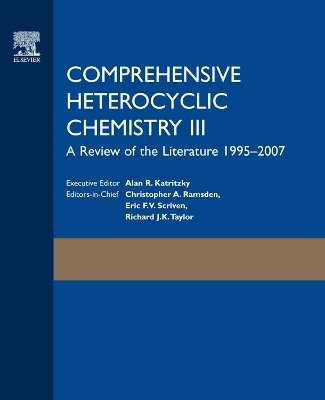
Comprehensive Heterocyclic Chemistry III
Elsevier Science Ltd
978-0-08-044991-3 (ISBN)
- Titel ist leider vergriffen;
keine Neuauflage - Artikel merken
Comprehensive Heterocyclic Chemistry III (CHEC-III) is a new 15-volume reference work which provides the first point of entry to the literature for all scientists interested in heterocyclic ring systems. Since publishing in 1984, Comprehensive Heterocyclic Chemistry (CHEC) has become the standard work on the subject, indispensable to all serious readers in the interdisciplinary areas where heterocycles are employed. CHEC-III builds on and complements the material in CHEC and CHEC-II and is designed to be used both alone and in conjunction with these two works. Written by leading scientists who have evaluated and summarized the most important data published over the last decade, Comprehensive Heterocyclic Chemistry III will be an invaluable addition to the reference library of those working with heterocyclic ring systems.
Chris Ramsden was born in Manchester, UK in 1946. He is a graduate of Sheffield University and received his PhD in 1970 for a thesis entitled ‘Meso-ionic Compounds’ (W. D. Ollis) and a DSc in 1990. Subsequently he was a Robert A. Welch Postdoctoral Fellow at the University of Texas (with M. J. S. Dewar)(1971-3), working on the development and application of semi-empirical MO methods, and an ICI Postdoctoral Fellow at the University of East Anglia (with A. R. Katritzky)(1973-6), working on the synthesis of novel heterocycles. In 1976 he moved to the pharmaceutical industry and was Head of Medicinal Chemistry (1986-1992) at Rhone-Poulenc, London. He moved to Keele University as Professor of Organic Chemistry in 1992, where he is now Emeritus Professor. His research interests include the structure and preparation of novel heterocycles, three-centre bonding in the context of the chemistry of betaines and hypervalent species, and the properties of the enzyme tyrosinase and related ortho-quinone chemistry. He was an Editor-in-Chief of ‘Comprehensive Heterocyclic Chemistry III’ and a co-author of ‘The Handbook of Heterocyclic Chemistry, 3rd Edn, 2010. Richard Taylor is currently Professor of Organic Chemistry at the University of York, where his research focuses on the development of novel synthetic methodology and the synthesis of natural products and related compounds of biological/medicinal interest. The methodology is concentrated primarily on organometallic, organosulfur and oxidation processes and the targets include, amino acids, carbohydrates, prostaglandins, and polyene and polyoxygenated natural products, particularly with activity as antibiotics and anti-cancer agents. Richard Taylor is a graduate and postgraduate of the University of Sheffield, and he then carried out postdoctoral research at Syntex, California (Dr. I. T. Harrison) and University College London (Professor F. Sondheimer). His first academic appointment was at the Open University in Milton Keynes. This post gave Professor Taylor the opportunity to contribute to Open University textbooks, radio programmes and television productions on various aspects of organic chemistry. Professor Taylor then moved to UEA, Norwich where he established his independent research programme,before taking up his present position in York in 1993. Richard Taylor is the current President of the Organic Division of the Royal Society of Chemistry and was awarded the 1999 RSC Tilden Lectureship and the 1999 RSC Heterocyclic Prize. He is currently the UK Regional Editor of the international journal Tetrahedron.
CHEC III is organized in 15 Volumes and closely follows the organization used in the previous edition:
Volumes 1 and 2: Cover respectively three- and four-membered heterocycles, together with all fused systems containing a three- or four-membered heterocyclic ring.
Volume 3: Five-membered rings with one heteroatom together with their benzo- and other carbocyclic-fused derivatives.
Volumes 4, 5 and 6: Cover five-membered rings with two heteroatoms, and three or more heteroatoms, respectively, each with their fused carbocyclic compounds.
Volumes 7, 8 and 9: Dedicated to six-membered rings with one, two, and more than two heteroatoms, respectively, again with the corresponding fused carbocylic compounds.
Volumes 10, 11 and 12: Cover systems containing at least two directly fused heterocyclic five- and/or six-membered rings: of these Volume 10 deals with bi-heterocyclic rings without a ring junction heteroatom, and Volume 11 deals with 5:5 and 5:6 fused rings systems with at least one ring junction nitrogen, while Volume 12 is devoted to all other systems of five and/or six-membered fused or spiro heterocyclic rings with ring junction heteroatoms.
Volumes 13 and 14: Seven-membered and larger heterocyclic rings including all their fused derivatives (except those containing three- or four-membered heterocyclic rings which are included in Volume 1 and 2, respectively).
Volume 15: Author, ring and subject indexes.
| Erscheint lt. Verlag | 5.3.2008 |
|---|---|
| Mitarbeit |
Chef-Herausgeber: Alan R. Katritzky, Eric Scriven, Christopher A. Ramsden, Richard J K Taylor |
| Verlagsort | Oxford |
| Sprache | englisch |
| Maße | 192 x 262 mm |
| Themenwelt | Naturwissenschaften ► Chemie ► Organische Chemie |
| ISBN-10 | 0-08-044991-3 / 0080449913 |
| ISBN-13 | 978-0-08-044991-3 / 9780080449913 |
| Zustand | Neuware |
| Informationen gemäß Produktsicherheitsverordnung (GPSR) | |
| Haben Sie eine Frage zum Produkt? |
aus dem Bereich
![Organic Chemistry plus Pearson Mastering Chemistry with Pearson eText [Global Edition] - Leroy Wade; Jan Simek](/media/110496757)