


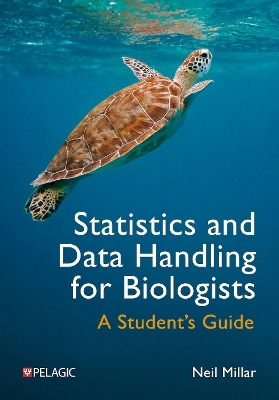
Statistics and Data Handling for Biologists
A Student’s Guide
Seiten
2026
Pelagic Publishing (Verlag)
978-1-78427-570-9 (ISBN)
Pelagic Publishing (Verlag)
978-1-78427-570-9 (ISBN)
- Noch nicht erschienen (ca. Februar 2026)
- Versandkostenfrei
- Auch auf Rechnung
- Artikel merken
An accessible and authoritative introduction to data handling and analysis for biology students—requiring no previous experience of statistics.
This book serves as a practical and thorough guide to statistics and data analysis, specifically tailored to the biological sciences. Written in straightforward language, it makes data analysis easy to understand for biology students with no previous knowledge of statistics – or any particular enthusiasm for mathematics.
The book shows students how to maintain focus on the biological meaning of their data analysis, rather than getting bogged down in technical mathematics, by using software such as Excel, Real Statistics (a free add-on for Excel) and jamovi (an easy-to-use front end for R). It also introduces simple strategies to make biological data analysis more reliable and to tackle the ‘reproducibility crisis’. These strategies include power analysis to choose suitable sample sizes; estimating the true probability of the null hypothesis from the p-value; and a ‘traffic light’ system to determine statistical significance.
Introductory chapters cover SI units and basic mathematics, study design, descriptive statistics, and presenting results in tables and charts, including a detailed discussion of the different kinds of biological investigation, data types, and uncertainty—essential for choosing the correct charts and tests to present and analyse data. There is also a comprehensive introduction to statistical tests, including effect size, how to determine statistical significance without making false-positive errors, and how to more easily draw out useful conclusions. This is followed by demonstrations of over 20 statistical tests, with worked examples for each, and an additional 70 practice questions with answers. Appendices include greater detail on how to carry out data analysis using calculators, spreadsheets and statistical software.
This book serves as a practical and thorough guide to statistics and data analysis, specifically tailored to the biological sciences. Written in straightforward language, it makes data analysis easy to understand for biology students with no previous knowledge of statistics – or any particular enthusiasm for mathematics.
The book shows students how to maintain focus on the biological meaning of their data analysis, rather than getting bogged down in technical mathematics, by using software such as Excel, Real Statistics (a free add-on for Excel) and jamovi (an easy-to-use front end for R). It also introduces simple strategies to make biological data analysis more reliable and to tackle the ‘reproducibility crisis’. These strategies include power analysis to choose suitable sample sizes; estimating the true probability of the null hypothesis from the p-value; and a ‘traffic light’ system to determine statistical significance.
Introductory chapters cover SI units and basic mathematics, study design, descriptive statistics, and presenting results in tables and charts, including a detailed discussion of the different kinds of biological investigation, data types, and uncertainty—essential for choosing the correct charts and tests to present and analyse data. There is also a comprehensive introduction to statistical tests, including effect size, how to determine statistical significance without making false-positive errors, and how to more easily draw out useful conclusions. This is followed by demonstrations of over 20 statistical tests, with worked examples for each, and an additional 70 practice questions with answers. Appendices include greater detail on how to carry out data analysis using calculators, spreadsheets and statistical software.
Neil Millar has been a biology researcher and teacher for over 40 years and has written and delivered statistics training for biologists. He currently works as a writer, trainer and examiner, with a particular focus on mathematics in biology.
| Erscheint lt. Verlag | 17.2.2026 |
|---|---|
| Verlagsort | Exeter |
| Sprache | englisch |
| Maße | 170 x 244 mm |
| Themenwelt | Informatik ► Datenbanken ► Data Warehouse / Data Mining |
| Mathematik / Informatik ► Mathematik ► Computerprogramme / Computeralgebra | |
| Mathematik / Informatik ► Mathematik ► Statistik | |
| Naturwissenschaften ► Biologie | |
| ISBN-10 | 1-78427-570-0 / 1784275700 |
| ISBN-13 | 978-1-78427-570-9 / 9781784275709 |
| Zustand | Neuware |
| Informationen gemäß Produktsicherheitsverordnung (GPSR) | |
| Haben Sie eine Frage zum Produkt? |
Mehr entdecken
aus dem Bereich

aus dem Bereich
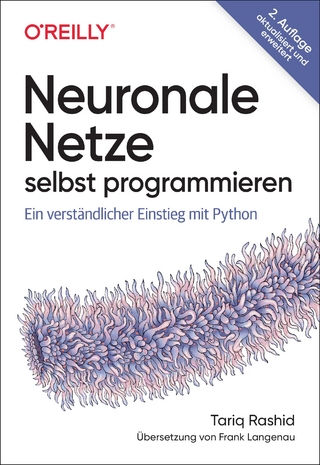
Ein verständlicher Einstieg mit Python
Buch | Softcover (2024)
O'Reilly (Verlag)
CHF 41,85
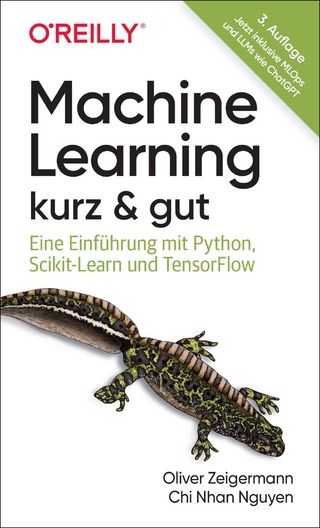
eine Einführung mit Python, Scikit-Learn und TensorFlow
Buch | Softcover (2024)
O'Reilly (Verlag)
CHF 27,85


