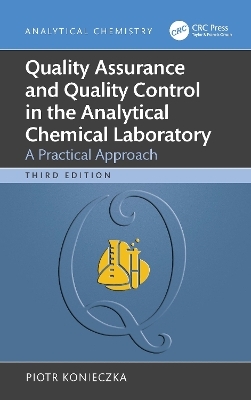
Quality Assurance and Quality Control in the Analytical Chemical Laboratory
CRC Press (Verlag)
978-1-032-82465-9 (ISBN)
Fully updated and revised references
New computational examples and solution problems
New chapter on Calibration and expanded coverage of Accreditation
A practical approach applicable to any field of analysis
Piotr Konieczka is Professor at Gdańsk University of Technology, where he is Head of the Department of Analytical Chemistry. He has co-authored 113 publications, 8 books and holds 1 patent. His research interests are environmental pollution analysis, trace analysis, in particular analysis of heavy metal content using spectroscopic techniques, as well as chemical statistics and metrology, as well as control and quality assurance of analytical measurement results, including aspects related to the production and use of certified reference materials (CRM) and the organization and development of proficiency test results (PT).
LIST OF ABBREVIATIONS
1. BASIC NOTIONS OF STATISTICS
1.1. Introduction
1.2. Distributions of random variables
1.2.1. Characterization of distributions
1.3. Measures of location
1.4. Measures of dispersion
1.5. Measures of asymmetry
1.6. Measures of concentration
1.7. Statistical hypothesis testing
1.8. Statistical tests
1.8.1 Confidence interval method
1.8.2. Critical range method
1.8.3. Dixon’s Q test
1.8.4. Chi-Square test
1.8.5. Snedecor’s F test
1.8.6. Hartley’s Fmax test
1.8.7. Bartlett’s test
1.8.8. Morgan’s test
1.8.9. Student’s t test
1.8.10. Cochran-Cox test
1.8.11. Aspin-Welch test
1.8.12. Cochran’s test
1.8.13. Grubbs’ test
1.8.14. Hampel’s test
1.8.15. Z-Score
1.8.16. En –Score
1.8.17. Mandel’s test
1.8.18. Kolmogorov-Smirnov test
1.9. Linear regression
1.10. Significant Digits. Rules of Rounding.
1.11. References
2. QUALITY OF ANALYTICAL RESULTS
2.1. Definitions
2.2. Introduction
2.3. Quality assurance system
2.4. Conclusions
2.5. References
3. INTERNAL QUALITY CONTROL
3.1. Definitions
3.2. Introduction
3.3. Quality control in the laboratory
3.4. Control charts 3.4.1. Shewhart charts
3.4.2. Shewhart chart preparation
3.4.3. Shewhart chart analysis
3.4.4. Types of control charts
3.4.5.Control samples
3.5. Conclusion
3.6. References
4. TRACEABILITY
4.1. Definitions
4.2. Introduction
4.3. The role of traceability in QA/QC system
4.4. Conclusion
4.5. References
5. UNCERTAINTY
5.1. Definitions
5.2. Introduction
5.3. Methods of estimating of measurement uncertainty
5.3.1. Procedure for estimating the measurement uncertainty according to GUM
5.4. Tools used for uncertainty estimation
5.5. Uncertainty and confidence interval
5.6. Calibration uncertainty
5.7. Conclusion
5.8. References
6. REFERENCE MATERIALS
6.1. Definitions
6.2. Introduction
6.3. Parameters which characterize RMs
6.3.1. General information
6.3.2. Representativeness 6.3.3. Homogeneity 6.3.4. Stability 6.3.5. Certified value
6.4. Production of CRMs – requirements (ISO 17034)
6.5. Practical application of CRM
6.6. Conclusion
6.7. References
7. INTERLABORATORY COMPARISIONS
7.1. Definitions
7.2. Introduction
7.3. Classification of interlaboratory studies
7.4. Characteristics and organization of interlaboratory comparisons
7.5. The presentation of interlaboratory comparison results. Statistical analysis in interlaboratory comparisons
7.5.1. Comparisons of results obtained using various procedures
7.5.2. Comparison of the measurement results obtained in a two-level study (for two samples with various analyte concentrations)
7.6. Organisation of PTs – requirements (ISO 17043)
7.7. Conclusions
7.8. References
8. CALIBRATION
8.1. Introduction
8.2. Types of calibration
8.3. Calibration techniques
8.3.1. Single standard technique
8.3.2. Bracketing solutions technique
8.3.3. Calibration curve technique
8.3.4. Standard addition technique
8.3.5. Multiple standard addition technique
8.3.6. Internal standard technique
8.3.6.1. Isotope Dilution Mass Spectrometry (IDMS) technique
8.4. Conclusions
8.5. References
9. METHOD VALIDATION
9.1. Introduction
9.2. Characterization of validation parameters
9.2.1. Selectivity
9.2.2. Linearity
9.2.3. Limit of Detection and Limit of Quantitation
9.2.4. Range
9.2.5. Sensitivity
9.2.6. Precision
9.2.6.1. Manners of estimating the standard deviation
9.2.7. Accuracy and Trueness
9.2.7.1. Measurement Errors
9.2.8. Robustness and ruggedness
9.2.9. Uncertainty
9.3. Conclusions
9.4. References
10. METHOD EQUIVALENCE
10.1. Introduction
10.2. Ways of equivalence demonstration
10.2.1. Difference testing
10.2.2. Equivalence testing
10.2.3. Regression analysis testing
10.3. Conclusions
10.4. References
APPENDIX
| Erscheinungsdatum | 12.09.2025 |
|---|---|
| Reihe/Serie | Analytical Chemistry |
| Zusatzinfo | 8 Tables, black and white; 22 Line drawings, black and white; 22 Illustrations, black and white |
| Verlagsort | London |
| Sprache | englisch |
| Maße | 156 x 234 mm |
| Gewicht | 780 g |
| Themenwelt | Naturwissenschaften ► Chemie ► Analytische Chemie |
| Technik | |
| ISBN-10 | 1-032-82465-4 / 1032824654 |
| ISBN-13 | 978-1-032-82465-9 / 9781032824659 |
| Zustand | Neuware |
| Informationen gemäß Produktsicherheitsverordnung (GPSR) | |
| Haben Sie eine Frage zum Produkt? |
aus dem Bereich