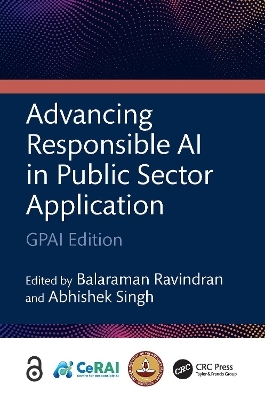
Advancing Responsible AI in Public Sector Application
CRC Press (Verlag)
978-1-032-70393-0 (ISBN)
Responsible use of AI in public sector applications requires engagement with various technical and non-technical areas such as human rights, inclusion, diversity, innovation and economic growth. The book covers topics spanning the technological socio-economic spectrum, including the potential of AI/ML technologies to address social and political inequities, privacy-enhancing technologies for datasets, friction-less data sharing and data stewardship models, regional/geographical inequities in extraction and so forth.
Features:
Focuses on technical aspects of responsible AI in the public sector
Covers a wide range of topics spanning the technological socio-economic spectrum
Presents viewpoints from public sector agencies as well as from practitioners
Discusses privacy-enhancing technologies for collecting, processing and storing datasets, and friction
Reviews frameworks to identify and address biased AI outcomes in the design, development and use of AI
This book is aimed at professionals, researchers and students in artificial intelligence, computer science and engineering, policy-makers, social scientists, economists and lawyers.
Abhishek Singh is a distinguished officer of the 1995 batch of the Indian Administrative Service (IAS), and currently serves as Additional Secretary in the Ministry of Electronics and Information Technology (MeitY), Government of India. With nearly three decades of experience in governance, policy formulation and administration, he specializes in leveraging technology to enhance governance and public service delivery. As Additional Secretary, he holds responsibilities including Artificial Intelligence, Emerging Technologies, Cybersecurity, and Digital Skilling with additional charge of CEO of IndiaAI Mission. An alumnus of IIT Kanpur, where he earned a B.Tech in Mechanical Engineering, Singh furthered his education with a Master’s in Public Administration from the Harvard Kennedy School as a Mason Fellow. Over the years, he has held several key positions, including CEO of Karmayogi Bharat, MyGov and the National e-Governance Division (NeGD). His leadership has been instrumental in implementing landmark initiatives, such as CoWIN, DigiLocker and DIKSHA. At the state level, he was with the Government of Nagaland and Uttar Pradesh and was responsible for implementing development schemes at the grassroots level, ensuring law and order as also for collecting revenues for the States. Balaraman Ravindran heads the Robert Bosch Centre for Data Science & Artificial Intelligence and the Centre for Responsible AI at IIT Madras, the leading interdisciplinary AI research centre in India. He is the Mindtree Faculty Fellow and Professor in the Department of Computer Science and Engineering at IIT Madras. He is the premier Deep Reinforcement Learning Expert and among the top three Machine Learning Experts in India. He has been elected as ACM Distinguished Member (2021) for his significant contributions to computing. He has been recognized, in 2020, as a senior member of the Association for Advancement of AI (AAAI) for his long-standing contributions to AI. He is also the co-director of the Prathap Subrahmanyam Centre for Digital Intelligence, Secure Hardware and Architecture (PSC-DISHA) and the Reconfigurable and Intelligent Systems Engineering (RISE) group at IIT Madras. He has been closely collaborating with various industrial research labs, such as Google Research, Intel Research, Ericsson R&D, and many more, working on applications of AI techniques to solve difficult real-world problems. He received his PhD from the University of Massachusetts, Amherst and his Master’s in research degree from the Indian Institute of Science, Bangalore. He has more than two decades of research experience in AI and ML, specifically, Reinforcement Learning. He has held visiting positions at the Indian Institute of Science, Bangalore, India; University of Technology, Sydney, Australia; and Google Research. Currently, his research interests are centred on learning from and through interactions and span the areas of geometric deep learning and reinforcement learning.
Preface ...................................................................................................................... vii
About the Editors ...................................................................................................... ix
List of Contributors ................................................................................................... xi
Chapter 1 Raising a Global Standard in the Procurement of Artificial
Intelligence and Automated Decision Systems .................................... 1
Gisele Waters and Cari Miller
Chapter 2 Data Empowerment and Protection Architecture (DEPA)
for Training Machine Learning (ML) Models ................................... 35
Shyam Sundaram, Kapil Vaswani, Gaurav Agarwal,
Sunu Engineer, and AVS Sridhar
Chapter 3 Generative AI Governance: Technological Monoculture, Market
Structure and the Risk of Correlated Failures.................................... 48
Ramayya Krishnan, Prasanna Parasurama, Joao Sedoc, and
Arun Sundararajan
Chapter 4 Empowering Citizens through Responsible AI Governance:
Policy Recommendations for Public Algorithm Registers .................51
Jens Meijen and Niharika Gujela
Chapter 5 Responsible Adoption of Cloud-Based Artificial Intelligence
in Health Care: A Validation Case Study of Multiple Artificial
Intelligence Algorithms for Diabetic Retinopathy Screening
in Public Health Settings .................................................................... 62
Mona Duggal, Anshul Chauhan, Ankita Kankaria, Preeti Syal,
Vishali Gupta, Priyanka Verma, Vaibhav Miglani,
Deepmala Budhija, and Luke Vale
Chapter 6 Participation in AI: Notes from the Trenches .................................... 72
Tarunima Prabhakar, Cheshta Arora, and Arnav Arora
Chapter 7 Risk Assessment Methodology for AI Regulation and
Navigating Liability Determination in an AI-Driven World:
A Policy Paper on Risk Assessment ................................................... 87
Aditya Mohan and Karthik Satishkumar
Chapter 8 Harnessing the Potential of AI for Indian Agriculture: Using
“Bhashini” as a Tool to Deploy Responsible AI and Increase
the Uptake of AI Applications Among Farmers ...............................119
Abhishek Raj, Harsh Singh, and Anshul Pachouri
Chapter 9 Regional Inequities in Extraction and Flow of Resources
That Support and Power the Design, Development and
Access to AI: Lessons from the Global South ..................................129
Saikat Datta, Shachi Solanki, and Anand Venkatanaryanan
Chapter 10 Assessing the Trustworthiness of Generative AI Used in
Higher Education ...............................................................................144
Adarsh Srivastava, Gokul Gawande, Divya Dwivedi,
Manu Dev, Vinayak Kottawar, Ishwar Chavhan, and
Roberto V. Zicari
Chapter 11 Actionable Ethics: From Philosophical Principles to
Operational Initiatives for Responsible AI Projects in the
Public Sector in the French Context ..................................................155
Anthéa Serafin, Lisa Fériol, and Bertrand Monthubert
Chapter 12 Supporting AI at Scale in the APEC Region through
International Standards .....................................................................167
Aurelie Jacquet, Karen Batt, and Jesse Riddell
Chapter 13 Suggested Framework for Improved Algorithmic Auditing
in India ..............................................................................................186
Harsh Lailer, Gadamsetti Srija, Aseem Saxena, and
Agrima Lailer
Chapter 14 Artificial Intelligence, Government, and Challenges: Initial
Insights from Rwanda’s Mbaza AI-Chatbot Project ........................ 200
Lea Gimpel and Keegan McBride
Index .......................................................................................................................211
| Erscheinungsdatum | 16.08.2025 |
|---|---|
| Zusatzinfo | 24 Tables, black and white; 21 Line drawings, black and white; 11 Halftones, black and white; 32 Illustrations, black and white |
| Verlagsort | London |
| Sprache | englisch |
| Maße | 156 x 234 mm |
| Gewicht | 590 g |
| Themenwelt | Informatik ► Theorie / Studium ► Künstliche Intelligenz / Robotik |
| Naturwissenschaften | |
| Technik ► Elektrotechnik / Energietechnik | |
| ISBN-10 | 1-032-70393-8 / 1032703938 |
| ISBN-13 | 978-1-032-70393-0 / 9781032703930 |
| Zustand | Neuware |
| Informationen gemäß Produktsicherheitsverordnung (GPSR) | |
| Haben Sie eine Frage zum Produkt? |
aus dem Bereich