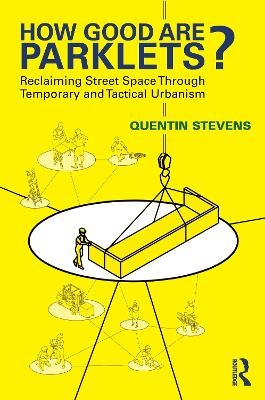
How Good Are Parklets?
Routledge (Verlag)
978-1-032-87615-3 (ISBN)
Parklets are innovative, dynamic public spaces that are installed onto on-street car-parking spots. These very small spaces have had a very large and lasting impact on city streets. How Good Are Parklets? is the first book to critically examine the parklet’s purposes, formats and impacts. It traces the parklet’s history, from its invention in 2005 as an experiment that tactically reclaimed street space for broader public use, to its surge in popularity worldwide after the COVID-19 pandemic for outdoor dining, community gathering and play. Drawing together archival research, expert interviews, typological analysis, mapping, field observation and design research, this book examines parklets’ design, production and implementation across varying urban contexts. By examining a wide range of contemporary practices, this book identifies parklets’ potentials to reshape streets, meet diverse social needs and foster community engagement. This book situates parklets within the wider push towards deploying temporary and tactical strategies in the planning and management of cities. Its deep enquiry into one question about one type of spatial intervention contributes new insights into the complex interplays of actors, interests, processes and materials that are currently transforming the urban landscape – one parking space at a time.
Quentin Stevens is Professor in the School of Architecture and Urban Design at RMIT University in Melbourne. He studied temporary uses of urban spaces in Germany as an Alexander von Humboldt Fellow and led a recent Australian Research Council funded project that examined temporary and tactical urbanism in Australia and internationally. His publications include Temporary and Tactical Urbanism (2022), The Ludic City (2007), Loose Space (2007) and Activating Urban Waterfronts (2020).
Introduction I. THE PARKLET’S FORMAT 1. A brief history of parklets 2. Parklet design II. THE PARKLET’S CONTEXT 3. Mapping parklet locations in Melbourne as an indicator of street capacity 4. Contexts and clustering 5. The contested value of parklets III. THE PARKLET’S FUTURE 6. From ‘pop-up’ to permanent 7. Creating a public, playful parklet: design practice and the COVID-19 pandemic 8. ‘Community parklets’ 9. Parklets and the public good
| Erscheinungsdatum | 17.09.2025 |
|---|---|
| Zusatzinfo | 13 Tables, black and white; 5 Line drawings, black and white; 72 Halftones, black and white; 77 Illustrations, black and white |
| Verlagsort | London |
| Sprache | englisch |
| Maße | 152 x 229 mm |
| Gewicht | 760 g |
| Themenwelt | Naturwissenschaften ► Geowissenschaften ► Geografie / Kartografie |
| Technik ► Architektur | |
| Technik ► Bauwesen | |
| ISBN-10 | 1-032-87615-8 / 1032876158 |
| ISBN-13 | 978-1-032-87615-3 / 9781032876153 |
| Zustand | Neuware |
| Informationen gemäß Produktsicherheitsverordnung (GPSR) | |
| Haben Sie eine Frage zum Produkt? |
aus dem Bereich