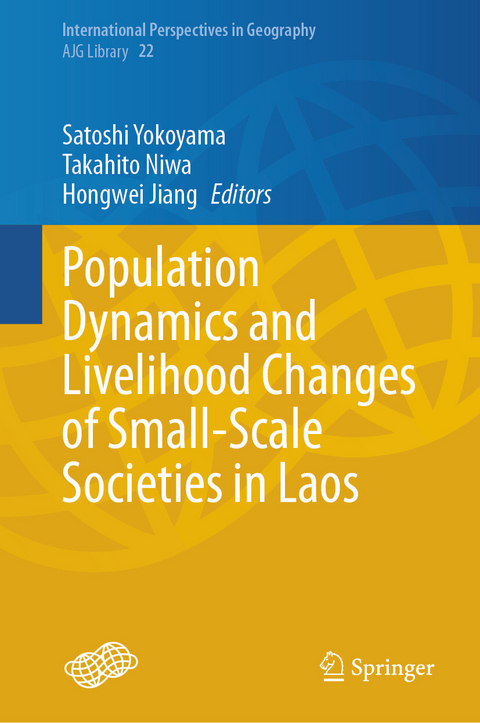
Population Dynamics and Livelihood Changes of Small-Scale Societies in Laos (eBook)
251 Seiten
Springer Nature Singapore (Verlag)
978-981-96-2956-5 (ISBN)
This book examines various trends in small-scale societies in Laos by linking population changes to livelihood changes. The primary research issues addressed in the book are as follows:
・ How are population dynamics and livelihood changes in small-scale societies interrelated?
・ What are the current demographic trends in rural areas of Laos?
・ How are the livelihoods of small-scale societies maintained?
・ How is the rapid population growth common in developing countries managed?
In order to investigate these issues in developing countries where statistical data are not well developed, it was necessary to collect information through detailed and distinctive fieldwork. To this end, a multidisciplinary study of geography, cultural anthropology, human ecology, and demography was conducted in three villages in Laos and compiled as an ethnography. The study included a four-generation retrospective survey of population and land use change, a two-year survey of food dairies, and a survey of the spatiotemporal distribution of residents' daily activities using GIS and GPS, etc.
The book provides valuable information on the slowdown in the rate of population growth in contemporary rural Laos. Livelihoods, family planning and population migration are explored in the context of the decreasing population growth rate. In addition, the book describes the process of adopting modern contraceptive methods in rural areas, as well as the Lao government's reproductive policies and villagers' responses to them. It also illustrates rural–rural and rural–urban population migration influenced by the government's resettlement policies, which encourages people to move from the highlands to the lowlands.
This book examines various trends in small-scale societies in Laos by linking population changes to livelihood changes. The primary research issues addressed in the book are as follows:? How are population dynamics and livelihood changes in small-scale societies interrelated?? What are the current demographic trends in rural areas of Laos?? How are the livelihoods of small-scale societies maintained?? How is the rapid population growth common in developing countries managed?In order to investigate these issues in developing countries where statistical data are not well developed, it was necessary to collect information through detailed and distinctive fieldwork. To this end, a multidisciplinary study of geography, cultural anthropology, human ecology, and demography was conducted in three villages in Laos and compiled as an ethnography. The study included a four-generation retrospective survey of population and land use change, a two-year survey of food dairies, and a survey of the spatiotemporal distribution of residents' daily activities using GIS and GPS, etc.The book provides valuable information on the slowdown in the rate of population growth in contemporary rural Laos. Livelihoods, family planning and population migration are explored in the context of the decreasing population growth rate. In addition, the book describes the process of adopting modern contraceptive methods in rural areas, as well as the Lao government's reproductive policies and villagers' responses to them. It also illustrates rural rural and rural urban population migration influenced by the government's resettlement policies, which encourages people to move from the highlands to the lowlands.
| Erscheint lt. Verlag | 6.5.2025 |
|---|---|
| Reihe/Serie | International Perspectives in Geography |
| Zusatzinfo | XVII, 251 p. 45 illus., 40 illus. in color. |
| Sprache | englisch |
| Themenwelt | Naturwissenschaften ► Biologie ► Ökologie / Naturschutz |
| Naturwissenschaften ► Geowissenschaften ► Geografie / Kartografie | |
| Sozialwissenschaften ► Politik / Verwaltung | |
| Sozialwissenschaften ► Soziologie ► Empirische Sozialforschung | |
| Schlagworte | Contemporary rural Laos • Family planning • Fieldwork • GIS • Livelihood Change • Modern contraceptive methods • Monetary Economy • multidisciplinary study • multi-generational • paddy fields • Population change • Population migration • Reproductive policy • resettlement policy • Retrospective methods • Small-scale society • spatiotemporal pattern • Subsistence economy • Swidden agriculture |
| ISBN-10 | 981-96-2956-X / 981962956X |
| ISBN-13 | 978-981-96-2956-5 / 9789819629565 |
| Informationen gemäß Produktsicherheitsverordnung (GPSR) | |
| Haben Sie eine Frage zum Produkt? |
 PDF (Wasserzeichen)
DRM: Digitales Wasserzeichen
Dieses eBook enthält ein digitales Wasserzeichen und ist damit für Sie personalisiert. Bei einer missbräuchlichen Weitergabe des eBooks an Dritte ist eine Rückverfolgung an die Quelle möglich.
Dateiformat: PDF (Portable Document Format)
Mit einem festen Seitenlayout eignet sich die PDF besonders für Fachbücher mit Spalten, Tabellen und Abbildungen. Eine PDF kann auf fast allen Geräten angezeigt werden, ist aber für kleine Displays (Smartphone, eReader) nur eingeschränkt geeignet.
Systemvoraussetzungen:
PC/Mac: Mit einem PC oder Mac können Sie dieses eBook lesen. Sie benötigen dafür einen PDF-Viewer - z.B. den Adobe Reader oder Adobe Digital Editions.
eReader: Dieses eBook kann mit (fast) allen eBook-Readern gelesen werden. Mit dem amazon-Kindle ist es aber nicht kompatibel.
Smartphone/Tablet: Egal ob Apple oder Android, dieses eBook können Sie lesen. Sie benötigen dafür einen PDF-Viewer - z.B. die kostenlose Adobe Digital Editions-App.
Buying eBooks from abroad
For tax law reasons we can sell eBooks just within Germany and Switzerland. Regrettably we cannot fulfill eBook-orders from other countries.
aus dem Bereich