


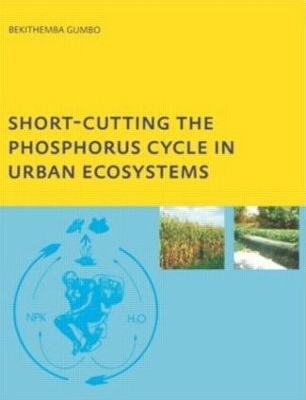
Short-cutting the Phosphorus Cycle in Urban Ecosystems
Seiten
2005
CRC Press (Verlag)
978-0-415-38484-1 (ISBN)
CRC Press (Verlag)
978-0-415-38484-1 (ISBN)
Bekithemba Gumbo's PhD dissertation discusses the short-cutting of the phosphorus cycle in urban ecosystems, with particular reference to the example of Harare, Zimbabwe.
This dissertation presents a methodology of short-cutting the phosphorus cycle in urban ecosystems. In nature, the P-cycle is a circular, closed-loop system, but human activities use and dispose P in a linear, open-ended system leading to the customary environmental problems. Lake Chivero in Zimbabwe is used as a case study to illustrate the unsustainable practice of discharging valuable and finite phosphorous into drinking water resources. Short-cutting or closing the P-cycle in the urban environment is closely related to the closure of water cycles. Closing the P-cycle is dependent on the adoption of ecological sanitation and eco-city concepts. These concepts lead to solutions, which are source orientated (local and small scale), non-mixing, ecologically sound, closed-loop systems. Recycling of P in urban ecological agriculture (without synthetic fertilisers) is used in this dissertation to test the feasibility of these concepts. A phosphorus calculator has been developed, based on studies of monthly P-fluxes and stocks, in a high-density suburb of Harare in Zimbabwe, where agriculture is an established activity.
This dissertation presents a methodology of short-cutting the phosphorus cycle in urban ecosystems. In nature, the P-cycle is a circular, closed-loop system, but human activities use and dispose P in a linear, open-ended system leading to the customary environmental problems. Lake Chivero in Zimbabwe is used as a case study to illustrate the unsustainable practice of discharging valuable and finite phosphorous into drinking water resources. Short-cutting or closing the P-cycle in the urban environment is closely related to the closure of water cycles. Closing the P-cycle is dependent on the adoption of ecological sanitation and eco-city concepts. These concepts lead to solutions, which are source orientated (local and small scale), non-mixing, ecologically sound, closed-loop systems. Recycling of P in urban ecological agriculture (without synthetic fertilisers) is used in this dissertation to test the feasibility of these concepts. A phosphorus calculator has been developed, based on studies of monthly P-fluxes and stocks, in a high-density suburb of Harare in Zimbabwe, where agriculture is an established activity.
Bekithemba Gumbo was born in Bulawayo, Zimbabwe. He studied civil engineering at the University of Zimbabwe, and later obtained his Masters Degree in Water and Waste Engineering at Loughborough University in the UK. He worked as Acting Project Manager in the programme Capacity Building in the Water Sector of Zimbabwe, beginning a collaboration with staff of UNESCO-IHE in the Netherlands which culminated in his PhD research at the IHE in Delft.
Chapter 1 Introduction
Chapter 2 Biogeochemistry of phosphorous global transfers and cycles
Chapter 3 Description of study area
Chapter 4 Establishing fluxes and stocks in an urban-shed
Chapter 5 Options for short-cutting the phosphorus cycle
Chapter 6 Conclusions
Chapter 7 Epilogue
| Erscheint lt. Verlag | 18.8.2005 |
|---|---|
| Verlagsort | London |
| Sprache | englisch |
| Maße | 152 x 229 mm |
| Gewicht | 453 g |
| Themenwelt | Naturwissenschaften ► Biologie ► Ökologie / Naturschutz |
| ISBN-10 | 0-415-38484-2 / 0415384842 |
| ISBN-13 | 978-0-415-38484-1 / 9780415384841 |
| Zustand | Neuware |
| Informationen gemäß Produktsicherheitsverordnung (GPSR) | |
| Haben Sie eine Frage zum Produkt? |
Mehr entdecken
aus dem Bereich


aus dem Bereich
Methoden – Lösungen – Anwendungen
Buch | Hardcover (2025)
Hanser (Verlag)
CHF 69,95


