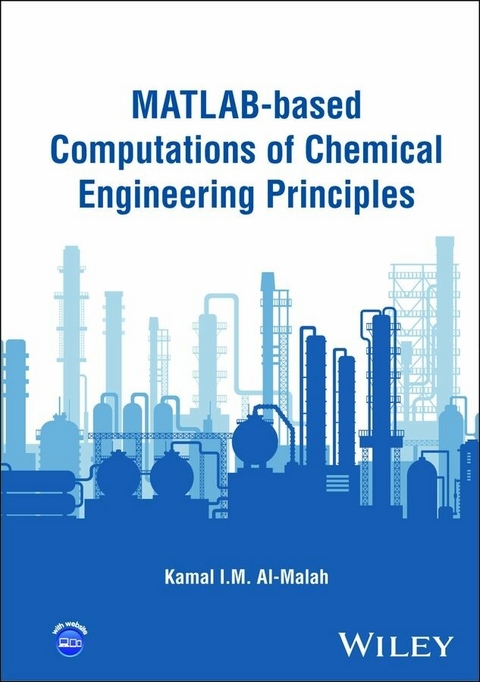
MATLAB-based Computations of Chemical Engineering Principles (eBook)
923 Seiten
Wiley (Verlag)
978-1-394-30883-5 (ISBN)
Explore chemical engineering principles using MATLAB for data analysis, visualization, and solving intricate problems
MATLAB-based Computations of Chemical Engineering Principles is an in-depth textbook that enables readers to transform classical chemical engineering principles and calculations into MATLAB-based calculations. Throughout the text, problems are solved through two methods: manually (i.e., classical) and via implementing MATLAB code (i.e., digital or software-assisted), with a focus on the latter when solving problems involving multiple steps or complex solutions, or when working with large databases, such as dealing with physical properties of compounds.
Seven appendices contain large-size MATLAB codes. In general, small-size MATLAB code is kept within the relevant chapter section. All codes have been verified using the MATLAB platform. End-of-chapter problems reinforce learning by students.
The textbook includes problems and solutions related to concepts including:
- System units and measurement, process variables measurement, and measurement variations and uncertainty
- Types of errors involved in measurements and energy balance applications for closed and open (flow) systems
- Total and component material balances, chemical reaction stoichiometry, conversion, yield, selectivity, and chemical equilibrium
- Properties of pure substances and mixtures as well as vapor liquid equilibrium for single and multi-component mixtures
- Equations of state for gases
Comprehensive in scope with a plethora of helpful learning aids included throughout, this is a perfect textbook for sophomore courses titled Chemical Engineering Principles, Chemical Engineering Stoichiometric Calculations, Fundamentals of Chemical Engineering, Introduction to Chemical Engineering, or Essentials of Chemical Engineering.
Dr. Kamal I.M. Al-Malah is a Professor of Chemical Engineering. He holds B.S., M.S., and Ph.D. degrees, all in chemical/biochemical engineering from Oregon State University. He currently researches the modeling, simulation, optimization, machine learning, and deep learning aspects of physical/biophysical systems and characterization of molecular properties within the fields of chemical, biochemical, pharmaceutical, and food engineering. He is sole author of four other textbooks with renowned science and engineering book publishers.
1
What is Chemical Engineering?
Chemical engineering is a branch of engineering that combines principles of chemistry, physics, mathematics, biology, and economics to design, develop, produce, transport, and transform materials and energy. It involves the application of various scientific principles to solve problems related to the production and use of chemicals, fuels, drugs, food, and various other products. Here is a brief list of chemical engineering industrial processes.
1.1 Chemical Engineering Industrial Processes
- Agrochemicals: Insecticides (e.g., neonicotinoids, pyrethroids), rodenticides, plant growth regulators, acaricides, herbicides (e.g., glyphosate, atrazine), nematicides, soil fumigants, micronutrient fertilizers (e.g., zinc, copper), potash fertilizers, compound fertilizers (e.g., NPK blends), slow‐release fertilizers, and micronutrient‐enriched fertilizers.
- Elastomers: Commonly known as rubber, are a fascinating class of materials known for their elasticity and ability to recover their original shape after deformation. They play a crucial role in various industries, from tires and hoses to seals and gaskets. Understanding the different types of elastomers is essential for choosing the right material for the job. Elastomers can be broadly categorized into natural and synthetic types.
- 2.a Natural Rubber: It is extracted from the sap of the Hevea brasiliensis tree, the original rubber known for its excellent physical properties like high tensile strength and resilience. Its main component is polyisoprene, a hydrocarbon polymer with a characteristic cis‐1,4 configuration.
- 2.b Synthetic Rubbers: They were developed to overcome the limitations of natural rubber, such as limited supply and susceptibility to certain oils and chemicals. Today, they account for a large portion of the rubber market. They are further divided into saturated and unsaturated rubbers.
- 2.b.1 Unsaturated Rubbers:
- Synthetic Polyisoprene: Mimics the structure and properties of natural rubber, offering a more consistent and controllable supply.
- Styrene–butadiene Rubber (SBR): A copolymer of styrene and butadiene, offering lower cost and good abrasion resistance but with lower resilience compared to natural rubber.
- Neoprene (Chloroprene Rubber, CR): Made from chloroprene, offering excellent oil and chemical resistance but with lower elasticity than natural rubber.
- Nitrile Butadiene Rubber (NBR): A copolymer of butadiene and acrylonitrile, known for its exceptional oil and solvent resistance, making it ideal for hoses and gaskets.
- Polybutadiene (BR): Similar to natural rubber but with better low‐temperature performance, often used in tires and belts.
- 2.b.2 Saturated Rubbers:
- Ethylene Propylene Diene Monomer (EPDM) Rubber: Offers outstanding ozone and weather resistance, making it suitable for outdoor applications like roofing and automotive seals.
- Epichlorohydrin Rubber: Known for its good chemical resistance and flame retardancy, it is used in hoses and linings for chemical processing equipment.
- Polyacrylic Rubber: Offers excellent heat resistance and oil resistance and is used in automotive gaskets and seals.
- Silicone Rubber: Features high heat resistance, chemical resistance, and electrical insulation properties, widely used in medical devices and food processing equipment.
- Fluoro‐silicone Rubber: Offers enhanced resistance to aggressive chemicals and fuels, making it ideal for aircraft and oilfield applications.
- Ethylene‐vinyl Acetate (EVA): Known for its good clarity, flexibility, and shock absorption, it is often used in footwear and sports equipment.
- 2.b.1 Unsaturated Rubbers:
- Fragrances and Flavors: Such fragrant, aromatic volatile substances can be classified into Vanillin, benzyl benzoate, cinnamaldehyde, coumarin, anisole, and isoamyl acetate. Here is a deeper dive into those six fascinating molecules:
- 3.a Vanillin:
- Aroma: Warm, sweet, creamy, reminiscent of vanilla.
- Occurrence: Naturally found in vanilla beans, also synthesized from lignin.
- Uses: Widely used in food and beverage flavorings, perfumes, ice cream, baked goods, and more.
- Chemistry: Phenolic aldehyde compound, contributing to the warm and sweet notes.
- 3.b Benzyl Benzoate:
- Aroma: Soft, floral, balsamic, with slight honey‐like tones.
- Occurrence: Naturally found in some flowers, also synthesized from benzyl alcohol and benzoic acid.
- Uses: Fixative in fragrances, found in soaps, detergents, and some perfumes.
- Chemistry: Ester compound, providing a smooth and powdery character to fragrances.
- 3.c Cinnamaldehyde:
- Aroma: Warm, spicy, cinnamon‐like with a slight citrusy edge.
- Occurrence: Main component of cinnamon bark oil.
- Uses: Food flavoring, spice in various cuisines, perfumes, and candles.
- Chemistry: Phenylpropanoid aldehyde, responsible for the spicy and warm notes of cinnamon.
- 3.d Coumarin:
- Aroma: Sweet, warm, hay‐like, with a distinct almond nuance.
- Occurrence: Found in Tonka beans and some berries and is synthetically produced.
- Uses: Used in food flavorings, tobacco flavorings, and formerly in perfumes (restricted due to potential liver toxicity).
- Chemistry: Lactone compound, contributing to the sweet and balsamic aroma.
- 3.e Anisole:
- Aroma: Sweet, licorice‐like, aniseed, with a slight almond hint.
- Occurrence: Found in star anise and licorice root, also synthesized from phenol.
- Uses: Food flavoring in liqueurs, baked goods, and candies, also used in perfumes and soaps.
- Chemistry: Ether compound, responsible for the anise and licorice‐like notes.
- 3.f Isoamyl Acetate:
- Aroma: Fruity, banana‐like, with a sweet pear and pineapple essence.
- Occurrence: Found in various fruits, also synthesized from isoamyl alcohol and acetic acid.
- Uses: Food flavoring in fruit‐flavored candies, ice cream, and beverages, also used in some perfumes.
- Chemistry: Ester compound, providing the fruity and sweet character in various products.
- 3.a Vanillin:
- Industrial Gases: Industrial gases play a crucial role in various industries, from metalworking and healthcare to food processing and electronics. Let us delve into the specific properties and applications of five key industrial gases: Nitrogen, oxygen, nitrous oxide, acetylene, and chlorine.
- 4.a Nitrogen (N₂): A colorless, odorless, and inert gas that makes up about 79% of the Earth's atmosphere. It is nonflammable and slightly lighter than air.
Applications:
- Food Industry: Inert atmosphere for packaging and preserving food, preventing spoilage caused by oxidation.
- Chemical Industry: Production of ammonia, fertilizers, and nitric acid.
- Electronics Industry: Inert atmosphere for soldering and preventing oxidation of sensitive components.
- Metalworking: Inert atmosphere for heat treatment of metals, preventing oxidation and discoloration.
- Cryogenics: Liquid nitrogen is used for freezing and preserving biological materials and for cooling applications.
- 4.b Oxygen (O₂): A colorless, odorless gas that makes up about 21% of the Earth's atmosphere. It is essential for combustion and respiration.
Applications:
- Metalworking: Cutting and welding metals with oxy‐fuel torches, providing the oxygen needed for intense heat generation.
- Medical: Oxygen therapy for patients with respiratory problems providing supplemental oxygen to improve breathing.
- Wastewater Treatment: Aerobic processes for breaking down organic matter in wastewater, requiring oxygen for bacterial activity.
- Chemical Industry: Production of various chemicals, including plastics, pharmaceuticals, and fertilizers.
- Aquaculture: Increasing oxygen levels in fish tanks and ponds, maintaining a healthy environment for aquatic life.
- 4.c Nitrous Oxide (N₂O): A colorless, a slightly sweet smell, and is also known as laughing gas. It is weakly acidic and soluble in water. It can act as an oxidizer but is not flammable itself.
Applications:
- Medical: Anesthetic for dental and surgical procedures, providing pain relief and sedation.
- Food Industry: Aerating whipped cream and mousses, creating a light and fluffy texture.
- Automotive Industry: Used as an oxidizing agent in some engine performance boosters.
- Rocketry: Oxidizer in some hybrid rocket propellants.
- 4.d Acetylene (C₂H₂): It is a colorless gas with a garlic‐like odor. It is highly flammable and explosive when mixed with air or oxygen. It can decompose violently at high temperatures or pressures.
Applications:
- Metalworking: Oxy‐acetylene welding and cutting, providing a hot, concentrated flame for...
- 4.a Nitrogen (N₂): A colorless, odorless, and inert gas that makes up about 79% of the Earth's atmosphere. It is nonflammable and slightly lighter than air.
| Erscheint lt. Verlag | 2.5.2025 |
|---|---|
| Sprache | englisch |
| Themenwelt | Naturwissenschaften ► Chemie |
| Schlagworte | Chemical Engineering Calculations • Chemical Engineering Fundamentals • Chemical Engineering Principles • Chemical Reaction Stoichiometry • Energy balance • Equations of State for Gases • Material balance • MATLAB |
| ISBN-10 | 1-394-30883-3 / 1394308833 |
| ISBN-13 | 978-1-394-30883-5 / 9781394308835 |
| Informationen gemäß Produktsicherheitsverordnung (GPSR) | |
| Haben Sie eine Frage zum Produkt? |
 EPUB (Adobe DRM)
Kopierschutz: Adobe-DRM
Adobe-DRM ist ein Kopierschutz, der das eBook vor Mißbrauch schützen soll. Dabei wird das eBook bereits beim Download auf Ihre persönliche Adobe-ID autorisiert. Lesen können Sie das eBook dann nur auf den Geräten, welche ebenfalls auf Ihre Adobe-ID registriert sind.
Details zum Adobe-DRM
Dateiformat: EPUB (Electronic Publication)
EPUB ist ein offener Standard für eBooks und eignet sich besonders zur Darstellung von Belletristik und Sachbüchern. Der Fließtext wird dynamisch an die Display- und Schriftgröße angepasst. Auch für mobile Lesegeräte ist EPUB daher gut geeignet.
Systemvoraussetzungen:
PC/Mac: Mit einem PC oder Mac können Sie dieses eBook lesen. Sie benötigen eine
eReader: Dieses eBook kann mit (fast) allen eBook-Readern gelesen werden. Mit dem amazon-Kindle ist es aber nicht kompatibel.
Smartphone/Tablet: Egal ob Apple oder Android, dieses eBook können Sie lesen. Sie benötigen eine
Geräteliste und zusätzliche Hinweise
Buying eBooks from abroad
For tax law reasons we can sell eBooks just within Germany and Switzerland. Regrettably we cannot fulfill eBook-orders from other countries.
aus dem Bereich