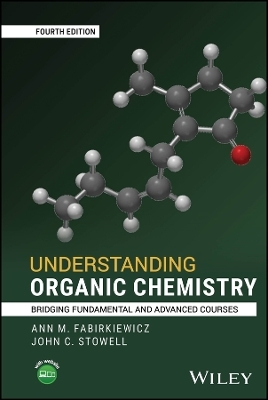
Understanding Organic Chemistry
John Wiley & Sons Inc (Verlag)
978-1-394-17983-1 (ISBN)
Understanding Organic Chemistry: Bridging Fundamental and Advanced Courses equips students with the conceptual tools and technical knowledge needed to transition confidently from lower-division coursework to upper-level study and research in organic chemistry. By integrating synthetic and physical organic chemistry, this popular textbook helps students understand reaction mechanisms, stereochemical principles, and synthetic strategies in a way that is both rigorous and accessible.
The new fourth edition continues its dual focus on theoretical grounding and hands-on problem-solving, making it ideal for those who want to deepen their command of the subject and begin reading primary research literature with confidence. The text incorporates substantial updates throughout, including contemporary examples from synthetic chemistry, enhanced coverage of chiral catalysts and ene reactions, and newly developed in-text problem sets designed to promote self-guided learning. The chapters are structured around major themes—such as spectroscopy, reaction mechanisms, and functional group transformations—and include clear, concise explanations followed by extensive end-of-chapter exercises. Select problem answers are now available in the text, with full solutions and teaching materials accessible to instructors through a companion website.
A balanced treatment of synthetic and physical organic chemistry that promotes a deeper conceptual understanding of the subject, Understanding Organic Chemistry:
Introduces modern synthetic topics and recent advances in bond-forming methodologies
Provides up-to-date coverage of spectroscopy, functional group transformations, and synthesis design
Explains stereochemistry and reaction mechanisms in a clear, structured manner ideal for advanced learners
Enables students to critically engage with primary research literature in organic chemistry
With a student-friendly format that supports both coursework and self-directed study, Understanding Organic Chemistry: Bridging Fundamental and Advanced Courses, Fourth Edition, is ideal for junior- and senior-level undergraduates as well as first-year graduate students enrolled in intermediate or advanced organic chemistry courses. It is also a valuable reference for chemistry majors preparing for careers or further study in pharmaceuticals, materials science, or academic research.
Ann M. Fabirkiewicz, PhD, is Chair of the Chemistry Department at Randolph College, where she teaches organic and biochemistry and studies antioxidants in foods. She is the author of the third edition of Intermediate Organic Chemistry. John C. Stowell, PhD, was Professor of Chemistry at the University of New Orleans, where he taught and conducted research in synthetic organic chemistry. He authored the first two editions of Intermediate Organic Chemistry and the monograph Carbanions in Organic Synthesis.
Preface to the Fourth Edition xi
Preface to the Third Edition xiii
Preface to the Second Edition xv
Preface to the First Edition xvii
About the Companion Website xix
1 Reading Nomenclature 1
1.1 Acyclic Polyfunctional Molecules 2
1.2 Monocyclic Aliphatic Compounds 3
1.3 Bridged Polycyclic Structures 4
1.4 Fused Polycyclic Compounds 6
1.5 Spiro Compounds 10
1.6 Monocyclic Heterocyclic Compounds 11
1.7 Fused-Ring Heterocyclic Compounds 16
1.8 Bridged and Spiro Heterocyclic Compounds 19
Resources 20
Problems 21
References 22
2 Accessing Chemical Information 25
2.1 Databases 25
2.2 Chemical Literature 26
2.3 Synthetic Procedures 28
2.4 Health and Safety Information 29
Problems 32
References 34
3 Stereochemistry 37
3.1 Representations 37
3.2 Vocabulary 39
3.3 Property Differences Among Stereoisomers 42
3.4 Resolution of Enantiomers 46
3.5 Enantioselective Synthesis 49
3.5.1 Chiral Templates 50
3.5.2 Chiral Catalysts 50
3.5.3 Chiral Reagents 51
3.5.4 Substrate-Directed Enantioselective Reactions 52
3.6 Reactions at a Stereogenic Atom 53
3.6.1 Racemization 53
3.6.2 Epimerization 53
3.6.3 Inversion 54
3.6.4 Retention 55
3.6.5 Transfer 56
3.7 Relative and Absolute Configurations 57
3.8 Topism 59
Resources 63
Problems 63
References 70
4 Mechanisms and Predictions 75
4.1 Reaction Coordinate Diagrams and Mechanisms 75
4.2 The Hammond Postulate 77
4.3 Methods for Determining Mechanisms 78
4.3.1 Identification of Products and Intermediates 78
4.3.2 Isotope Tracing 78
4.3.3 Stereochemical Determination 79
4.3.4 Concentration Dependence of Kinetics 81
4.3.5 Isotope Effects in Kinetics 90
4.3.6 Temperature Effects on Kinetics 92
4.3.7 Substituent Effects on Kinetics 94
4.4 Worked Examples 100
4.4.1 Reactions in Basic Solutions 100
4.4.2 Reactions in Acidic Solutions 104
4.4.3 Free Radical Reactions 108
4.4.4 Molecular Rearrangements 111
Resource 113
Problems 114
References 126
5 Electron Delocalization Aromatic Character and Pericyclic Reactions 129
5.1 Molecular Orbitals 130
5.2 Aromatic Character 136
5.3 Pericyclic Reactions 141
5.3.1 Cycloaddition Reactions 143
5.3.2 Electrocyclic Reactions 148
5.3.3 Sigmatropic Reactions 153
5.3.4 Ene Reactions 156
5.3.5 Selection Rules for Pericyclic Reactions 158
Resources 159
Problems 159
References 167
6 Functional Group Transformations 171
6.1 Carboxylic Acids and Related Derivatives 172
6.1.1 Carboxylic Acids 172
6.1.2 Carboxylic Esters 174
6.1.3 Carboxylic Amides 176
6.1.4 Carboxylic Acid Halides 176
6.1.5 Carboxylic Anhydrides 176
6.1.6 Nitriles 177
6.1.7 Ortho Esters 178
6.2 Aldehydes Ketones and Derivatives 179
6.2.1 Aldehydes 179
6.2.2 Ketones 182
6.2.3 Imines and Enamines 182
6.2.4 Acetals 183
6.2.5 Vinyl Ethers 185
6.3 Alcohols 186
6.4 Ethers 187
6.5 Alkyl Halides 189
6.5.1 Alkyl Chlorides and Alkyl Bromides 190
6.5.2 Alkyl Iodides 192
6.5.3 Alkyl Fluorides 192
6.6 Amines 194
6.7 Isocyanates 195
6.8 Alkenes 195
6.9 Reductive Removal of Functionality 198
Resources 199
Problems 199
References 206
7 Carbon–Carbon Bond Formation 213
7.1 Carbon–Carbon Single-Bond Formation 214
7.1.1 Reactions in Basic Solutions 214
7.1.2 Reactions in Acidic Solutions 221
7.1.3 Organometallic Coupling Reactions 224
7.2 Carbon–Carbon Double-Bond Formation 226
7.3 Multibond Processes 229
Resources 231
Problems 232
References 238
8 Planning Multistep Syntheses 243
8.1 Retrosynthetic Analysis 243
8.2 Disconnection at a Functional Group or a Branch Point 244
8.3 Cooperation for Difunctionality 248
8.4 Ring Closure 258
8.5 Acetylide Alkylation and Addition 262
8.6 The Diels–Alder Reaction 264
8.7 The Claisen Rearrangement 268
8.8 Asymmetric Synthesis 272
8.9 Synthetic Strategies 273
8.10 Final Note 276
Resources 276
Problems 277
References 282
9 Physical Influences on Reactions 289
9.1 Unimolecular Reactions 290
9.2 Homogeneous Two-Component Reactions 291
9.3 Temperature Effects 292
9.4 Pressure Effects 294
9.5 Solvent Effects 295
9.6 Biphasic Reactions 296
9.6.1 Phase-Transfer Catalysis 296
9.6.2 Increasing Solubility 299
9.6.3 Increasing Surface Area 299
9.6.4 Flow Chemistry 300
9.6.5 Ultrasound 301
9.7 Reactions on Chemical Supports 302
9.8 Using Unfavorable Equilibria 305
9.9 Green Chemistry 307
Resources 308
Problems 309
References 312
10 Survey of Organic Spectroscopy 317
10.1 Electromagnetic Radiation 317
10.2 Ultraviolet Spectroscopy 319
10.2.1 Origin of the Signals 319
10.2.2 Interpretation 320
10.2.3 Visible Spectroscopy 320
10.3 Infrared Spectroscopy 322
10.3.1 Origin of the Signals 322
10.3.2 Interpretation 322
10.4 Mass Spectrometry 324
10.4.1 Origin of the Signals 324
10.4.2 Interpretation 325
10.5 NMR Spectroscopy 326
10.5.1 Origin of the Signals 327
10.5.2 Interpretation of Proton NMR Spectra 330
10.6 Carbon NMR Spectra 342
10.6.1 General Characteristics 343
10.6.2 Interpretation of 13C NMR Spectra 345
10.7 Correlation of 1H and 13C NMR Spectra 348
Resources 350
Problems 350
References 357
Appendix A Common Chemical Abbreviations 359
Appendix B Common Protecting Groups 365
Appendix C Answers to Selected Problems 371
Index 415
| Erscheinungsdatum | 23.10.2025 |
|---|---|
| Verlagsort | New York |
| Sprache | englisch |
| Maße | 158 x 236 mm |
| Gewicht | 703 g |
| Themenwelt | Naturwissenschaften ► Chemie ► Organische Chemie |
| Naturwissenschaften ► Chemie ► Physikalische Chemie | |
| ISBN-10 | 1-394-17983-9 / 1394179839 |
| ISBN-13 | 978-1-394-17983-1 / 9781394179831 |
| Zustand | Neuware |
| Informationen gemäß Produktsicherheitsverordnung (GPSR) | |
| Haben Sie eine Frage zum Produkt? |
aus dem Bereich