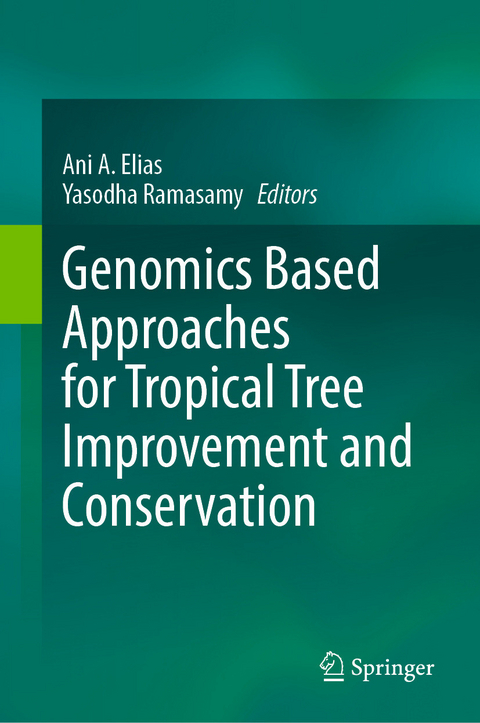
Genomics Based Approaches for Tropical Tree Improvement and Conservation (eBook)
278 Seiten
Springer Nature Singapore (Verlag)
978-981-96-4616-6 (ISBN)
This book offers foundational knowledge to advance genomic approaches in forest tree improvement and genetic resource conservation. The tropical tree breeding sector has fallen behind in genomic breeding not due to a lack of resources but rather a limited understanding and an underdeveloped genomic breeding pipeline. While marker-assisted selection (MAS) has been the preferred method for incorporating genomic data into breeding programs, it primarily targets major genes, overlooking minor gene effects. This limitation makes MAS less effective for enhancing quantitative traits such as heartwood content.
The primary goal of statistical methodologies using whole-genome information is to predict promising candidates for breeding advancement/commercialization while efficiently managing resources such as land, labor, and, most critically, time. Given the long rotation period of forest tree crops, the ability to identify, select, and modify genotypes with high heritability for economically valuable traits within a shorter timeframe marks a significant advancement in breeding. This book provides comprehensive guidelines on leveraging genomic data, including pathogenomics, to breed resilient, future-ready trees and manage populations effectively. To reinforce these guidelines, the book presents case studies on species such as Tectona grandis, Santalum album, Casuarina, Shorea, Artocarpus, tropical and sub-tropical pines, and tropical fruit trees. Additionally, the book explores broader applications of genetic data, including timber tracing and the conservation of germplasm while minimizing genetic redundancy.
This book will be a valuable resource for tropical tree breeders and researchers, equipping them with the methods and tools needed to adopt advanced genomic breeding. Additionally, students and scholars will benefit from the comprehensive information it provides, enhancing their understanding of modern breeding techniques.
This book offers foundational knowledge to advance genomic approaches in forest tree improvement and genetic resource conservation. The tropical tree breeding sector has fallen behind in genomic breeding not due to a lack of resources but rather a limited understanding and an underdeveloped genomic breeding pipeline. While marker-assisted selection (MAS) has been the preferred method for incorporating genomic data into breeding programs, it primarily targets major genes, overlooking minor gene effects. This limitation makes MAS less effective for enhancing quantitative traits such as heartwood content.The primary goal of statistical methodologies using whole-genome information is to predict promising candidates for breeding advancement/commercialization while efficiently managing resources such as land, labor, and, most critically, time. Given the long rotation period of forest tree crops, the ability to identify, select, and modify genotypes with high heritability for economically valuable traits within a shorter timeframe marks a significant advancement in breeding. This book provides comprehensive guidelines on leveraging genomic data, including pathogenomics, to breed resilient, future-ready trees and manage populations effectively. To reinforce these guidelines, the book presents case studies on species such as Tectona grandis, Santalum album, Casuarina, Shorea, Artocarpus, tropical and sub-tropical pines, and tropical fruit trees. Additionally, the book explores broader applications of genetic data, including timber tracing and the conservation of germplasm while minimizing genetic redundancy.This book will be a valuable resource for tropical tree breeders and researchers, equipping them with the methods and tools needed to adopt advanced genomic breeding. Additionally, students and scholars will benefit from the comprehensive information it provides, enhancing their understanding of modern breeding techniques.
| Erscheint lt. Verlag | 30.4.2025 |
|---|---|
| Zusatzinfo | XII, 278 p. 18 illus., 17 illus. in color. |
| Sprache | englisch |
| Themenwelt | Naturwissenschaften ► Biologie ► Botanik |
| Naturwissenschaften ► Biologie ► Genetik / Molekularbiologie | |
| Naturwissenschaften ► Biologie ► Ökologie / Naturschutz | |
| Naturwissenschaften ► Geowissenschaften ► Geografie / Kartografie | |
| Weitere Fachgebiete ► Land- / Forstwirtschaft / Fischerei | |
| Schlagworte | forest genetic resource conservation • Genome editing • genomic tree improvement • Next generation sequencing • Organellar genomics • tropical trees |
| ISBN-10 | 981-96-4616-2 / 9819646162 |
| ISBN-13 | 978-981-96-4616-6 / 9789819646166 |
| Informationen gemäß Produktsicherheitsverordnung (GPSR) | |
| Haben Sie eine Frage zum Produkt? |
 PDF (Wasserzeichen)
DRM: Digitales Wasserzeichen
Dieses eBook enthält ein digitales Wasserzeichen und ist damit für Sie personalisiert. Bei einer missbräuchlichen Weitergabe des eBooks an Dritte ist eine Rückverfolgung an die Quelle möglich.
Dateiformat: PDF (Portable Document Format)
Mit einem festen Seitenlayout eignet sich die PDF besonders für Fachbücher mit Spalten, Tabellen und Abbildungen. Eine PDF kann auf fast allen Geräten angezeigt werden, ist aber für kleine Displays (Smartphone, eReader) nur eingeschränkt geeignet.
Systemvoraussetzungen:
PC/Mac: Mit einem PC oder Mac können Sie dieses eBook lesen. Sie benötigen dafür einen PDF-Viewer - z.B. den Adobe Reader oder Adobe Digital Editions.
eReader: Dieses eBook kann mit (fast) allen eBook-Readern gelesen werden. Mit dem amazon-Kindle ist es aber nicht kompatibel.
Smartphone/Tablet: Egal ob Apple oder Android, dieses eBook können Sie lesen. Sie benötigen dafür einen PDF-Viewer - z.B. die kostenlose Adobe Digital Editions-App.
Buying eBooks from abroad
For tax law reasons we can sell eBooks just within Germany and Switzerland. Regrettably we cannot fulfill eBook-orders from other countries.
aus dem Bereich