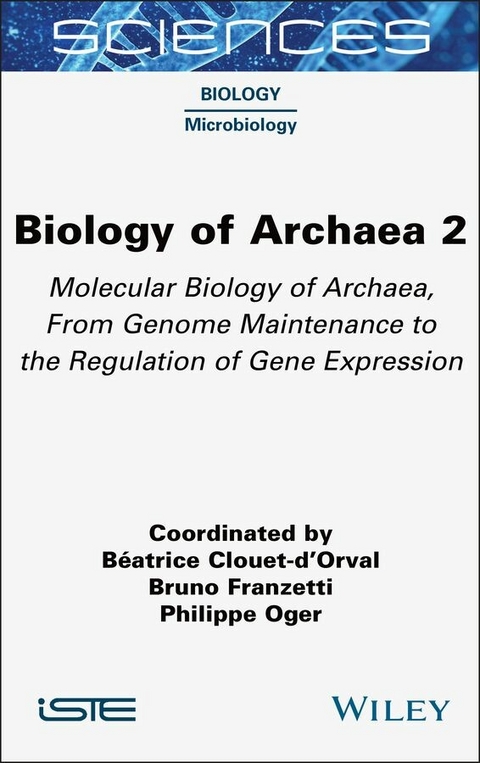
Biology of Archaea 2 (eBook)
377 Seiten
Wiley-Iste (Verlag)
978-1-394-37255-3 (ISBN)
Archaea constitute a new branch of life alongside bacteria and eukaryotes. These microorganisms are unique in their cellular and molecular aspects. They have evolutionary links with the first eukaryotic cells and are now being used to elucidate fundamental biological questions.
Champions of extremophilicity, archaea are helping to lift the veil on the limits of life on Earth. Biology of Archaea 2 presents the diverse molecular mechanisms involved in the fundamental processes of genome maintenance and regulation of gene expression in archaeal cells.
This book analyzes the complex machinery involved in chromosome replication, DNA repair, RNA synthesis (transcription) and protein synthesis (translation), and explores the different classes of RNAs and enzymes involved in RNA maturation and degradation. These regulate the stability of messenger and regulatory non-coding RNAs, and contribute to the formation of the mature forms of ribosomal RNAs and transfer RNAs. These molecular mechanisms are closely related to those of eukaryotes.
Béatrice Clouet-d'Orval is Research Director at the CNRS and works at the Center for Integrative Biology, Toulouse, France. Her main research areas focus on the post-transcriptional regulation of gene expression.
Bruno Franzetti is Research Director at the CNRS, France, where he specializes in the structural biology of archaea. His research areas include biophysical and cellular mechanisms that maintain proteome integrity under extreme conditions.
Philippe Oger is Research Director at the CNRS, France. His research areas include understanding the adaptations of prokaryotes in response to extreme conditions, using a multidisciplinary approach combining the methods derived from atomic physics and cutting-edge molecular biology and modeling.
Archaea constitute a new branch of life alongside bacteria and eukaryotes. These microorganisms are unique in their cellular and molecular aspects. They have evolutionary links with the first eukaryotic cells and are now being used to elucidate fundamental biological questions. Champions of extremophilicity, archaea are helping to lift the veil on the limits of life on Earth. Biology of Archaea 2 presents the diverse molecular mechanisms involved in the fundamental processes of genome maintenance and regulation of gene expression in archaeal cells. This book analyzes the complex machinery involved in chromosome replication, DNA repair, RNA synthesis (transcription) and protein synthesis (translation), and explores the different classes of RNAs and enzymes involved in RNA maturation and degradation. These regulate the stability of messenger and regulatory non-coding RNAs, and contribute to the formation of the mature forms of ribosomal RNAs and transfer RNAs. These molecular mechanisms are closely related to those of eukaryotes.
1
Replication of Archaeal Chromosomes
Ghislaine Henneke1, Roxane Lestini2, Marc Nadal3 and Didier Flament1
1BEEP, CNRS, Ifremer, Université de Bretagne Occidentale, Plouzané, France
2Laboratoire d’optique et biosciences, Inserm, CNRS, Institut Polytechnique de Paris, Palaiseau, France
3IBENS, CNRS, Inserm, PSL University, Paris, France
It was only when Watson and Crick proposed the double helix structure of DNA, in the early 1950s, that the scientific community finally accepted that DNA could be the carrier of heredity. Since then, the study of DNA replication has become one of the key themes of molecular biology. First developed in bacteria in the 1960s, then in eukaryotes in the 1980s, it was only after Carl Woese and George Fox clarified the phylogenetic position of archaea that the study of the molecular mechanisms of DNA replication began in archaea, in the early 1980s. This new scientific venture has proved exciting in several ways. First, although the composition of the replication machinery shows a high degree of diversity in archaea, it is similar to that of eukaryotes, indicating a common evolutionary history (see Volume 1, Chapters 2 and 3).
Thus, archaeal proteins and the metabolic pathways involved in this process represent excellent models for study. Furthermore, the study of replication initiation in these organisms has recently challenged one of the dogmas of molecular biology, according to which an origin of replication is required to initiate the autonomous replication of a DNA fragment. Indeed, in some archaea, the origin(s) of replication (of which there can be several) can be genetically suppressed without the cell exhibiting growth defects. This suggests the presence of an alternative replication initiation mechanism in archaea, which remains to be characterized.
The general process of DNA replication is conserved throughout all cellular organisms. DNA replication can be divided into four main stages. The first stage involves initiation, during which specific proteins recognize and bind to the origin of replication. This DNA–protein complex recruits a helicase to unwind the double-stranded DNA at the origin. DNA primase and DNA polymerases are then recruited to the replication bubble generated by the helicase activity. The second stage is elongation, which corresponds to the duplication of both DNA strands simultaneously and bidirectionally. Due to the antiparallel structure of DNA and the direction of nucleotide polymerization from 5′ to 3′, the leading strand is synthesized continuously, while the lagging strand is replicated discontinuously in the form of Okazaki fragments. In the third stage, the RNA primers on the lagging strand are removed by the coordinated action of ribonucleases, flap endonucleases and DNA ligases. Finally, the last stage, known as termination, corresponds to the end of synthesis, when the replication forks meet or when they encounter a termination signal.
In this chapter, we will summarize what we know about DNA replication in archaea through the different phases of this process.
1.1. Replication initiation
1.1.1. Identifying the origins of replication
Although we now know the complete genome of some 420 cultivated isolates, our knowledge of the replication of these organisms is limited to <20 species, some of which are very closely related, and do not cover all the phyla of the archaea domain. In terms of genome structure, very different situations coexist, since some archaea have a single circular chromosome, like most bacteria, while halophilic archaea (Haloarchaea) have several chromosomes. Furthermore, while some archaea are haploid, others are polyploid. This genomic diversity implies different couplings with the cell cycle and different regulations of replication initiation.
The first origin of replication observed in archaea was that of Pyrococcus abyssi. This Euryarcheota, of the order Thermococcales, has a single chromosome containing a single bidirectional origin of replication (Matsunaga et al. 2001). In methanogens, in silico studies indicate the presence of a single origin. Allele frequency analysis in Nitrosopumilus maritimus, a Thaumarchaeota, reveals the presence of a single origin of replication. However, multiple origins of replication per chromosome have been found in Halobacteria. In Crenarchaeota, there seems to be the presence, on a single circular chromosome, of up to four multiple origins of replication, this being unrelated to genome size. Surprisingly, in 2013, Thorsten Allers’ team at the University of Nottingham demonstrated that all the origins of replication in the halophilic archaea Haloferax volcanii could be deleted without preventing the mutant strain from dividing and continuing to grow (Hawkins et al. 2013). This same finding was then established in a hyperthermophilic archaea of the order Thermococcales (Gehring et al. 2017), raising the question of the role of these origins of replication in certain archaea, as well as the alternative mechanism enabling chromosome replication in the absence of the origin of replication. Although these studies still only concern a small number of archaea, it seems that the vast majority of archaea have multiple origins of replication, with Thermococcales and Thaumarchaeota being the exceptions. To date, all observed origins of replication allow bidirectional replication of the associated replicon.
1.1.2. Recognizing the origins of replication
Replication initiation takes place at specific sites, composed of at least two short repetitive sequences, the ORBs (origin recognition boxes) (Matsunaga et al. 2001; Robinson et al. 2007), located near an AT-rich DNA sequence enabling local separation of the two complementary strands, known as DNA unwinding element (DUE) (Figure 1.1(a)). These sequences are recognized by specific proteins, the Orc/Cdc6 proteins. These proteins belong to the same family as the Orc (origin recognition complex) proteins involved in the initiation of replication in eukaryotes. Their binding induces local DNA unwinding (Matsunaga et al. 2009). In eukaryotes, the six Orc proteins (Orc1–6) associate at replication origins with Cdc6 and Cdt1 proteins, so as to enable initiation. In archaea, the initiator proteins are both homologous to the Orc protein family, essentially Orc1, and to Cdc6 proteins. It was surprising to find these proteins in multiple copies, with more than 14 in H. volcanii (Norais et al. 2007). Furthermore, genes are most often localized in the immediate vicinity of the origin to which they bind, reflecting the localization of the bacterial initiator protein DnaA (Figure 1.1). Sulfolobus islandicus has been shown to possess three replication origins, OriC1, OriC2 and OriC3, which bind Orc1-1, Orc1-3 and WhiP proteins, respectively. Unlike the other initiation proteins, WhiP is related to Cdt1, a protein involved in origin recognition in eukaryotes. Although the order Sulfolobales has an Orc1-2 protein, it is WhiP that binds to the OriC3 region.
As in eukaryotes, expression of the genes encoding Orc/Cdc6 proteins is finely regulated during the cell cycle. In Sulfolobales, genes encoding Orc1-1 and Orc1-3 proteins are expressed at the start of the G1 phase (Lundgren and Bernander 2007), leading to the binding of these initiator proteins to replication origin sequences at the start of the G1 phase. The Orc1/Cdc6 proteins have an ATP binding and hydrolysis site, and conformational changes take place during the ATP binding/hydrolysis cycle. ATP binding is necessary for the activation of replication origins, but ATP hydrolysis is not essential for replication. For the moment, the precise signals leading to replication induction are not known. However, the third Orc1/Cdc6-like protein, Orc1-2, which is not involved in replication initiation, could act as a replication repressor. The sequence recognized by Orc1-2 overlaps with those recognized by Orc1-1 and Orc1-3 (at OriC1 and OriC2 origins, respectively). Consequently, its binding would competitively block these two origins, which is consistent with the fact that this protein is specifically expressed in the G2 phase.
While the main mode of replication in archaea seems to be the replicon hypothesis proposed by Jacob et al. (1963) – in other words, involving the attachment of an inducible protein transacting on a particular sequence – the presence of these origins, and the proteins capable of recognizing them, is not essential in archaea. In fact, in H. volcanii, deletion of the four replication origins of the largest chromosome enables faster growth of these cells without it being possible to identify a dormant origin, as is the case in Haloferax mediterranei (Yang et al. 2015). In the H. volcanii mutant without the origin sequences, the presence of the RadA protein, the homologue of the RecA/Rad51 homologous recombination proteins, is required to allow for replication (Hawkins et al. 2013). The same is true for Thermococcus kodakarensis, in which deletion of the single origin of replication and/or the Cdc6 protein does not alter the growth of this archaea.
This type of replication, known as RDR (recombination-dependent DNA replication), makes use of homologous recombination, as already described in bacteria (Ogawa et al. 1984), but...
| Erscheint lt. Verlag | 29.4.2025 |
|---|---|
| Reihe/Serie | ISTE Invoiced |
| Sprache | englisch |
| Themenwelt | Medizin / Pharmazie ► Medizinische Fachgebiete |
| Naturwissenschaften ► Biologie | |
| ISBN-10 | 1-394-37255-8 / 1394372558 |
| ISBN-13 | 978-1-394-37255-3 / 9781394372553 |
| Informationen gemäß Produktsicherheitsverordnung (GPSR) | |
| Haben Sie eine Frage zum Produkt? |
 EPUB (Adobe DRM)
Kopierschutz: Adobe-DRM
Adobe-DRM ist ein Kopierschutz, der das eBook vor Mißbrauch schützen soll. Dabei wird das eBook bereits beim Download auf Ihre persönliche Adobe-ID autorisiert. Lesen können Sie das eBook dann nur auf den Geräten, welche ebenfalls auf Ihre Adobe-ID registriert sind.
Details zum Adobe-DRM
Dateiformat: EPUB (Electronic Publication)
EPUB ist ein offener Standard für eBooks und eignet sich besonders zur Darstellung von Belletristik und Sachbüchern. Der Fließtext wird dynamisch an die Display- und Schriftgröße angepasst. Auch für mobile Lesegeräte ist EPUB daher gut geeignet.
Systemvoraussetzungen:
PC/Mac: Mit einem PC oder Mac können Sie dieses eBook lesen. Sie benötigen eine
eReader: Dieses eBook kann mit (fast) allen eBook-Readern gelesen werden. Mit dem amazon-Kindle ist es aber nicht kompatibel.
Smartphone/Tablet: Egal ob Apple oder Android, dieses eBook können Sie lesen. Sie benötigen eine
Geräteliste und zusätzliche Hinweise
Buying eBooks from abroad
For tax law reasons we can sell eBooks just within Germany and Switzerland. Regrettably we cannot fulfill eBook-orders from other countries.
aus dem Bereich