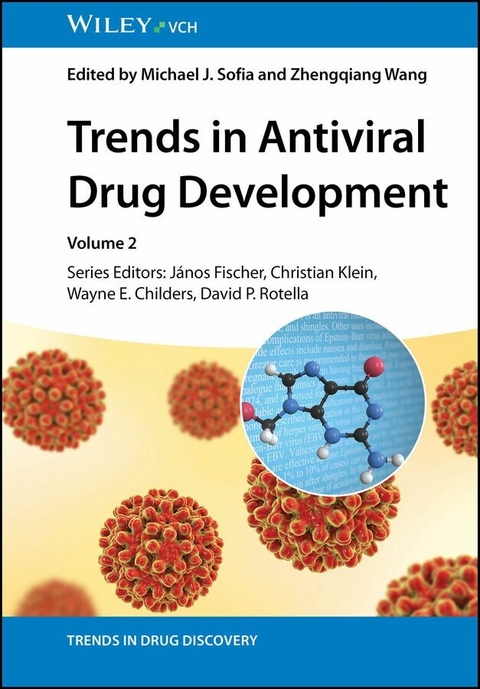
Trends in Antiviral Drug Development (eBook)
959 Seiten
Wiley-VCH (Verlag)
978-3-527-84509-5 (ISBN)
Hard-to-find insights from industry professionals on success strategies for developing the next generation of antiviral blockbuster drugs
Presented by industry professionals with a track record of discovering new drugs and treatments, Trends in Antiviral Drug Development describes successful development efforts for antiviral compounds and therapies that have entered the market or are currently in clinical trials. Viruses are ordered by their target tissue, in line with contemporary drug development that focuses on tissue-targeted therapeutics. Other key trends in antiviral therapy, such as the effort to develop long-acting drugs, are described for each virus type, enabling readers to follow the current and future state in this core area of contemporary drug development.
Trends in Antiviral Drug Development includes discussion on:
- Novel drugs against herpes viruses as well as the breakthrough drugs that cured HCV
- siRNA therapeutics, a new antiviral modality, and the drug candidates that are progressing toward achieving an HBV cure
- Drugs targeting viral entry, such as in HIV entry through attachment, co-receptor binding, and fusion
- Novel therapeutics against tropical diseases such as dengue fever and monkey pox
Trends in Antiviral Drug Development is an essential read for medicinal chemists, pharmaceutical chemists, virologists, and all professionals seeking to understand new ideas and approaches to combat the ever-expanding universe of viral infections.
Michael J. Sofia, Ph.D. is Co-founder and Chief Scientific Officer of Arbutus Biopharma, Inc. where he established the programs in HBV-cure and coronavirus therapeutics.
Zhengqiang Wang, Ph.D. is Professor and Director of Chemistry at the Center for Drug Design, College of Pharmacy, University of Minnesota.
Introduction
Successes and Challenges in Antiviral Drug Development
Zhengqiang Wang1 and Michael J. Sofia2
1 Center for Drug Design, College of Pharmacy, University of Minnesota, Minneapolis, MN 55455, USA
2 Arbutus Biopharma, Inc., 701 Veterans Circle, Warminster, PA 18974, USA
Introduction
Viral infections have had a profound impact on socioeconomics and life expectancy of human societies throughout human history [1–7]. However, the discovery and development of specific antiviral drugs to treat viral diseases has a relatively short history, largely concomitant with the advent of modern biomedical sciences. Specifically, the FDA approval of idoxuridine (IDU) [8] in 1963, a deoxynucleoside analog first synthesized by Prusoff in 1958 [9], ushered in the era of direct-acting antivirals (DAAs). Since then, many antiviral drugs and drug combinations have been successfully developed and marketed [10], which have largely mitigated many human viral pathogens that historically plagued human societies. Not surprisingly, most of these drugs target viruses that cause chronic infections and/or establish latency. Human immunodeficiency virus (HIV), in particular, has been at the center of antiviral drug development and drug regimen evolution, with dozens of single agents and fixed-dose combinations (FDCs) approved, spanning a wide range of compound classes and molecular targets [11, 12]. The everlasting needs to prevent infection, enhance drug accessibility, and improve adherence have also spurred developments in pre-exposure prophylaxis (PrEP) [13, 14], regimen simplification [15–17], and long-acting injectables (LAIs) [18–20]. Prior to HIV, the earliest antiviral drugs mostly targeted human herpesviruses (HHVs), including herpes simplex virus (HSV), varicella zoster virus (VZV), and human cytomegalovirus (HCMV). Other major chronic viruses targeted by various small-molecule antiviral drugs include hepatitis B virus (HBV) and hepatitis C virus (HCV), both causing viral hepatitis and increasing risk of hepatocarcinoma. Although current antiviral drugs typically do not clear HIV, HBV, or HHVs, the development of DAAs to successfully cure HCV represents a major breakthrough [21, 22] in antiviral therapy and provides hope that further development in antiviral drugs could eventually lead to the functional cure of other challenging viral infections. Widespread and seasonal acute viral infections, such as influenza virus, respiratory syncytia virus (RSV), and SARS-CoV-2, have also caused major mortality and morbidity, and have been targeted by successful and ongoing antiviral drug development efforts.
Antiviral Drugs Targeting Human Herpesviruses
HHVs, a family of eight large DNA viruses, are highly prevalent within human populations [23]. While primary infections are generally associated with low risk, these viruses are all capable of establishing lifelong latency. In immunocompromised individuals, the reactivation of the latent infection causes high morbidity and mortality. Among HHVs, ɑ-herpesviruses HSV and VZV, and β-herpesvirus HCMV, have received particular attention in drug discovery.
The vast majority, if not all, of the earliest HHV drugs belonged to four distinct subclasses of nucleos(t)ide analogs (Table 1): (1) C-5 substituted thymidine analogs, including IDU [8, 24, 25], trifluridine (TFT) [26], and brivudine (BVDU) [27], where the C-5 substituent is mechanistically important by disrupting base pairing; (2) marine sponge tectitethya crypta spongonucleoside [28] vidarabine (ara-A) [29], which contains d-arabinose rather than d-ribose; (3) acyclic nucleosides [30] aciclovir (ACV), penciclovir (PCV), and ganciclovir (GCV); and (4) acyclic nucleoside phosphonate (ANP) [31] cidofovir. Intracellularly, all nucleoside analogs (the first three subclasses) are converted to monophosphate (MP) by a virally encoded kinase, and then further phosphorylated by cellular kinases to the active form triphosphate (TP). ANP cidofovir bypasses the function of viral kinase as the MP is already chemically installed, but still uses cellular kinases to form the active TP. Early mechanistic studies showed that these TPs can stop viral DNA synthesis via competitive viral polymerase inhibition or by getting incorporated into the DNA and acting as chain terminators. Of these nucleos(t)ide anti-herpes antiviral drugs, ACV [32, 33] is considered a milestone drug due to its excellent selectivity and low toxicity and has been used to effectively treat infections caused by most known HHVs, particularly HSV and VZV. Another acyclic nucleoside drug GCV [34, 35] has been the first-line treatment for HCMV for decades.
Table 1 Antiviral drugs against HHVs.
| Drug class and MOA | Drug name | Note | Year approved | Indication approved |
|---|
| Nucleos(t)ide analogs: phosphorylated intracellularly, incorporated and act as chain terminators | Idoxuridine (IDU) | Thymidine analog. 5-I blocking base paring. | 1963 | Topical treatment of herpes simplex keratitis |
| Trifluridine (TFT) | Thymidine analog. 5-CF3 blocking base paring | 1980 | Eye drops for treating keratitis and keratoconjunctivitis caused by HSV |
| Brivudine (BVDU) | Thymidine analog. 5-Bromovinyl blocking base paring | 2000 | Herpes zoster (VZV) in adult patients |
| Vidarabine (ara-A) | Marine spongonucleoside analog | 1976 | Ointment for treating HSV; herpes zoster (VZV) in AIDS patients |
| Aciclovir (ACV) | Acyclic nucleoside analog | 1981 | Treatment of HSV and VZV infections |
| Penciclovir (PCV) | Competitive viral pol inhibition and chain termination | 1996 | Treatment of zoster (VZV) and genital HSV |
| Ganciclovir (GCV) | Competitive viral pol inhibition and chain termination | 1988 | First-line treatment of CMV infections |
| Cidofovir (CDV) | Competitive viral pol inhibition and chain termination | 1996 | ACV-resistant HSV and GCV-resistant CMV infections |
| Pyrophosphate mimic | Foscarnet (PFA) | Binding to the PPi binding site and blocking PPi release | 1991 | ACV-resistant HSV and VZV; GCV-resistant CMV infections |
| Terminase inhibitor | Letermovir (LTV) | Targeting viral terminase component protein pUL56 | 2017 | Prophylaxis of post-transplant HCMV |
| Viral kinase inhibitor | Maribavir (MBV) | Inhibition of viral kinase (pUL97) | 2021 | Treating post-transplant HCMV infections resistant to other drugs |
| Viral helicase–primase inhibitors | Amenamevir (AMNV) | Inhibition of viral helicase–primase complex | 2017 | Herpes zoster (shingles) |
| Pritelivir (PTV) | Inhibition of viral helicase–primase complex | Phase 3 | HSV infections in immunocompromised patients |
Another mechanistically distinct viral polymerase inhibitor is the pyrophosphate (PPi) mimic foscarnet (PFA), which binds to a site similar to but distinct from the PPi binding site of the viral polymerase to block the pyrophosphate exchange [36]. Notably, PFA does not require phosphorylation and thus is kinase-independent.
Although polymerase-targeting nucleos(t)ide analogs and the PPi mimic PFA are largely effective against HHVs, they are limited by dose-related adverse effects and the emergence of drug resistance. In line with expanding the anti-herpes antiviral drug repertoire, efforts in recent years have led to the successful development of three mechanistically novel drug classes: amenamevir (AMNV) and pritelivir (PTV), inhibitors of viral helicase–primase complex, for treating VZV and HSV, respectively; letemovir (LTV), which targets pUL56, a component protein of the HCMV terminase complex, for HCMV prophylaxis post stem cell transplants; and maribavir (MBV), an HCMV kinase (pUL97) inhibitor for treating post-transplant HCMV resistant to other drugs.
Antiviral Drugs Targeting Human Immunodeficiency Virus
HIV drug discovery [37, 38] has been particularly successful with the approval of dozens of single agents in the past four decades (Table 2). These drugs, comprising a few distinct drug classes and mechanisms of action, coalesce to a large repertoire for effective antiretroviral therapy (ART), termed the highly active antiretroviral therapy (HAART) [39]. HAART regimens typically consist of two nucleoside reverse transcriptase inhibitors (NRTIs), along with an integrase inhibitor (INSTI), a protease inhibitor (PI) or a non-nucleoside reverse transcriptase inhibitor (NNRTI).
Table 2 Antiviral drugs against HIV.
| Drug class and MOA | Drug name | Note | Year approved |
|---|
| NRTIs: intracellularly phosphorylated, incorporated and act as obligate... |
| Erscheint lt. Verlag | 23.4.2025 |
|---|---|
| Reihe/Serie | Trends in Drug Discovery |
| Mitarbeit |
Herausgeber (Serie): János Fischer, Christian Klein, Wayne E. Childers, David P. Rotella |
| Sprache | englisch |
| Themenwelt | Naturwissenschaften ► Chemie |
| Schlagworte | antiviral compounds • Antiviral Therapies • contemporary drugs • drug design • first generation treatments • long acting drugs • novel drugs • Novel Treatments • viral causative treatment • virus target tissue • West Nile virus • Yellow fever |
| ISBN-10 | 3-527-84509-7 / 3527845097 |
| ISBN-13 | 978-3-527-84509-5 / 9783527845095 |
| Informationen gemäß Produktsicherheitsverordnung (GPSR) | |
| Haben Sie eine Frage zum Produkt? |
 EPUB (Adobe DRM)
Kopierschutz: Adobe-DRM
Adobe-DRM ist ein Kopierschutz, der das eBook vor Mißbrauch schützen soll. Dabei wird das eBook bereits beim Download auf Ihre persönliche Adobe-ID autorisiert. Lesen können Sie das eBook dann nur auf den Geräten, welche ebenfalls auf Ihre Adobe-ID registriert sind.
Details zum Adobe-DRM
Dateiformat: EPUB (Electronic Publication)
EPUB ist ein offener Standard für eBooks und eignet sich besonders zur Darstellung von Belletristik und Sachbüchern. Der Fließtext wird dynamisch an die Display- und Schriftgröße angepasst. Auch für mobile Lesegeräte ist EPUB daher gut geeignet.
Systemvoraussetzungen:
PC/Mac: Mit einem PC oder Mac können Sie dieses eBook lesen. Sie benötigen eine
eReader: Dieses eBook kann mit (fast) allen eBook-Readern gelesen werden. Mit dem amazon-Kindle ist es aber nicht kompatibel.
Smartphone/Tablet: Egal ob Apple oder Android, dieses eBook können Sie lesen. Sie benötigen eine
Geräteliste und zusätzliche Hinweise
Buying eBooks from abroad
For tax law reasons we can sell eBooks just within Germany and Switzerland. Regrettably we cannot fulfill eBook-orders from other countries.
aus dem Bereich