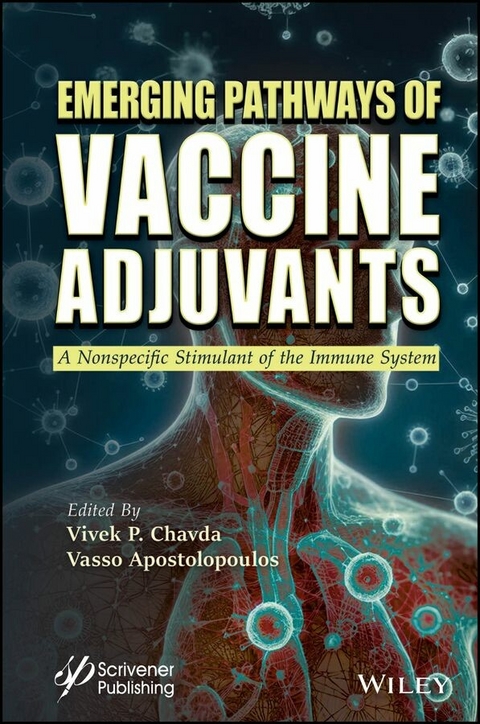
Emerging Pathways of Vaccine Adjuvants (eBook)
403 Seiten
Wiley-Scrivener (Verlag)
978-1-394-23763-0 (ISBN)
The book presents invaluable insights into the latest advancements, challenges, and research on vaccine adjuvants, which are key to developing more effective and safer vaccines essential for tackling pressing global health challenges.
Emerging Pathways of Vaccine Adjuvants: A Nonspecific Stimulant of the Immune System aims to drive progress in vaccine research, paving the way for the development of more potent and safer vaccines to address global health threats. This volume provides a comprehensive overview of the evolving landscape of vaccine adjuvants, encompassing a wide range of topics critical to their design, development, and application. Adjuvants play a crucial role in vaccine formulations by boosting the immunogenicity of antigens, thereby enhancing vaccine efficacy. While antigens can initiate immune responses independently, adjuvants amplify these responses. Extensive research efforts are focused on the formulation of adjuvants to establish accurate, efficient, and safe manufacturing techniques. This book provides a clear explanation of the strict regulatory issues, making it an essential resource for students, businesspeople, and academics across the globe.
Readers will find the book:
- Encompasses current adjuvant usage and possible tactics to ensure effective production and delivery of the active constituent;
- Presents challenges and innovations with implications to provide cheaper, more efficient solutions in the industry;
- Prepares students for work in the industry, refining their skills for the production of critical medications.
Audience
Researchers and pharmacy students in biomedical engineering and chemical engineering, biotechnology, as well as pharmaceutical and biopharmaceutical industry engineers working in drug discovery, chemical biology, computational chemistry, medicinal chemistry, and bioinformatics.
Vivek P. Chavda is an assistant professor in the Department of Pharmaceutics and Pharmaceutical Technology, L.M. College of Pharmacy, Gujarat, India with over eight years of teaching and biologics industry experience. He has more than 200 national and international publications, four edited books, an authored book, and 28 book chapters and is working on three patents. His research interests include the development of biologics processes and formulations, medical device development, nanodiagnostics and non-carrier formulations, long-acting parenteral formulations, and nanovaccines.
Vasso Apostolopoulos, PhD, is a Vice-Chancellor Distinguished Fellow and Director of the Immunology and Translational Research Group at Victoria University, Australia and the Immunology Program Director at the Australian Institute for Musculoskeletal Science, Australia. She is a world-renowned researcher with over 100 awards, 510 research publications, and 22 patents to her credit. Her interests include vaccine and drug development for cancer, chronic, infectious, and autoimmune diseases.
The book presents invaluable insights into the latest advancements, challenges, and research on vaccine adjuvants, which are key to developing more effective and safer vaccines essential for tackling pressing global health challenges. Emerging Pathways of Vaccine Adjuvants: A Nonspecific Stimulant of the Immune System aims to drive progress in vaccine research, paving the way for the development of more potent and safer vaccines to address global health threats. This volume provides a comprehensive overview of the evolving landscape of vaccine adjuvants, encompassing a wide range of topics critical to their design, development, and application. Adjuvants play a crucial role in vaccine formulations by boosting the immunogenicity of antigens, thereby enhancing vaccine efficacy. While antigens can initiate immune responses independently, adjuvants amplify these responses. Extensive research efforts are focused on the formulation of adjuvants to establish accurate, efficient, and safe manufacturing techniques. This book provides a clear explanation of the strict regulatory issues, making it an essential resource for students, businesspeople, and academics across the globe. Readers will find the book: Encompasses current adjuvant usage and possible tactics to ensure effective production and delivery of the active constituent; Presents challenges and innovations with implications to provide cheaper, more efficient solutions in the industry; Prepares students for work in the industry, refining their skills for the production of critical medications. Audience Researchers and pharmacy students in biomedical engineering and chemical engineering, biotechnology, as well as pharmaceutical and biopharmaceutical industry engineers working in drug discovery, chemical biology, computational chemistry, medicinal chemistry, and bioinformatics.
1
Adjuvants Boosting Vaccine Effectiveness
Vasso Apostolopoulos
School of Health and Biomedical Sciences, RMIT University, Melbourne VIC, Australia
Abstract
Vaccine development has evolved significantly with the identification and isolation of specific antigens, leading to subunit vaccines. Adjuvants, crucial in modern vaccine design, enhance antigen immunogenicity, allowing for more effective vaccines that stimulate both humoral and cell-mediated immunity. Conventional adjuvants, including aluminum salts, SAF-1, QS-21, and squalene-based adjuvants such as MF59 and AS03, play pivotal roles in enhancing vaccine efficacy. Particulate adjuvants, including liposomes, immunostimulatory complexes, and emulsions like MF59 and AS03, offer improved antigen stability and targeted delivery. Additionally, immunostimulatory adjuvants like Toll-like receptor agonists, monophosphoryl lipid A, cytokines, and CpG oligodeoxynucleotides directly activate immune responses. Approved adjuvants, AS01, AS03, AS04, MF59, Matrix-M, and virosomes are key adjuvants in approved human vaccines, enhancing immune responses and vaccine efficacy. Despite advancements, ongoing research is required to optimize adjuvant safety and efficacy in order to develop safer and more effective vaccines against infectious diseases and cancers.
Keywords: Adjuvants, vaccination, AS01, MF59, Matrix-M, virosomes, SAF-1, QS-21
1.1 Vaccines Over the Years
The history of vaccination spans over a millennium, with early attempts to prevent infectious diseases dating back to 1000 A.D. in China, where smallpox vesicles were used for inoculation. Edward Jenner’s work in the late 1700s marked a significant advancement when he observed that individuals who had contracted cowpox were protected against smallpox. By 1796, Jenner successfully immunized a young boy with cowpox, confirming protection against smallpox. Louis Pasteur furthered the field by demonstrating the use of attenuated pathogens as vaccines in the late 19th century. He attenuated Pasteurella septica to develop a vaccine against fowl cholera and later applied a similar approach to Bacillus anthrax, achieving remarkable success in protecting farm animals. Additionally, Pasteur’s work with rabies marked a significant milestone in the development of live virus vaccines. In the realm of dead organism vaccines, the Salk vaccine against poliomyelitis, developed in 1960, had a profound impact on disease incidence before being succeeded by the Sabin vaccine. Challenges persisted in producing killed vaccines due to potential destruction of important antigenic components.
The identification and isolation of specific antigens responsible for protection paved the way for “subunit” and “extract” vaccines. For instance, diphtheria and tetanus toxoids were purified and inactivated using formalin, retaining their antigenicity but reducing adverse reactions. Despite these advancements, the history of vaccine development is not without setbacks. Disasters such as the Lubeck Disaster in 1932, where infants were mistakenly given Mycobacterium tuberculosis instead of BCG vaccine, and the Cutter Disaster in 1955, where a faulty polio vaccine led to cases of poliomyelitis, highlighted the need for stringent quality control and safety measures. As public awareness and standards for vaccine safety have increased, modern vaccinology has embraced advancements in genetics, chemistry, peptide synthesis, protein production methods, DNA, mRNA, x-ray crystal structures, molecular biology, and immunology, allowing for the development of safer and more efficient vaccines [1]. However, there are still many obstacles for their clinical use, and the limited immunogenicity of many of these candidates has hindered their development as potential vaccines. Strategies to enhance the immunogenicity of candidate vaccines are therefore critical. As such, adjuvants have been developed to enhance immunogenicity of vaccines, aiming to overcome their limited efficacy. These advancements are critical for optimizing the clinical potential of novel vaccine candidates.
1.2 Adjuvants in the Modern Era
Adjuvants play a pivotal role in modern vaccine development, enhancing the immune response to antigens and thereby improving vaccine efficacy [2–4]. While antigens alone can stimulate the immune system to some extent, adjuvants amplify this response, making vaccines more effective at inducing both humoral and cell-mediated immunity. This is particularly crucial for subunit vaccines, which consist of purified antigens and often require adjuvants to boost their immunogenicity. Additionally, adjuvants can help reduce the amount of antigen needed per dose, which is beneficial for both vaccine production and delivery. Adjuvants enable the use of novel vaccine technologies, such as synthetic peptides and recombinant proteins, which may otherwise lack sufficient immunogenicity to elicit a protective immune response [5]. Despite their importance, the development and use of adjuvants in human vaccines have been limited by safety concerns, requiring the need for rigorous testing and evaluation. As the area of vaccine development continues to advance, the discovery and optimization of safe and effective adjuvants remain a critical area of research, holding the potential to revolutionize vaccine design and contribute to global health by combating infectious diseases more effectively [6].
1.3 Conventional Adjuvants
Adjuvants play a crucial role in enhancing antigen immunogenicity, amplifying both humoral and cell-mediated immune responses. A widely used adjuvant in experimental animals is complete Freund’s adjuvant (CFA), a water-in-oil emulsion containing killed M. tuberculosis. Despite its effectiveness and long sustained immune responses, CFA is not suitable for human use due to its propensity to induce granulomas, fever, and inflammation. Incomplete Freund’s adjuvant, which lacks the mycobacterial component, has been evaluated, which does not induce granulomas and is safer than CFA, but it is still not approved for human vaccines due to other safety concerns. However, aluminum salts approved for human use in the 1930s, being either as aluminum hydroxide or aluminum phosphate, are the most widely used adjuvants in human vaccines. They enhance the immune response by forming a depot at the injection site, facilitating antigen uptake by antigen-presenting cells and stimulating cytokine secretion [7–9]. Alum primarily stimulates humoral immune responses and is used in vaccines against diphtheria, tetanus, and hepatitis B. However, aluminum-based adjuvants primarily stimulate humoral immune responses and are limited in cell-mediated immune stimulation (Figure 1.1). Emerging conventional adjuvants include the following:
- SAF-1: Comprising squalene oil, threonyl-MDP, and non-ionic block polymers, SAF-1’s block polymers act as adhesive molecules, enhancing antigen presentation and have been used in malaria and influenza vaccine studies [10–12].
Figure 1.1 A timeline of vaccine adjuvant development over the last 100 years and used in humans.
Figure adapted by content experts Iwasaki, A., Lee, J-H. and Omer, S.B at Biorender.com as Figure 1.1 in https://www.cell.com/cell/pdf/S0092-8674(20)31327-X.pdf
- QS-21: QS-21 is a potent vaccine adjuvant sourced by extraction from the Chilean soapbark tree (Quillaja saponaria ). QS-21 exhibits freeze-thaw stability and has shown promise as an adjuvant for inducing specific CD8+ T-cell responses and exhibits minimal toxicity [13]. Quil A is also derived from Quillaja saponaria tree.
- Monophosphoryl Lipid A: A derivative of lipopolysaccharide has been used as an adjuvant in vaccines to enhance antibody and T-cell immune response to antigens. Monophosphoryl lipid A binds to Toll-like receptor 4 (TLR4) on antigenpresenting cells stimulating pro-inflammatory cytokines, maturation, and activation of antigen-presenting cells [14, 15]. AS04 is the best known formulation, which incorporates both monophosphoryl lipid A and aluminum hydroxide.
- Ribi Formulation: Incorporating mycobacterial cell walls and monophosphoryl lipid A, this formulation has demonstrated superior antibody titers and both humoral and cellular immune responses compared to aluminum hydroxide adjuvants [14, 16, 17].
- Squalene-Based Adjuvants: MF59 by Novartis approved in 1997 and AS03 by GlaxoSmithKline approved in 2013 are oil-in-water emulsions containing squalene, a naturally occurring lipid. MF59 and AS03 adjuvants enhance antigen uptake by antigen-presenting cells and stimulate immune cells at the injection site, resulting in activation of both humoral and cell-mediated immune responses. MF59 is used in seasonal influenza vaccines for older adults, whereas AS03 is used in some pre-pandemic (H5N1) and pandemic influenza vaccines [5, 18–20].
- Bacterial Toxoids: Toxoids, such as detoxified forms of tetanus and diphtheria toxins, can serve as adjuvants when co-administered with antigens [21]. They provide T cell help and can enhance the immune response to the co-administered antigen as were shown to be effective in anti-cancer peptide based vaccines [22–27].
- Mineral Salts: Besides aluminum salts, other mineral salts like calcium phosphate and calcium carbonate have been used as...
| Erscheint lt. Verlag | 23.4.2025 |
|---|---|
| Sprache | englisch |
| Themenwelt | Naturwissenschaften ► Chemie |
| ISBN-10 | 1-394-23763-4 / 1394237634 |
| ISBN-13 | 978-1-394-23763-0 / 9781394237630 |
| Informationen gemäß Produktsicherheitsverordnung (GPSR) | |
| Haben Sie eine Frage zum Produkt? |
 EPUB (Adobe DRM)
Kopierschutz: Adobe-DRM
Adobe-DRM ist ein Kopierschutz, der das eBook vor Mißbrauch schützen soll. Dabei wird das eBook bereits beim Download auf Ihre persönliche Adobe-ID autorisiert. Lesen können Sie das eBook dann nur auf den Geräten, welche ebenfalls auf Ihre Adobe-ID registriert sind.
Details zum Adobe-DRM
Dateiformat: EPUB (Electronic Publication)
EPUB ist ein offener Standard für eBooks und eignet sich besonders zur Darstellung von Belletristik und Sachbüchern. Der Fließtext wird dynamisch an die Display- und Schriftgröße angepasst. Auch für mobile Lesegeräte ist EPUB daher gut geeignet.
Systemvoraussetzungen:
PC/Mac: Mit einem PC oder Mac können Sie dieses eBook lesen. Sie benötigen eine
eReader: Dieses eBook kann mit (fast) allen eBook-Readern gelesen werden. Mit dem amazon-Kindle ist es aber nicht kompatibel.
Smartphone/Tablet: Egal ob Apple oder Android, dieses eBook können Sie lesen. Sie benötigen eine
Geräteliste und zusätzliche Hinweise
Buying eBooks from abroad
For tax law reasons we can sell eBooks just within Germany and Switzerland. Regrettably we cannot fulfill eBook-orders from other countries.
aus dem Bereich