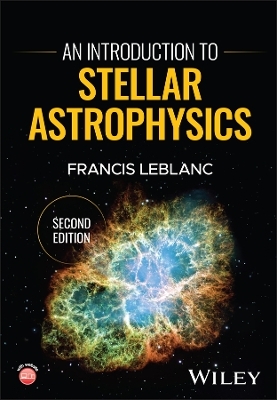
An Introduction to Stellar Astrophysics
John Wiley & Sons Inc (Verlag)
978-1-394-25179-7 (ISBN)
An Introduction to Stellar Astrophysics is a concise textbook containing core content on and detailed examples of stellar physics and stellar astronomy. This new edition is revised and expanded and contains updated and new material on nearest and brightest stars, binary stars, Wolf Rayet stars and blue horizontal-branch stars, stellar evolution modeling and gravitational waves.
The book is divided in seven chapters: basic concepts, stellar formation, radiative transfer in stars, stellar atmospheres, stellar interiors, nucleosynthesis and stellar evolution, and chemically peculiar stars and diffusion. Student-friendly features include detailed examples, exercises with selected solutions, brief recalls of the most important physical concepts, chapter summaries, and optional and advanced sections that can be skipped on first reading.
A large number of graphs and figures are included to better explain the concepts covered. Only essential astronomical data are given, and the amount of observational results shown is deliberately limited in scope.
An Introduction to Stellar Astrophysics includes information on:
The electromagnetic spectrum, blackbody radiation, luminosity, effective temperature, the Boltzmann and Saha equations, and the Hertzsprung-Russell diagram
Hydrostatic equilibrium, the Virial theorem, the Jeans criteria, free-fall times, and pre-main-sequence evolution
Radiative opacities, specific intensity and radiative moments, local thermodynamic equilibrium, radiative transfer and stellar atmospheres
Energy transport in stars, polytropic models, stellar evolution, advanced nuclear burning, stellar remnants, and novae and supernovae
Diffusion theory, radiative accelerations, and other transport processes
New to this edition: sections on nearest and brightest stars, binary stars, the Eddington limit and stellar evolution modeling as well as several new special topics and additional exercises
Delivering intermediate knowledge on stars in a concise format, An Introduction to Stellar Astrophysics is an excellent textbook on the subject for advanced undergraduate and graduate students studying physics and astrophysics.
Francis LeBlanc, PhD, is Professor in the Department of Physics and Astronomy of Université de Moncton (Canada). His fields of expertise are diffusion in stars, chemically peculiar stars, and stellar atmospheres. Professor LeBlanc has taught several undergraduate courses on general astronomy, astrophysics and space sciences, and modern physics and nuclear physics, as well as a graduate course on stellar astrophysics. He has been invited to present talks and as an invited professor or researcher at several universities.
Preface ix
Acknowledgments xi
About the Companion Website xii
1 Basic Concepts 1
1.1 Introduction 1
1.2 The Electromagnetic Spectrum 3
1.3 Blackbody Radiation 5
1.4 Luminosity, Effective Temperature, Flux, and Magnitudes 8
1.5 Boltzmann and Saha Equations 13
1.6 Spectral Classification of Stars 21
1.7 The Hertzsprung–Russell Diagram 26
1.8 Nearest and Brightest Stars 30
1.9 Summary 33
1.10 Exercises 34
2 Stellar Formation 37
2.1 Introduction 37
2.2 Hydrostatic Equilibrium 38
2.3 The Virial Theorem 42
2.4 The Jeans Criterion 47
2.5 Free-Fall Times† 54
2.6 Pre-Main-Sequence Evolution† 56
2.7 Summary 59
2.8 Exercises 59
3 Radiative Transfer in Stars 63
3.1 Introduction 63
3.2 Radiative Opacities 64
3.3 Specific Intensity and Radiative Moments 72
3.4 Radiative Transfer Equation 79
3.5 Local Thermodynamic Equilibrium 83
3.6 Solution of the Radiative-Transfer Equation 84
3.7 Radiative Equilibrium 91
3.8 Radiative Transfer at Large Optical Depths 93
3.9 Rosseland and Other Mean Opacities 95
3.10 Schwarzschild–Milne Equations†† 98
3.11 Demonstration of the Radiative-Transfer Equation† 100
3.12 Radiative Acceleration of Matter and Radiative Pressure† 101
3.13 Summary 105
3.14 Exercises 106
4 Stellar Atmospheres 109
4.1 Introduction 109
4.2 The Gray Atmosphere 110
4.3 Line Opacities and Broadening 118
4.4 Equivalent Width and Formation of Atomic Lines 135
4.5 Atmospheric Modeling 141
4.6 Types of Binary Stars† 149
4.7 Summary 150
4.8 Exercises 151
5 Stellar Interiors 153
5.1 Introduction 153
5.2 Equations of Stellar Structure 154
5.3 Energy Transport in Stars 161
5.4 Polytropic Models 173
5.5 Structure of the Sun 178
5.6 Equation of State 180
5.7 The Eddington Limit 187
5.8 Variable Stars and Asteroseismology 188
5.9 Summary 199
5.10 Exercises 200
6 Nucleosynthesis and Stellar Evolution 203
6.1 Introduction 203
6.2 Generalities Concerning Nuclear Fusion 204
6.3 Models of the Nucleus† 209
6.4 Basic Physics of Nuclear Fusion 214
6.5 Main-Sequence Burning 216
6.6 Helium-Burning Phase 228
6.7 Advanced Nuclear Burning 230
6.8 Evolutionary Tracks in the H–R Diagram 234
6.9 Stellar Evolution Modeling† 247
6.10 Stellar Clusters 249
6.11 Stellar Remnants 257
6.12 Novae and Supernovae† 270
6.13 Heavy Element Nucleosynthesis: s, r, and p Processes† 276
6.14 Nuclear Reaction Cross Sections and Rates†† 279
6.15 Summary 283
6.16 Exercises 283
7 Chemically Peculiar Stars and Diffusion† 287
7.1 Introduction and Historical Background 287
7.2 Chemically Peculiar Stars 289
7.3 Atomic Diffusion Theory†† 292
7.4 Radiative Accelerations†† 299
7.5 Other Transport Mechanisms†† 305
7.6 Summary 308
7.7 Exercises 308
Answers to Selected Exercises 309
Appendix A: Physical Constants 311
Appendix B: Units in the cgs and SI Systems 313
Appendix C: Astronomical Constants 315
Appendix D: Ionization Energies (in eV) for the First Five Stages of Ionization for the Most Important Elements 317
Appendix E: Solar Abundances for the Most Important Elements 319
Appendix F: Atomic Masses 321
Appendix G: Physical Parameters for Main-Sequence Stars 323
Appendix H: Periodic Table of the Elements 325
References 327
Bibliography 329
Index 333
| Erscheinungsdatum | 06.12.2025 |
|---|---|
| Verlagsort | New York |
| Sprache | englisch |
| Maße | 173 x 244 mm |
| Gewicht | 658 g |
| Themenwelt | Naturwissenschaften ► Physik / Astronomie ► Astronomie / Astrophysik |
| ISBN-10 | 1-394-25179-3 / 1394251793 |
| ISBN-13 | 978-1-394-25179-7 / 9781394251797 |
| Zustand | Neuware |
| Informationen gemäß Produktsicherheitsverordnung (GPSR) | |
| Haben Sie eine Frage zum Produkt? |
aus dem Bereich