


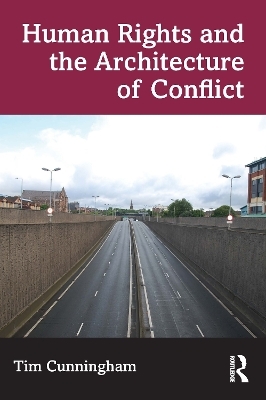
Human Rights and the Architecture of Conflict
Seiten
2025
Routledge (Verlag)
978-1-032-07545-7 (ISBN)
Routledge (Verlag)
978-1-032-07545-7 (ISBN)
Human Rights and the Architecture of Conflict exposes real estate developers’ role in entrenching ethnic and political divisions from Baltimore to Belfast and beyond.
Human Rights and the Architecture of Conflict exposes how governments, public officials and private actors on both sides of the Atlantic entrenched racial and ethnic divisions through manipulation of the planning and design of the built environment.
Based on interviews, never-before-seen documents, and field work carried out in Belfast,Chicago, Miami, Washington D.C., and New York City, this book shows how the planning and design of our built environment impacts the physical, mental, social, economic, political, and environmental well-being of communities. Tim Cunningham, an urban scholar and human rights advocate, reveals how the British Army set about reconfiguring the urban fabric of Belfast as part of a counter-insurgency strategy in the 1970s. His research shows how the techniques used in Northern Ireland during this period mirror earlier processes deployed in U.S. cities under urban renewal and the Interstate Highway Program. A global genealogy of segregation, that examines the trajectory of colonial urbanism in the twentieth century, the text highlights the real-life walls and barriers that cleave communities along ethnic and racial lines and the role of architects, planners, developers, and public officials in erecting them. The final chapter considers some contemporary efforts to address the legacy of these practices through restorative architecture and planning initiatives that aim to deliver more cohesive, sustainable, and inclusive urban spaces.
This book is ideal reading for courses in architecture, city planning, community development, geography, human rights, sociology, transitional justice, urban studies, and Irish history.
Human Rights and the Architecture of Conflict exposes how governments, public officials and private actors on both sides of the Atlantic entrenched racial and ethnic divisions through manipulation of the planning and design of the built environment.
Based on interviews, never-before-seen documents, and field work carried out in Belfast,Chicago, Miami, Washington D.C., and New York City, this book shows how the planning and design of our built environment impacts the physical, mental, social, economic, political, and environmental well-being of communities. Tim Cunningham, an urban scholar and human rights advocate, reveals how the British Army set about reconfiguring the urban fabric of Belfast as part of a counter-insurgency strategy in the 1970s. His research shows how the techniques used in Northern Ireland during this period mirror earlier processes deployed in U.S. cities under urban renewal and the Interstate Highway Program. A global genealogy of segregation, that examines the trajectory of colonial urbanism in the twentieth century, the text highlights the real-life walls and barriers that cleave communities along ethnic and racial lines and the role of architects, planners, developers, and public officials in erecting them. The final chapter considers some contemporary efforts to address the legacy of these practices through restorative architecture and planning initiatives that aim to deliver more cohesive, sustainable, and inclusive urban spaces.
This book is ideal reading for courses in architecture, city planning, community development, geography, human rights, sociology, transitional justice, urban studies, and Irish history.
After nearly two decades as a human rights advocate and researcher, Tim Cunningham earned a PhD from Ulster University’s Transitional Justice Institute. He has held senior positions at non-governmental organizations and as a member of government bodies. As a member of Northern Ireland’s Historic Monuments Council, he advised the government on preservation issues.
1. The Architecture of Inequality. 2. The Origins of Urban Segregation. 3. Modernist Planning: A Road to Wreck and Ruin. 4. The Legacy of Coercive Architecture and Planning in Belfast. Case Study: The Redevelopment of the Crumlin Road Gaol & Girdwood Barracks. 5. The Legacy of Coercive Architecture in the U.S. 6. Restorative Architecture and the Politics of Reparations.
| Erscheinungsdatum | 16.08.2025 |
|---|---|
| Zusatzinfo | 47 Halftones, black and white; 47 Illustrations, black and white |
| Verlagsort | London |
| Sprache | englisch |
| Maße | 156 x 234 mm |
| Gewicht | 555 g |
| Themenwelt | Naturwissenschaften ► Geowissenschaften ► Geografie / Kartografie |
| Technik ► Architektur | |
| Wirtschaft ► Betriebswirtschaft / Management ► Rechnungswesen / Bilanzen | |
| Betriebswirtschaft / Management ► Spezielle Betriebswirtschaftslehre ► Immobilienwirtschaft | |
| ISBN-10 | 1-032-07545-7 / 1032075457 |
| ISBN-13 | 978-1-032-07545-7 / 9781032075457 |
| Zustand | Neuware |
| Informationen gemäß Produktsicherheitsverordnung (GPSR) | |
| Haben Sie eine Frage zum Produkt? |
Mehr entdecken
aus dem Bereich

aus dem Bereich
Erfolgsstrategien für den modernen Immobilienmarkt
Buch | Softcover (2024)
ForwardVerlag
CHF 21,90
Handbuch für Studium und Praxis
Buch | Hardcover (2023)
Vahlen (Verlag)
CHF 109,95
Grundlagenwissen für die Planungs-, Bau- und Nutzungsphase sowie …
Buch | Softcover (2023)
Springer Vieweg (Verlag)
CHF 27,95


