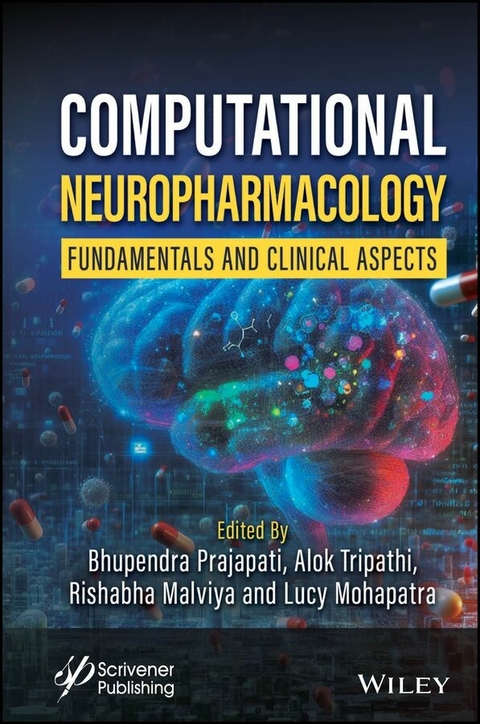
Computational Neuropharmacology (eBook)
512 Seiten
Wiley-Scrivener (Verlag)
978-1-394-24246-7 (ISBN)
The book gives comprehensive insights into the cutting-edge intersection of computational methods and neuropharmacology, making it an essential resource for understanding and advancing medication for neurological and psychiatric disorders.
Computational Neuropharmacology is an in-depth exploration of the convergence of computational methods with neuropharmacology, a science concerned with understanding pharmacological effects on the nervous system. This volume explores the most recent breakthroughs and potential advances in computational neuropharmacology, providing an extensive overview of the computational tools that are transforming medication discovery and development for neurological and psychiatric illnesses. Fundamental principles of computational neuropharmacology, descriptions of molecular-level interactions and their consequences for modern neuropharmacology, and an introduction to theoretical neuroscience are highlighted throughout this resource. Additionally, this study addresses computational attitudes in counseling psychology to improve therapeutic procedures through data-driven insights. Computational psychiatry uses computational technologies to bridge the gap between the molecular basis and clinical symptoms of psychiatric diseases.
This volume covers computational approaches to drug discovery in neurohumoral transmission and signal transduction, Parkinson's disease, epilepsy, and Alzheimer's disease, and the use of molecular docking and machine learning in drug development for neurological disorders. It also discusses the use of computational methods to uncover potential treatments for autism spectrum disorder, depression, and anxiety.
Audience
This book is a valuable resource for computer scientists, engineers, researchers, clinicians, and students, providing a detailed understanding of the computational tools that are changing the developing field of neuropharmacology, leading the future of medication discovery and development for neurological and psychiatric illnesses by combining modern computational approaches with neuropharmacological research.
Bhupendra Prajapati, PhD, is a professor in the Department of Pharmaceutics, Shree S.K. Patel College of Pharmaceutical Education and Research, Ganpat University, Gujarat, India, with over 20 years of research and teaching experience. He has published over 100 research and review papers in national and international journals and 20 book chapters, edited three books, and serves as an editor and reviewer of several journals. In addition to this work, he has published two Indian patents and has three applications under evaluation.
Alok Tripathi, PhD, is a professor and the Head of the Department of Pharmacology, Era College of Pharmacy, Era University, Gujarat, India, with over 14 years of teaching and research experience. He has published 40 research papers in various national and international journals, five book chapters, and one book and serves as a reviewer and editorial board member for several international journals. His research focuses on diabetes and its complications, drug interaction, and neurodegenerative disorders.
Rishabha Malviya, PhD, is an associate professor in the Department of Pharmacy, School of Medical and Allied Sciences, Galgotias University, India, with over 12 years of research and teaching experience. He has published 28 books and over 150 research papers in national and international journals and has been granted 10 patents, with an additional 40 under review. His research interests include formulation optimization, nanoformulation, targeted drug delivery, artificial intelligence in healthcare, and characterization of natural polymers as pharmaceutical excipients.
Lucy Mohapatra, PhD, is an assistant professor in the Department of Pharmacology, Amity Institute of Pharmacy, Amity University Uttar Pradesh, India, with eight years of teaching and research experience. She has published over 17 research papers in various national and international journals, five book chapters, and four patents and serves as a reviewer and editorial board member for several journals. Her research interests include metabolic disorders, mitochondrial disorders, pharmacology, and pathophysiology.
The book gives comprehensive insights into the cutting-edge intersection of computational methods and neuropharmacology, making it an essential resource for understanding and advancing medication for neurological and psychiatric disorders. Computational Neuropharmacology is an in-depth exploration of the convergence of computational methods with neuropharmacology, a science concerned with understanding pharmacological effects on the nervous system. This volume explores the most recent breakthroughs and potential advances in computational neuropharmacology, providing an extensive overview of the computational tools that are transforming medication discovery and development for neurological and psychiatric illnesses. Fundamental principles of computational neuropharmacology, descriptions of molecular-level interactions and their consequences for modern neuropharmacology, and an introduction to theoretical neuroscience are highlighted throughout this resource. Additionally, this study addresses computational attitudes in counseling psychology to improve therapeutic procedures through data-driven insights. Computational psychiatry uses computational technologies to bridge the gap between the molecular basis and clinical symptoms of psychiatric diseases. This volume covers computational approaches to drug discovery in neurohumoral transmission and signal transduction, Parkinson s disease, epilepsy, and Alzheimer s disease, and the use of molecular docking and machine learning in drug development for neurological disorders. It also discusses the use of computational methods to uncover potential treatments for autism spectrum disorder, depression, and anxiety. Audience This book is a valuable resource for computer scientists, engineers, researchers, clinicians, and students, providing a detailed understanding of the computational tools that are changing the developing field of neuropharmacology, leading the future of medication discovery and development for neurological and psychiatric illnesses by combining modern computational approaches with neuropharmacological research.
| Erscheint lt. Verlag | 14.4.2025 |
|---|---|
| Sprache | englisch |
| Themenwelt | Naturwissenschaften ► Chemie |
| ISBN-10 | 1-394-24246-8 / 1394242468 |
| ISBN-13 | 978-1-394-24246-7 / 9781394242467 |
| Informationen gemäß Produktsicherheitsverordnung (GPSR) | |
| Haben Sie eine Frage zum Produkt? |
 PDF (Adobe DRM)
Kopierschutz: Adobe-DRM
Adobe-DRM ist ein Kopierschutz, der das eBook vor Mißbrauch schützen soll. Dabei wird das eBook bereits beim Download auf Ihre persönliche Adobe-ID autorisiert. Lesen können Sie das eBook dann nur auf den Geräten, welche ebenfalls auf Ihre Adobe-ID registriert sind.
Details zum Adobe-DRM
Dateiformat: PDF (Portable Document Format)
Mit einem festen Seitenlayout eignet sich die PDF besonders für Fachbücher mit Spalten, Tabellen und Abbildungen. Eine PDF kann auf fast allen Geräten angezeigt werden, ist aber für kleine Displays (Smartphone, eReader) nur eingeschränkt geeignet.
Systemvoraussetzungen:
PC/Mac: Mit einem PC oder Mac können Sie dieses eBook lesen. Sie benötigen eine
eReader: Dieses eBook kann mit (fast) allen eBook-Readern gelesen werden. Mit dem amazon-Kindle ist es aber nicht kompatibel.
Smartphone/Tablet: Egal ob Apple oder Android, dieses eBook können Sie lesen. Sie benötigen eine
Geräteliste und zusätzliche Hinweise
Buying eBooks from abroad
For tax law reasons we can sell eBooks just within Germany and Switzerland. Regrettably we cannot fulfill eBook-orders from other countries.
aus dem Bereich