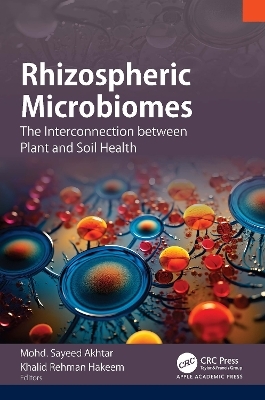
Rhizospheric Microbiomes
Apple Academic Press Inc. (Verlag)
978-1-77491-999-6 (ISBN)
The rhizosphere, the zone of chemical, biological, and physical influence generated by root growth and
activity, offers a favorable ecological environment for a wide variety of microorganisms and is renowned
for its high level of microbial activity. This book explores how taking advantage of the diversity and
benefits of rhizospheric microbiomes in soil and environment management can enhance soil quality and
stimulate the production of defense-related compounds in various pathosystems, resulting in better plant
health. It presents an array of advancements in rhizosphere science that involve soil management, hostpathogen
interactions, nutrient mobilization, bioremediation, mechanisms and modes of action of
signaling molecules, molecular aspects of microbial interactions, and bioformulation strategies, among
others. The volume consolidates comprehensive information on the advanced and applied aspects of
microbial consortia and their role in promoting plant fitness, soil management, nutrient mobilization,
bioremediation, and environmental health.
Mohd. Sayeed Akhtar, PhD, is a Senior Assistant Professor at Gandhi Faiz-e-Aam College, Shahjahanpur, U.P., India. He received his PhD degree from Aligarh Muslim University, Aligarh, India, prior to conducting postdoctoral research at the Botanical Institute, University of Basel, Switzerland, and Chonbuk National University, Republic of Korea. He was formerly an Assistant Professor at Jimma University in Ethiopia and research fellow at the Universiti Putra Malaysia’s (UPM) Institute of Tropical Agriculture. He has been listed among the top 2% of scientists in the world consecutively from past three years, according to Stanford University in the United States. Dr. Akhtar is the author and co-author of more than 150 articles in peer-reviewed journals, conference proceedings, and book chapters, and has edited over 20 books. He has received many awards and honors for his work. A member and fellow of many prestigious organizations, he is also an editorial board member and reviewer for several international journals. His current work focuses on the molecular biotechnology, bioremediation, biomineralization, nanofertilizers, and nanobiotechnology of rhizospheric plant-microbe interactions. Khalid Rehman Hakeem, PhD, is a Professor at King Abdulaziz University, Jeddah, Saudi Arabia. After completing his doctorate (botany, specialization in plant eco-physiology and molecular biology) at Jamia Hamdard, New Delhi, India, he worked as a lecturer at the University of Kashmir, India, and at Universiti Putra Malaysia, Selangor, where he was a postdoctoral fellow researcher for several years. Dr. Hakeem has more than 15 years of teaching and research experience in plant ecophysiology, biotechnology and molecular biology, medicinal plant research, plant-microbe-soil interactions, as well as in environmental studies. He is the recipient of several fellowships at both national and international levels. He has served as a visiting scientist at Jinan University, Guangzhou, China. To date, Dr. Hakeem has authored and edited many books and has published many research publications in international journals and 55 book chapters in edited volumes. He is on the advisory board of Cambridge Scholars Publishing, UK, and is also a fellow of the Plantae Group of the American Society of Plant Biologists.
1. Diversity and Benefits of Rhizospheric Microbiomes in Soil and Environment Management. 2. Role of Rhizospheric Microbes in Soil Management. 3. Challenges for Microbial Consortia in Improving Plant Health. 4. Use of Rhizospheric Microbiomes Toward Nutrient Acquisitions and Soil Sustainability. 5. Utilization of Molecular Techniques for the Development of an Effective Microbial Consortium: Challenges and Applications. 6. Use of Bioreactors in the Propagation of Microbial Consortia. 7. Heavy Metal Tolerance Ability of Microbial Consortia. 8. Signal Transduction and Plant Health via Microbial Consortia. 9. Application and Utility of Microbial Consortia.
| Erscheinungsdatum | 17.04.2025 |
|---|---|
| Zusatzinfo | 18 Tables, black and white; 10 Line drawings, color; 13 Line drawings, black and white; 1 Halftones, color; 8 Halftones, black and white; 11 Illustrations, color; 21 Illustrations, black and white |
| Verlagsort | Oakville |
| Sprache | englisch |
| Maße | 152 x 229 mm |
| Gewicht | 760 g |
| Themenwelt | Naturwissenschaften ► Biologie ► Botanik |
| Naturwissenschaften ► Biologie ► Genetik / Molekularbiologie | |
| ISBN-10 | 1-77491-999-0 / 1774919990 |
| ISBN-13 | 978-1-77491-999-6 / 9781774919996 |
| Zustand | Neuware |
| Informationen gemäß Produktsicherheitsverordnung (GPSR) | |
| Haben Sie eine Frage zum Produkt? |
aus dem Bereich