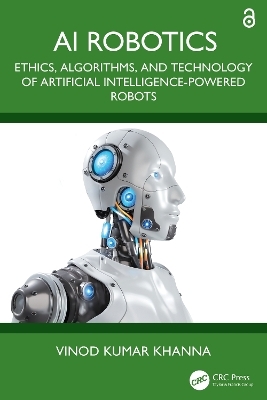
AI Robotics
CRC Press (Verlag)
978-1-032-69519-8 (ISBN)
Artificial intelligence (AI) robots can learn from their experiences, make decisions in real time, understand natural language and human gestures, and utilize computer vision to perceive and comprehend their environments. Beginning with the rudimentary concepts of AI, AI Robotics: Ethics, Algorithms, and Technology of Artificial Intelligence-Powered Robots explores the intersection of robotics and physics and emphasizes the need for strict adherence to ethical principles in relation to overall progress and the development of humankind. Chapters on robots capable of talking, listening, and visual perception similar to human beings are followed by discussions of those that display emotional intelligence. This book also discusses task and motion planning, a set of methods that help robot hardware achieve high-level goals by breaking down tasks into smaller, more manageable steps. Lastly, the text describes autonomous robots that can make independent decisions and execute tasks on their own, utilizing sensors and AI-enabled software programmed with predefined guidelines and data. Examples of autonomous robots are presented in a chapter on robot swarms that operate in a decentralized, self-organizing manner through local communication to manage disaster relief, search-and-rescue operations, warehouse logistics, agricultural practices, and environmental exploration. Offering an up-to-date, expansive, and comprehensive treatment of the vast interdisciplinary field of AI robotics, this book will be an invaluable resource for postgraduate and doctorate students as well as academic researchers and professional engineers working on AI-enabled robotics.
The Open Access version of this book, available at https://www.taylorfrancis.com, has been made available under a Creative Commons Attribution-Non Commercial-No Derivatives (CC-BY-NC-ND) 4.0 license.
Key Features
Explores the research frontiers and advancements leveraged by integrating AI with robotics
Highlights the unique challenges faced in robot vision and speech recognition vis-à-vis computer vision and standard speech processing
Provides a state-of-the-art overview of emotional recognition, task and motion planning, and coordinated functioning of robots in multi-robot systems
Vinod Kumar Khanna is an independent researcher from Chandigarh, India. He is a retired Chief Scientist from the Council of Scientific and Industrial Research (CSIR) – Central Electronics Engineering Research Institute (CEERI), Pilani, India, and a retired Professor from the Academy of Scientific and Innovative Research (AcSIR), Ghaziabad, India. He is a former Emeritus Scientist, CSIR, and Professor Emeritus, AcSIR, India. His broad areas of research include the design, fabrication, and characterization of power semiconductor devices and micro- and nanosensors. He has published 194 research papers in leading peer-reviewed national and international journals and conference proceedings. He has authored 22 books and contributed six chapters to edited books. He has five granted patents to his credit, including two US patents.
1. Artificial Intelligence, Ethical Concerns, and Social Responsibility
2. AI-Driven Robotics, Robophysics, and Roboethics
3. Robotic Sensing and Actuation Techniques
4. Talking and Listening Robots: Speech Synthesis, Recognition, and Understanding
5. Robots Able to See: General Aspects of Robot Vision
6. Robot Vision: Object Detection by Robots
7. Robot Vision: Exclusive Challenges Faced by Robots
8. Emotionally Intelligent Robots: Bayesian Inference and Fuzzy Logic
9. Emotionally Intelligent Robots: Unlocking More Opportunities
10. Robot Task and Motion Planning
11. Autonomous Robots: SLAM, APF, and PID Algorithms
12. Autonomous Robots: Broadening the Perspective
13. Robotic Swarms: Preliminaries
14. Robotic Swarms: Exploring Additional Avenues and Vistas
15. Robotic Swarms: Expanding Horizons
Appendix: Interactive Mini Glossary of AI Algorithms and Related Terms for Robotics in Question-Answer Format
Index
| Erscheinungsdatum | 12.09.2025 |
|---|---|
| Zusatzinfo | 34 Tables, black and white; 56 Line drawings, black and white; 30 Halftones, black and white; 86 Illustrations, black and white |
| Verlagsort | London |
| Sprache | englisch |
| Maße | 156 x 234 mm |
| Gewicht | 640 g |
| Themenwelt | Informatik ► Theorie / Studium ► Künstliche Intelligenz / Robotik |
| Naturwissenschaften ► Physik / Astronomie ► Angewandte Physik | |
| ISBN-10 | 1-032-69519-6 / 1032695196 |
| ISBN-13 | 978-1-032-69519-8 / 9781032695198 |
| Zustand | Neuware |
| Informationen gemäß Produktsicherheitsverordnung (GPSR) | |
| Haben Sie eine Frage zum Produkt? |
aus dem Bereich