


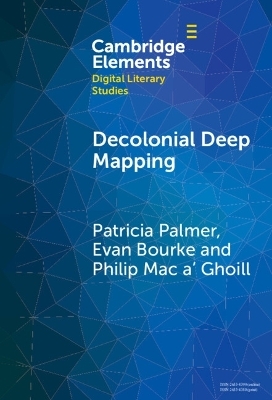
Decolonial Deep Mapping
Seiten
2025
Cambridge University Press (Verlag)
978-1-009-49184-6 (ISBN)
Cambridge University Press (Verlag)
978-1-009-49184-6 (ISBN)
This Element explores how deep-mapping techniques and a decolonial data ethic can create culturally and linguistically inclusive archives and literary histories. Using early modern Ireland as a template, it recovers colonized voices, challenges colonial narratives, and proposes decolonial reading strategies to disrupt the canon.
Deep maps capture complex relationships to place and help trace the relationship between the abstract spaces of traditional maps and the cultural and literary history of the places that they represent. Using early modern Ireland as a template, this Element explores how deep-mapping techniques and a decolonial data ethic can be used to assemble a more culturally and linguistically representative archive and create more inclusive literary histories. It shows how deep mapping can disrupt colonial teleology and counter the monophone (and, specifically, anglophone) colonial record by bringing the long-neglected voices of the colonised back into the conversation. In doing so, it recovers a pre-conquest cultural vibrancy which colonisation, the language shift from Irish to English, and scholarly inattention successively occluded. More broadly, it offers a model for engaging with decolonial literary deep maps by developing reading strategies for 'juxtapuntal' reading that has the potential to decolonise the canon.
Deep maps capture complex relationships to place and help trace the relationship between the abstract spaces of traditional maps and the cultural and literary history of the places that they represent. Using early modern Ireland as a template, this Element explores how deep-mapping techniques and a decolonial data ethic can be used to assemble a more culturally and linguistically representative archive and create more inclusive literary histories. It shows how deep mapping can disrupt colonial teleology and counter the monophone (and, specifically, anglophone) colonial record by bringing the long-neglected voices of the colonised back into the conversation. In doing so, it recovers a pre-conquest cultural vibrancy which colonisation, the language shift from Irish to English, and scholarly inattention successively occluded. More broadly, it offers a model for engaging with decolonial literary deep maps by developing reading strategies for 'juxtapuntal' reading that has the potential to decolonise the canon.
1. Countering colonial cartography and coloniality; 2. Developing a decolonial literary deep map; 3. Decolonial reading strategies: archives, contiguity, and the juxtapuntal; 4. Juxtapuntal readings: mapping counter-discourses; 5. Coda; Bibliography.
| Erscheinungsdatum | 05.08.2025 |
|---|---|
| Reihe/Serie | Elements in Digital Literary Studies |
| Zusatzinfo | Worked examples or Exercises |
| Verlagsort | Cambridge |
| Sprache | englisch |
| Gewicht | 265 g |
| Themenwelt | Reisen ► Karten / Stadtpläne / Atlanten ► Welt / Arktis / Antarktis |
| Geisteswissenschaften ► Geschichte ► Hilfswissenschaften | |
| Naturwissenschaften ► Geowissenschaften ► Geografie / Kartografie | |
| ISBN-10 | 1-009-49184-9 / 1009491849 |
| ISBN-13 | 978-1-009-49184-6 / 9781009491846 |
| Zustand | Neuware |
| Informationen gemäß Produktsicherheitsverordnung (GPSR) | |
| Haben Sie eine Frage zum Produkt? |
Mehr entdecken
aus dem Bereich

aus dem Bereich
mit Fakten und Infos zu allen Kontinenten
Buch | Hardcover (2024)
Kosmos Kartografie in der Franckh-Kosmos Verlags-GmbH & Co. …
CHF 35,90


