Dynamic Aquaria
Academic Press Inc (Verlag)
978-0-12-370641-6 (ISBN)
- Titel erscheint in neuer Auflage
- Artikel merken
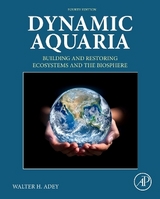
In its third edition, this praised book demonstrates how the living systems modeling of aquatic ecosystems for ecological, biological and physiological research, and ecosystem restoration can produce answers to very complex ecological questions. Dynamic Aquaria further offers an understanding developed in 25 years of living ecosystem modeling and discusses how this knowledge has produced methods of efficiently solving many environmental problems. Public education through this methodology is the additional key to the broader ecosystem understanding necessary to allow human society to pass through the next evolutionary bottleneck of our species. Living systems modeling as a wide spectrum educational tool can provide a primary vehicle for that essential step.
This third editon covers the many technological and biological developments in the eight plus years since the second edition, providing updated technological advice and describing many new example aquarium environments.
Walter Adey received his B.S. in Geophysics from MIT, performed graduate studies at MIT and Harvard in Paleontology and Biology, and obtained his Ph.D. in Marine Botany and Geology from the University of Michigan. Since 1977, he has been the Director of the Marine Systems Laboratory at the Museum of Natural History, Smithsonian Institution. Dr. Adey is an associate editor for Restoration Ecology and The Journal of Ecological Engineering. He has authored numerous publications, and has developed several exhibits and operational mesocosm systems. Karen Loveland is a multi-international award-winning documentary film maker who has produced and directed films for the Smithsonian Institution for over 30 years. In her present position as Deputy Director for Smithsonian Productions, she assists in the management and programming for Smithsonian media activities as well as overseas production and co-production using a wide variety of electronic technologies and formats. She founded the Smithsonians Motion Picture Unit in 1969. She has been the recipient of more than 70 prestigious national and international awards and honors.
1. Introduction
Part I: Physical Environment
2. The Envelope: Physical Parameters and Energy State
3. Substrate: The Active Role of Rock, Mud, and Sand
4. Water Composition: Management of Salinity, Hardness, and Evaporation
5. The Input of Solar Energy: Lighting Requirements
6. The Input of Organic Energy: Particulates and Feeding
Part II : Biochemical Environment
7. Metabolism: Respiration, Photosynthesis, and Biological Loading
8. Organisms and Gas Exchange: Oxygen, Carbon Dioxide, pH, and Alkalinity
9. The Primary Nutrients—Nitrogen, Phosphorus, and Silica: Limitation and Eutrophication
10. Biomineralization and Calcification: A Key to Biosphere and Ecosystem Function
11. Control of the Biochemical Environment: Filters, Bacteria, and the Algal Turf Scrubber
Part III: Biological Structure
12. Community Structure: Biodiversity in Model Ecosystems
13. Trophic Structure: Ecosystems and the Dynamics of Food Chains
14. Primary Producers: Plants That Grow on the Bottom
15. Herbivores: Predators of Plants and Omnivores, Predators of Plants and Animals
16. Carnivores: Predators of Animals
17. Plankton and Planktivores: Floating Plants and Animals and Their Predators
18. Detritus and Detritivores: The Dynamics of Muddy Bottoms
19. Symbionts and Other Feeders
Part IV: Ecological Systems in Microcosms, Mesocosms, and Aquaria
20. Models of Coral Reef Ecosystems
21. A Subarctic/Boreal Microcosm: Test of a Biogeographic Model
22. Estuaries: Ecosystem Modeling and Restoration: Where Fresh and Salt Waters Interact
23. Freshwater Ecosystem Models
Part V: The Environment and Ecological Engineering
24. Organisms and Natural Products: Commercial Ecosystem Culture
25. Large Scale Water Quality Management with Solar Energy Capture
Part VI: Summary
26. Microcosms, Mesocosms, and Macrocosms: Building and Restoring Ecosystems: A Synthesis
| Erscheint lt. Verlag | 12.3.2007 |
|---|---|
| Verlagsort | San Diego |
| Sprache | englisch |
| Maße | 216 x 276 mm |
| Gewicht | 1710 g |
| Themenwelt | Naturwissenschaften ► Biologie ► Zoologie |
| Weitere Fachgebiete ► Land- / Forstwirtschaft / Fischerei | |
| ISBN-10 | 0-12-370641-6 / 0123706416 |
| ISBN-13 | 978-0-12-370641-6 / 9780123706416 |
| Zustand | Neuware |
| Informationen gemäß Produktsicherheitsverordnung (GPSR) | |
| Haben Sie eine Frage zum Produkt? |
aus dem Bereich