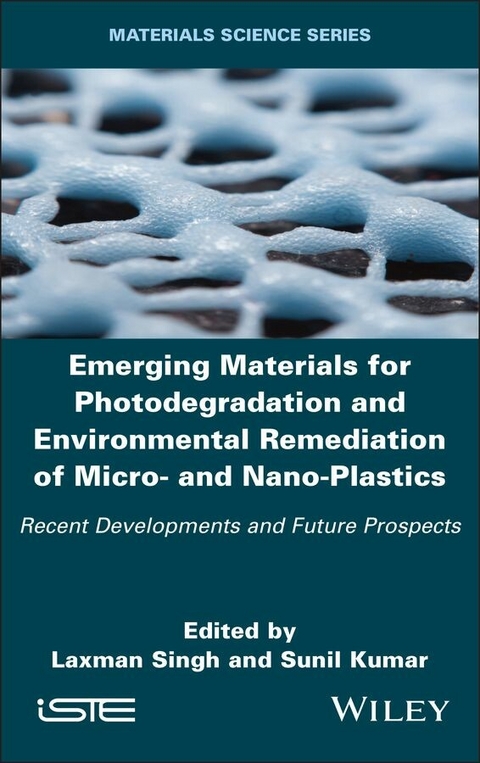
Emerging Materials for Photodegradation and Environmental Remediation of Micro- and Nano-Plastics (eBook)
408 Seiten
Wiley-Iste (Verlag)
978-1-394-36187-8 (ISBN)
Emerging Materials for Photodegradation and Environmental Remediation of Micro- and Nano-Plastics provides an in-depth understanding of the materials, design choices and applications needed for the mitigation of micro- and nano-plastic pollutants from environmental wastewater. This is a topic that continually attracts attention worldwide.
This is an important book for academic institutes and libraries, scientific organizations, and global research industries, and has been created for a wide audience. The book provides the scope of material design, synthesis, detailed mechanisms, spectroscopic analysis, and problem-solving strategies in environmental remediation.
The scope of the book on reactive, functional materials and applications extends far beyond the emerging technologies that possess valuable insights of the synthesis, processing and physiochemical characteristics and their functional properties for academics, postgraduates, research scholars, scientists, technologists, environmental chemists and industrialists. This book presents fifteen chapters, which explore new ideas in processing, designing, synthesis, selection, application, photocatalytic efficiency and economic justifications of emerging materials.
Laxman Singh is Head and Associate Professor at the Department of Chemistry, Siddharth University, Siddharthnagar, India, and has research and teaching experience in Materials Chemistry. He has published more than 60 research articles in well-reputed international science journals.
Sunil Kumar is Senior Assistant Professor and Head of the Department of Chemistry at L.N.T. College, B.R.A. Bihar University, Muzaffarpur, India, and has seven years of teaching experience. His research interests include synthesis and processing of functional polyurethanes, redox polymers, gel polymer electrolytes, nanomaterials, composites and many others.
Emerging Materials for Photodegradation and Environmental Remediation of Micro- and Nano-Plastics provides an in-depth understanding of the materials, design choices and applications needed for the mitigation of micro- and nano-plastic pollutants from environmental wastewater. This is a topic that continually attracts attention worldwide. This is an important book for academic institutes and libraries, scientific organizations, and global research industries, and has been created for a wide audience. The book provides the scope of material design, synthesis, detailed mechanisms, spectroscopic analysis, and problem-solving strategies in environmental remediation. The scope of the book on reactive, functional materials and applications extends far beyond the emerging technologies that possess valuable insights of the synthesis, processing and physiochemical characteristics and their functional properties for academics, postgraduates, research scholars, scientists, technologists, environmental chemists and industrialists. This book presents fifteen chapters, which explore new ideas in processing, designing, synthesis, selection, application, photocatalytic efficiency and economic justifications of emerging materials.
| Erscheint lt. Verlag | 1.4.2025 |
|---|---|
| Reihe/Serie | ISTE Invoiced |
| Sprache | englisch |
| Themenwelt | Naturwissenschaften ► Chemie |
| Schlagworte | environmental remediation • environmental wastewater • Materials Science • micro-plastics • nano-plastics • photocatalytic efficiency • Pollutants • spectroscopic analysis |
| ISBN-10 | 1-394-36187-4 / 1394361874 |
| ISBN-13 | 978-1-394-36187-8 / 9781394361878 |
| Informationen gemäß Produktsicherheitsverordnung (GPSR) | |
| Haben Sie eine Frage zum Produkt? |
 PDF (Adobe DRM)
Kopierschutz: Adobe-DRM
Adobe-DRM ist ein Kopierschutz, der das eBook vor Mißbrauch schützen soll. Dabei wird das eBook bereits beim Download auf Ihre persönliche Adobe-ID autorisiert. Lesen können Sie das eBook dann nur auf den Geräten, welche ebenfalls auf Ihre Adobe-ID registriert sind.
Details zum Adobe-DRM
Dateiformat: PDF (Portable Document Format)
Mit einem festen Seitenlayout eignet sich die PDF besonders für Fachbücher mit Spalten, Tabellen und Abbildungen. Eine PDF kann auf fast allen Geräten angezeigt werden, ist aber für kleine Displays (Smartphone, eReader) nur eingeschränkt geeignet.
Systemvoraussetzungen:
PC/Mac: Mit einem PC oder Mac können Sie dieses eBook lesen. Sie benötigen eine
eReader: Dieses eBook kann mit (fast) allen eBook-Readern gelesen werden. Mit dem amazon-Kindle ist es aber nicht kompatibel.
Smartphone/Tablet: Egal ob Apple oder Android, dieses eBook können Sie lesen. Sie benötigen eine
Geräteliste und zusätzliche Hinweise
Buying eBooks from abroad
For tax law reasons we can sell eBooks just within Germany and Switzerland. Regrettably we cannot fulfill eBook-orders from other countries.
aus dem Bereich