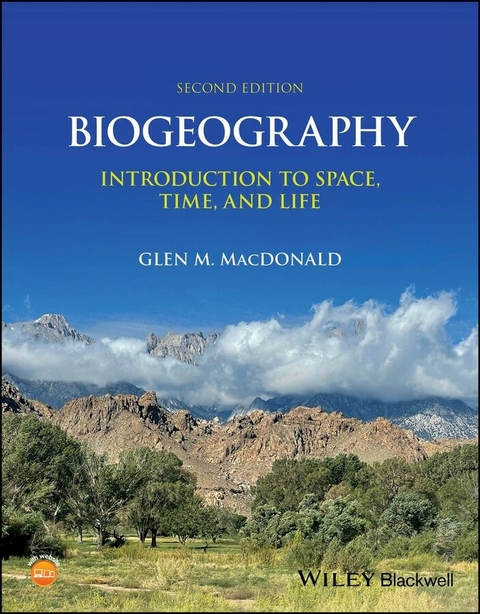
Biogeography (eBook)
1483 Seiten
Wiley-Blackwell (Verlag)
978-1-119-90459-5 (ISBN)
Introduce students to the diversity embraced by the discipline of biogeography, revised and updated throughout
Biogeography: Space, Time and Life provides a comprehensive introduction to the study of large-scale geographic distributions of life, focusing on ecology, evolution, physical geography and conservation. Now in its second edition, this award-winning textbook illustrates key concepts in biogeography using engaging empirical examples of modern plant and animal distributions, long-term evolutionary history and current conservation challenges.
With an accessible style and clear structure, Biogeography defines fundamental terms from biology and physical geography, describes ecological biogeography and the biological features of the physical environment, explains key concepts in historical biogeography, explores the Earth's diverse biogeographic subdivisions, current issues in conservation and more. Student-friendly chapters cover topics including biological interactions, speciation and extinction, changing continents and climates, human evolution, modern biodiversity, the relationship between humans and plants, animals and other organisms, and the role of biogeography in conservation.
- Introduces basic concepts in the study of animal and vegetation distributions, including various human and environmental impacts on these distributions
- Examines how biological factors such as heat and predation impact different species of plants and animals
- Features short biographical sketches of major figures in the field and examples of the natural histories of various species
- Considers the application of biogeographic theory and techniques for the benefit of conservation and sustainability
- Includes a companion website for students, as well as an instructor's site with supplementary teaching resources
Designed for students across a wide range of disciplines, from the biological and physical sciences to the social sciences and humanities, Biogeography: Space, Time and Life, Second Edition is an excellent textbook for undergraduate courses in biogeography, Earth systems science, and environmental studies.
GLEN M. MACDONALD is Distinguished Professor, Endowed Chair of California and the American West in Geography, Director of the UC White Mountain Research Center, and Chair of UCLA Canadian Studies at the University of California, Los Angeles (UCLA). He has published more than 200 peer-reviewed articles, authored Op-Ed pieces for the Los Angeles Times, the San Francisco Chronicle, and the Sacramento Bee, and received numerous research and teaching awards.
Introduce students to the diversity embraced by the discipline of biogeography, revised and updated throughout Biogeography: Space, Time and Life provides a comprehensive introduction to the study of large-scale geographic distributions of life, focusing on ecology, evolution, physical geography and conservation. Now in its second edition, this award-winning textbook illustrates key concepts in biogeography using engaging empirical examples of modern plant and animal distributions, long-term evolutionary history and current conservation challenges. With an accessible style and clear structure, Biogeography defines fundamental terms from biology and physical geography, describes ecological biogeography and the biological features of the physical environment, explains key concepts in historical biogeography, explores the Earth s diverse biogeographic subdivisions, current issues in conservation and more. Student-friendly chapters cover topics including biological interactions, speciation and extinction, changing continents and climates, human evolution, modern biodiversity, the relationship between humans and plants, animals and other organisms, and the role of biogeography in conservation. Introduces basic concepts in the study of animal and vegetation distributions, including various human and environmental impacts on these distributions Examines how biological factors such as heat and predation impact different species of plants and animals Features short biographical sketches of major figures in the field and examples of the natural histories of various species Considers the application of biogeographic theory and techniques for the benefit of conservation and sustainability Includes a companion website for students, as well as an instructor s site with supplementary teaching resourcesDesigned for students across a wide range of disciplines, from the biological and physical sciences to the social sciences and humanities, Biogeography: Space, Time and Life, Second Edition is an excellent textbook for undergraduate courses in biogeography, Earth systems science, and environmental studies.
CHAPTER 1
AN INTRODUCTION
There cannot be many people who have never marveled at an unusual flower or animal, or contemplated the deeper history of the human race and how they, themselves, originated. Even those with the most casual interest in the environment know that today the earth abounds with an incredible diversity of interesting plants and animals, but many are facing grave threats due to habitat destruction, overhunting, and climate change. You may have wondered: How did this wonderful diversity of life, including our own species, arise; how did we get to this present state of environmental crisis; and what can we do about it? These are big questions, and in picking up this book you might be wondering what the science of biogeography can tell us about all of this.
If this is your first exposure to the science of biogeography, you probably have three basic questions: What exactly is biogeography? Why should I bother studying it? How will this book help me understand biogeography? Let’s start with a simple answer to the first question. Biogeography is the study of the past and present geographic distributions of plants and animals and other organisms.1 Of course, there is much more to it than that. We will explore this question further and expand on this definition presently, but first let us consider why you might want to study biogeography as an aid in understanding both the diversity of life and how we might conserve that diversity.
More than most sciences, biogeography helps us to understand and appreciate the living environment that we experience every single day. Biogeography helps us answer questions such as how the great diversity of life that we experience today arose, where the modern human species came from, and what we can do to preserve the natural environment in the face of increasing human population growth and environmental change. How does answering such questions directly affect you? When we think of nature we tend to think about distant national parks and wildlands. These are important, but let’s think about closer to home. You cannot set foot outside your door without seeing plants that are growing around you. Many of the plants you see are native to the area in which you live, but many others are exotic species that have been recently introduced by humans. You cannot escape hearing the calls of wild birds, some of which are native and some of which have been introduced. Even if you do not know the scientific names of the plants and animals near your home, you are familiar with the way they look and sound. At some point you must have wondered how this diversity of life around you arose and specifically where all of these different plants and animals that live near you originated. These plants and animals fill your neighborhood with beauty and interest. They can also provide more tangible benefits such as the trees that provide shade or shelter from winds, or the small fish that keep populations of mosquitos in check. These tangible benefits that arise from the diverse plants and animals around you are called ecosystem services. Biogeography helps you understand the plant and animal life that you encounter everyday where you live and that provide important ecosystem services to you on a daily basis.
If you have ventured far from your home, perhaps visiting another state, province, or country, you have undoubtedly noticed differences in the vegetation and animal life you encountered. For example, during the winter millions of people travel from the northeastern United States and Canada to enjoy the sunshine and palm‐lined beaches of southern Florida. The green vegetation of Florida contrasts greatly with the cold and leafless winter forests of the Northeast. Many animals found in Florida, such as alligators, are not found in the northeastern United States or in Canada. Why are alligators and most other plants and animals found in southern Florida not found in the Northeast? The obvious answer might be that these plants and animals require the warm and humid environment of Florida to survive. However, many plant and animal species from Florida are also absent from the other warm tropical and subtropical areas of the earth. Travel to South America, West Africa, Southeast Asia, or northeastern Australia and you will see palm trees and many interesting animals, including relatives of alligators such as crocodiles, but not a single native alligator (Fig. 1.1). Surprisingly, however, you will find native alligators in southern China. Why are certain plant and animal species limited to relatively small areas of the earth? Why are other types of organisms widely distributed? Why can’t you grow many of the plants found in Florida in a garden in New York?
An important role of biogeography is to record such geographic differences in vegetation and wildlife and seek to explain them. Biogeography can tell us why North American alligators (Alligator mississipiensis) are found only in warm, moist areas such as Florida and adjacent states. Biogeography can also help us to understand why alligators are also found in China (Alligator sinensis), and not in tropical regions of Africa and Australia. In studying biogeography, you will come to understand that a combination of geographical, environmental, and historical factors led to the great diversity and current geographic distribution of plant and animal life. In studying biogeography, you can develop a much greater awareness, understanding, and appreciation of the wonderful diversity of plant and animal life found on a global basis as well as the diversity of life that you encounter every single day.
The study of biogeography also helps us to appreciate the development and history of our own species. We do not stand as far apart from the natural world as we might think. Our development, both biologically and culturally, is influenced by geography, the earth’s physical environment, and interactions with other organisms. The evolution and spread of humans around the world make up one of the great stories of biogeography. At present, humans play an increasingly greater role in changing the world’s environments and have a significant impact on the lives of plants and animals with which they share the earth. We have helped some species spread throughout the world while driving others from much of their former habitat. Some plants and animals owe their existence to human activity. Sadly, many more species owe their extinction to us. Since our existence depends on our relationships with the other species of the earth, our future will ultimately be determined by how we treat them. Biogeography helps us understand where living organisms, including humans, have come from and where we and earth’s other inhabitants are potentially headed.
FIGURE 1.1 The world distribution of alligator species (Alligator mississipiensis and Alligator sinensis). Understanding why alligators are found only in North America and China is a classic biogeographical question. Alligators are found in warm subtropical regions because they cannot tolerate prolonged exposure to cold and freezing temperatures. In the geologic past, Europe, Asia, and North America were joined together in one large continent that experienced relatively warm climates. Therefore, the geographic range of the ancestors of modern alligators was much larger than it is today. Over time, as continents shifted, climate changed, and alligators faced competition from crocodiles and caimans, the geographic range of alligators became fragmented and small.
The ability of humans to alter the environment and affect the survival of plants and animals bestows a great deal of responsibility upon us. We are responsible for making sure our actions cause as little damage as possible to the natural environment. In this effort we will always face tradeoffs between the needs of people for food, resources, living space, and recreational areas, and the preservation and conservation of nature. In some cases, we can alter our activities to lessen the damage we cause. In other instances, we might try to restore damaged areas to a semblance of their natural state. In these enterprises, biogeography can provide important guidance. By examining the long‐term histories of plant and animal communities, biogeographers provide information on how humans have altered the environment. In studying the natural distributions of plants and animals, biogeographers can help preserve nature. Biogeography provides important guidance on how we are affecting the environment and what actions we can take to conserve resources and preserve natural environments.
The contrasting state of health of the North American alligator and its relative, the Chinese alligator, underscores the conservation challenges facing biogeographers. According to the Wildlife Conservation Society, there are only 120 Chinese alligators remaining in the wild. This makes it the most endangered crocodilian (crocodiles and their relatives) in the world. Why are the North American alligator populations relatively healthy today and their Chinese relatives so endangered? What might be done to alleviate the risk to the Chinese alligator? Biogeography has much to contribute to such questions.
Let us now turn to further defining biogeography. In studying the present and past distributions of life, biogeographers have two basic tasks: description and explanation. Describing where a plant or animal species occurs today is the easiest part, and yet this task remains incomplete for vast numbers of plants, animals, and other organisms. So far,...
| Erscheint lt. Verlag | 31.3.2025 |
|---|---|
| Sprache | englisch |
| Themenwelt | Naturwissenschaften ► Geowissenschaften ► Geografie / Kartografie |
| Schlagworte | biogeography basics • biogeography biodiversity • biogeography conservation • biogeography environmental studies • biogeography examples • biogeography introduction • biogeography textbook • distribution of life introduction • distribution of life textbook |
| ISBN-10 | 1-119-90459-5 / 1119904595 |
| ISBN-13 | 978-1-119-90459-5 / 9781119904595 |
| Informationen gemäß Produktsicherheitsverordnung (GPSR) | |
| Haben Sie eine Frage zum Produkt? |
 EPUB (Adobe DRM)
Kopierschutz: Adobe-DRM
Adobe-DRM ist ein Kopierschutz, der das eBook vor Mißbrauch schützen soll. Dabei wird das eBook bereits beim Download auf Ihre persönliche Adobe-ID autorisiert. Lesen können Sie das eBook dann nur auf den Geräten, welche ebenfalls auf Ihre Adobe-ID registriert sind.
Details zum Adobe-DRM
Dateiformat: EPUB (Electronic Publication)
EPUB ist ein offener Standard für eBooks und eignet sich besonders zur Darstellung von Belletristik und Sachbüchern. Der Fließtext wird dynamisch an die Display- und Schriftgröße angepasst. Auch für mobile Lesegeräte ist EPUB daher gut geeignet.
Systemvoraussetzungen:
PC/Mac: Mit einem PC oder Mac können Sie dieses eBook lesen. Sie benötigen eine
eReader: Dieses eBook kann mit (fast) allen eBook-Readern gelesen werden. Mit dem amazon-Kindle ist es aber nicht kompatibel.
Smartphone/Tablet: Egal ob Apple oder Android, dieses eBook können Sie lesen. Sie benötigen eine
Geräteliste und zusätzliche Hinweise
Buying eBooks from abroad
For tax law reasons we can sell eBooks just within Germany and Switzerland. Regrettably we cannot fulfill eBook-orders from other countries.
aus dem Bereich