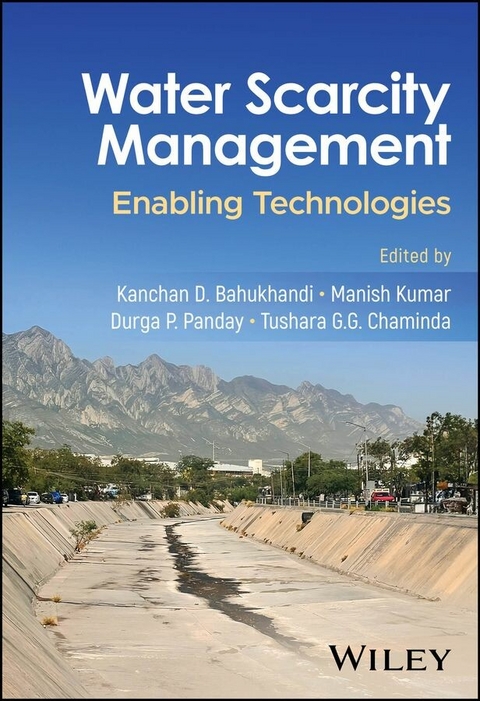
Water Scarcity Management (eBook)
553 Seiten
Wiley (Verlag)
978-1-394-17673-1 (ISBN)
Authoritative, forward-thinking resource presenting strategies and technologies to mitigate water scarcity and improve water quality
Founded on the idea that conventional procedures are unsuccessful in providing a solution to water security as a whole, Water Scarcity Management delivers integrated, cross-cutting approaches to solve some of the biggest problems that the world faces in terms of freshwater through a nature-based approach.
Written by a team of authors and leaders in the field of environmental science and technology, this book explores topics including:
- Water availability, management, governance, and quality and policy development in the Anthropocene
- New global trends of water management and wastewater reuse, as well as novel integrated strategies and technologies for the mitigation of biotic and abiotic emerging contaminants
- Water stress due to decades of poor management, over-extraction of groundwater, and contamination of freshwater supplies
- Rising demand of freshwater due to rapid population growth, urbanization, and increasing needs across sectors including agriculture, industry, and energy
Water Scarcity Management is a timely, essential, forward-thinking resource on the subject for environmental engineers, microbiologists, environmental scientists, policy developers and modelers seeking to integrate findings on water scarcity, availability, management, reuse, conservation, and treatment into policy development.
Dr. Kanchan D. Bahukhandi is a Senior Associate Professor in Sustainability Cluster, School of Advanced Engineering at UPES. She is a passionate academician and environmental researcher and has around 22 years of experience in environmental science, sustainability, water pollution, hydro geochemistry, and solid waste management. She has published more than 50 research papers in international journal and contributed 30 book chapters and Three Edited books. She has delivered few invitee lectures at premier institute and organization. She has also presented around 40 research papers at the National and International Conference and also got membership of IWA international Water Association and EGU - European Geosciences.
Dr. Manish Kumar is a distinguished professor in Water Science at Tecnológico de Monterrey, with expertise in sustainability, contaminant remediation, and environmental engineering. He has contributed significantly to wastewater surveillance and water supply strategies in the context of climate change. Prof. Kumar's research, recognized globally, spans over 200 international journal articles and numerous projects. He is a fellow of the Royal Society of Chemistry and has been listed among the top 2% of researchers worldwide by Stanford University (since inception).
Dr. Durga P. Panday is an associate professor at UPES, specializing in Water Resources Engineering and Management. His research focuses on water quality and quantity, hydroclimatic extremes, and conflict resolution in water sharing using game theory. He has extensive teaching experience in water resources and structural engineering and actively contributes to scholarly activities and training programs.
Dr. (Eng). Tushara G.G. Chaminda is a Professor in Civil and Environmental Engineering, at the Faculty of Engineering, University of Ruhuna, Sri Lanka.
Authoritative, forward-thinking resource presenting strategies and technologies to mitigate water scarcity and improve water quality Founded on the idea that conventional procedures are unsuccessful in providing a solution to water security as a whole, Water Scarcity Management delivers integrated, cross-cutting approaches to solve some of the biggest problems that the world faces in terms of freshwater through a nature-based approach. Written by a team of authors and leaders in the field of environmental science and technology, this book explores topics including: Water availability, management, governance, and quality and policy development in the AnthropoceneNew global trends of water management and wastewater reuse, as well as novel integrated strategies and technologies for the mitigation of biotic and abiotic emerging contaminantsWater stress due to decades of poor management, over-extraction of groundwater, and contamination of freshwater suppliesRising demand of freshwater due to rapid population growth, urbanization, and increasing needs across sectors including agriculture, industry, and energy Water Scarcity Management is a timely, essential, forward-thinking resource on the subject for environmental engineers, microbiologists, environmental scientists, policy developers and modelers seeking to integrate findings on water scarcity, availability, management, reuse, conservation, and treatment into policy development.
1
Emerging Contaminants and Water Conservation: Challenges, Strategies, and Solutions for Sustainable Water Management
Sachin Tripathi1,2, Durga P. Panday1,2, and Manish Kumar1,2,3
1 Sustainability Cluster, School of Advanced Engineering, UPES, Dehradun, Uttarakhand, India
2 Escuela de Ingeniería y Ciencias, Tecnológico de Monterrey, Monterrey, Nuevo León, Mexico
3 Research and Development Initiative, Chuo University, Korakuen Campus 1‐13‐27, Kasuga, Bunkyo‐ku, Tokyo, Japan
1.1 Introduction
As the number of people living on Earth continues to increase and there is a corresponding decrease in the amount of available water, water conservation has emerged as an increasingly pressing issue (Alotaibi et al. 2023). Emerging pollutants, on the other hand, pose a substantial danger to both the quality of the water supply and human health (Tripathi et al. 2023). The purpose of this chapter is to give a complete analysis of contemporary developing pollutants as well as water conservation practises, covering the sources, impacts, and management measures associated with these contaminants.
Emerging pollutants may have their origins in a wide number of sources, such as agricultural practises, industrial operations, wastewater treatment plants (WWTPs), or consumer products. Emerging contaminants (ECs) may come from industrial, municipal (household), agricultural, hospital, or laboratory effluent (Figure 1.1). Surface water, groundwater, drinking water, and WWTP effluent include environmental pollutants (Tripathi et al. 2023). Municipal wastewater is known to emit novel contaminants into the environment. These contaminants come from non‐point and point sources, industrial activities, storm water runoff, home wastewater, and water treatment facilities (Pradhan et al. 2023). Due to high EC values in sludge, management is becoming more concerned (Das et al. 2022, Kumar et al. 2023a, b).
The use of agricultural practises such as pesticides and fertilisers, among other things, can contribute to the presence of newly discovered pollutants in both surface water and groundwater. WWTPs, which are designed to eliminate conventional pollutants but are less successful at removing ECs, are a substantial source of ECs (Dubey et al. 2023). This is because of the way that they are designed. Manufacturing and mining are two examples of industrial activity that might contribute to the discharge of chemicals into rivers. Last but not least, consumer goods, such as flame retardants and plasticizers, have the potential to make their way into water sources (Macklin et al. 2023).
Figure 1.1 Classification of emerging contaminants that impact on soil, water, plants, and treatment processes.
It has been discovered that ECs have a wide range of effects on both human health and the environment (Neog et al. 2024). These effects can be broken down into several categories. Pharmaceuticals and personal care items, for instance, have been connected to endocrine disruption, which can have an effect on both the function and development of the reproductive system (Kumar et al. 2023d). There is evidence that flame retardants cause neurotoxicity, and certain per‐ and polyfluoroalkyl substances (PFAS) have been related to cancer and dysfunction in the immune system. Microplastics, which are small plastic particulates that can be discovered in water sources, have the potential to have both a physical and a chemical impact on the creatures that live in water (Farooq et al. 2023).
Emerging pollutants, in addition to having these effects, can also have ecological repercussions, such as changing the composition of microbial communities and disrupting the regular functioning of ecosystems (Li et al. 2023). These consequences can have cascade repercussions throughout food webs, which can have an effect on the health of organisms living in both aquatic and terrestrial environments. The Figure 1.1 represents a classification of emerging contaminants and their varied impacts on soil, water, and plants, highlighting the complex challenges they pose to environmental health. Additionally, it illustrates how these contaminants influence treatment processes, often requiring advanced or modified remediation strategies due to their persistence and resistance to conventional methods.
1.1.1 Sources of Heavy Metal
Approximately 40% of the world’s lakes and rivers have been contaminated by heavy metals (Zhou et al. 2020), stemming from both natural and human activities. Natural sources involve interactions with metal‐containing rocks and volcanic eruptions (Ali et al. 2019). Volcanic emissions, including geothermal activity and degassing, contribute sporadically (Naggar et al. 2018). Anthropogenic sources encompass industrial processes, agriculture, and domestic practices (Gautam et al. 2014); as shown in Figure 1.2.
Mining, pivotal for many economies, releases heavy metals into water bodies, impacting groundwater, soil erosion, and health. Urbanisation and industrialisation exacerbate pollution levels, as evidenced by arsenic in India’s drinking water and various heavy metals in Nigeria’s mining communities. Latin America faces chronic exposure issues, with millions affected by arsenic‐contaminated water exceeding WHO limits. China grapples with high metal concentrations in coastal rivers (Xu et al. 2017), while mercury contamination plagues Venezuela’s artisan gold mining areas. Turkey also battles heavy metal contamination. Mitigating heavy metal pollution is crucial globally, with economic challenges hindering remediation efforts in developing nations.
1.1.2 Irrigation Water Quality
1.1.2.1 Sodium Percent
Sodium, when interacting with soil, diminishes its permeability. Higher levels of sodium prompt a cation exchange process, leading to a reduction in water and air movement within the soil, particularly under moist conditions (Hopkins et al. 2007). The term “sodium percent” is defined as follows:
Figure 1.2 Sources of heavy metal concentration in food plants and trophic transfer to human
Wilcox diagram is used to classify irrigation water based on sodium percent.
1.1.2.2 Chloride
Chloride levels in irrigation water contribute to its overall salinity and can pose toxicity risks to plants when concentrations are excessively high. Elevated chloride levels can lead to foliar burns when deposited on leaves. Some plant species are more vulnerable to chloride damage than others. To mitigate the harm caused by high chloride levels in irrigation water, options include selecting less sensitive crop varieties, utilising irrigation methods such as furrow, flood, or drip irrigation to minimise foliar contact, and rinsing plants at the conclusion of each irrigation cycle if a source of high‐quality water is accessible. Excessive chlorine in plants can lead to leaf tissue accumulation, resulting in a burnt appearance, despite chlorine being a micronutrient essential for plant growth (Hopkins et al. 2007).
1.1.2.3 Salinity
Irrigation water with an electrical conductivity below 0.2 μS/cm, as discussed earlier, can lead to issues with soil permeability. When water salinity is very low, it can leach out calcium and cause soil particles to become more prone to breaking apart, resulting in difficulties with water infiltration. To prevent these infiltration problems, it is suggested to add a calcium salt such as gypsum or calcium chloride to the irrigation water, increasing the salinity to 0.2–0.3 μS/cm (Hopkins et al. 2007).
1.2 Emerging Contaminants
1.2.1 Pharmaceuticals
Due to the widespread use of pharmaceuticals in the medical treatment of human and animal diseases, accidents, and illnesses, this industry is considered to be one of the largest contributors to the world’s most critical environmental problems. Pharmaceutically active compounds are complex molecules that contain a variety of diverse functions and physical properties in order to engage in specific biological activities (Kumar et al. 2023c). Pharmaceuticals and medications contain these compounds. The vast quantity of these compounds necessitates their subdivision into a variety of sub‐classes.
Non‐steroidal anti‐inflammatory medications (NSAIDs) are the compounds most frequently used to relieve pain which are frequently detected in surface water and are especially resistant to conventional wastewater treatment methods (Khumalo et al. 2023). Hormones and oestrogens are considered to be significant emerging pollutants due to their ability to persist in living organisms for extended periods of time and also disrupt the endocrine systems (Almazrouei et al. 2023). Compared to other oestrogens, 17‐ethinylestradiol is a prevalent oral contraceptive for women that possesses endogenous activity (Thacharodi et al. 2023). Typically discovered in wastewater, it is notoriously challenging to eradicate. Antibiotics are complex chemical compounds used to inhibit or eliminate pathogenic microorganisms. Most frequently detected in the environment are...
| Erscheint lt. Verlag | 31.3.2025 |
|---|---|
| Sprache | englisch |
| Themenwelt | Naturwissenschaften ► Chemie |
| Naturwissenschaften ► Geowissenschaften | |
| Schlagworte | wastewater reuse • water abiotic contaminants • water availability • water biotic contaminants • water demand • Water Governance • Water Management • Water policy development • water population • water quality • water scarcity • Water Stress |
| ISBN-10 | 1-394-17673-2 / 1394176732 |
| ISBN-13 | 978-1-394-17673-1 / 9781394176731 |
| Informationen gemäß Produktsicherheitsverordnung (GPSR) | |
| Haben Sie eine Frage zum Produkt? |
 EPUB (Adobe DRM)
Kopierschutz: Adobe-DRM
Adobe-DRM ist ein Kopierschutz, der das eBook vor Mißbrauch schützen soll. Dabei wird das eBook bereits beim Download auf Ihre persönliche Adobe-ID autorisiert. Lesen können Sie das eBook dann nur auf den Geräten, welche ebenfalls auf Ihre Adobe-ID registriert sind.
Details zum Adobe-DRM
Dateiformat: EPUB (Electronic Publication)
EPUB ist ein offener Standard für eBooks und eignet sich besonders zur Darstellung von Belletristik und Sachbüchern. Der Fließtext wird dynamisch an die Display- und Schriftgröße angepasst. Auch für mobile Lesegeräte ist EPUB daher gut geeignet.
Systemvoraussetzungen:
PC/Mac: Mit einem PC oder Mac können Sie dieses eBook lesen. Sie benötigen eine
eReader: Dieses eBook kann mit (fast) allen eBook-Readern gelesen werden. Mit dem amazon-Kindle ist es aber nicht kompatibel.
Smartphone/Tablet: Egal ob Apple oder Android, dieses eBook können Sie lesen. Sie benötigen eine
Geräteliste und zusätzliche Hinweise
Buying eBooks from abroad
For tax law reasons we can sell eBooks just within Germany and Switzerland. Regrettably we cannot fulfill eBook-orders from other countries.
aus dem Bereich