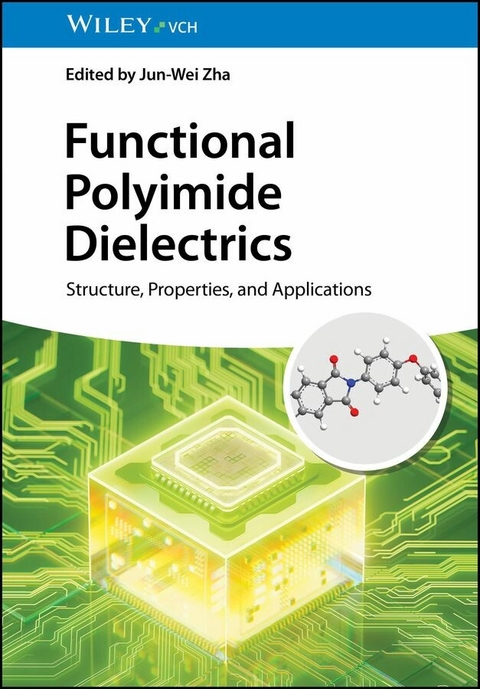
Functional Polyimide Dielectrics (eBook)
511 Seiten
Wiley-VCH (Verlag)
978-3-527-84901-7 (ISBN)
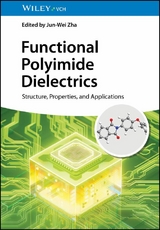
An of-the-moment discussion of the most cutting-edge research in the field of polyimide dielectrics
In Functional Polyimide Dielectrics: Structure, Properties, and Applications, distinguished researcher Dr. Jun-Wei Zha delivers an up-to-date and authoritative discussion of the latest advancements in the application of polyimide dielectrics (PIDs) in electrical and electronic equipment. Readers will find coverage of the application of PIDs in aerospace, high-temperature energy storage capacitors, corona-resistant motors, new energy power equipment, packaging, and more.
The book serves as a valuable reference for improving the performance and expanding the application of existing PIDs, as well as designing and developing new PIDs. It also provides a current overview of research and frontier applications that will prove useful to students and researchers from multiple disciplines.
Functional Polyimide Dielectrics also contains:
- A thorough introduction to the different types of polyimide dielectrics, including their synthesis, composites & blends, processing-property relationships, processing strategies and technologies, properties and applications
- Comprehensive explorations of a wide range of PID applications in a variety of special applications, like energy storage, insulation, thermal conductivity, intelligence, and more
- Practical discussions of the environmental aspects of the technology, as well as life cycle assessment sustainable alternative possibilities
- Complete treatments of smart polyimide dielectrics
Perfect for materials scientists, electronics engineers, polymer chemists, physicists, and mechanical engineers, Functional Polyimide Dielectrics: Structure, Properties, and Applications will also benefit professionals, engineers, and scientists working in the chemical industry.
Jun-Wei Zha, PhD, is Professor at the University of Science and Technology Beijing, China. He was previously selected as a Hong Kong Scholar. He is currently the IET Fellow, IEEE Senior Member, member of IEEE/DEIS Technical Committee on Nanodielectrics and CIGRE WG D1-73 etc. He won the first prize of Natural Science of the Ministry of Education in 2019, the first prize of Natural Science of Beijing Science and Technology Award in 2022 and Young Scientist Award of Chinese Society for Composite Materials in 2021.
1
Overview of Polyimide Dielectrics
Mengyu Xiao and Jun‐Wei Zha
University of Science and Technology Beijing, School of Chemistry and Biological Engineering, Department of Chemistry, 30 Xueyuan Road, Haidian District, Beijing, 100083, P. R. China
1.1 Introduction
The advancements in aerospace and new energy technologies have accelerated the demand for high‐temperature‐resistant and high‐performance polymer dielectric materials. Researchers have developed a range of specialty engineering plastics such as polyphenylene sulfide (PPS), polytetrafluoroethylene (PTFE), poly(ether ether ketone) (PEEK), polyethersulfone (PES), and polyimide (PI) [1]. PI is a class of polymer that contains an imide structure in the molecular backbone. The rigid imide ring gives PI excellent high‐temperature resistance; thus, only cyclic polyimides are of practical application. PI was first reported in 1908, [2] and DuPont commercialized Kapton films in the mid‐1960s. Since then, PI has entered an era of booming growth.
PI has been fully developed as a promising polymer, especially in the field of insulating and functional materials. The reason for the considerable interest in PI, compared to other high‐temperature‐resistant polymers, is due to its high structural designability, numerous synthesis and processing methods, as well as its outstanding comprehensive performance and wide range of applications.
This chapter provides a concise overview of the design, fabrication, and application of PIs. Firstly, the PI is introduced from a structural perspective in order to provide an overview of the general relationship between structure and function, which will then be used to guide the subsequent design. Then, the synthesis of PI and the preparation of different types of PI dielectric materials are discussed. Subsequently, the various properties of PI and the corresponding application areas are summarized. Finally, the key points of PI dielectrics are summed up and the future development is prospected.
1.2 Structure Design of Polyimide
The process of designing a polyimide usually involves careful planning of its molecular structure to ensure that the resulting material has the desired properties. PI consists of alternating electron donors (diamines) and electron acceptors (dianhydrides). Therefore, designing PI can be realized by changing the structure of diamine and dianhydride. More than 1000 diamines and more than 400 dianhydrides are currently used to synthesize PIs, resulting in thousands of PIs with different structures. Here, only some common structure–property relationships are briefly described, such as thermal, mechanical, and electrical properties.
For PI, during aromatic heterocyclic polymerization, the glass transition temperature (Tg) is mainly related to the relevant chain length of the macromolecule and the intermolecular forces. PI has a higher Tg and thermal stability than the corresponding polyether or polyester due to intermolecular forces other than van der Waals forces. Intramolecular or intermolecular charge transfer interactions are induced between the electron acceptor and electron donor of the PI, as shown in Figure 1.1. The charge transfer effect is related to the electron affinity of the dianhydride (or the hole affinity of the diamine) and the conformation of the molecular chain. It can be qualitatively argued that increasing the electron affinity of the dianhydride enhances interchain interactions, i.e., increases Tg. Intramolecular charge transfer is greatest when the electron donor and the electron acceptor are co‐planar, but least when they are perpendicular. The planar structure between the electron donor and acceptor can be disrupted by making neighboring substitutions to the C—N bond. For example, with neighboring methyl substitution of diamines, the site‐blocking effect disrupts the coplanar structure and increases the rigidity of the molecular chain, resulting in an improved Tg.
Figure 1.1 Intermolecular and intramolecular charge transfer (CT) in PI.
Source: Ref. [3]/Springer Nature.
The mechanical properties of polymers are mainly influenced by the molecular structure, which determines the intramolecular chemical bonding forces and intermolecular forces. For example, increasing the polarity of the PI or creating hydrogen bonds can increase the chemical bonding and intermolecular forces of the main chain, resulting in increased tensile strength. In addition to the molecular structure, the mechanical properties of PI depend on the synthesis method and processing conditions. The thermal history during the formation of PI affects its aggregate state structure, which ultimately has an impact on the mechanical properties.
The electrical properties of polymers refer to the behavior of polymers under the action of an applied voltage or electric field and the various physical phenomena they exhibit. PI is a typical linear dielectric with excellent dielectric and insulating and properties. The dielectric permittivity of PI is mainly contributed by dipolar polarization of their polar groups. Therefore, the introduction of polar groups into the PI molecular chain, or an appropriate increase in free volume can improve the dielectric permittivity of PI. For instance, Liu et al. [4] introduced polar groups ‐COOH and ‐CO‐NH‐ into the PI main chain by controlling the degree of imidization of PAA (Figure 1.2), resulting in a dielectric permittivity up to 4.59@1 kHz. However, the promotion strategies of dielectric permittivity usually lead to a higher dielectric loss. Thus, systematic consideration of the molecular/structure design according to the polarization mechanisms is necessary to improve the dielectric loss of PIs. The insulating properties of PIs depend mainly on the bandgap and carrier traps. Wang et al. [5] found that the high‐temperature insulation performance would experience diminishing marginal utility as the bandgap increases beyond a critical point (∼3.3 eV) through the study of some series of PI derivatives. Therefore, it is essential to ensure a wide bandgap while constructing deep traps to enhance the insulation performance of PI [6]. There are three strategies for constructing carrier traps: adjusting the intrinsic structure of polymers, preparing inorganic/polymer composites and all organic polymer composites.
Figure 1.2 Schematic diagram of the thermal imidization process of PAA.
Source: Adapted from Ref. [4].
1.3 Fabrication of Polyimide
PI boasts of numerous synthetic pathways and can be tailored for diverse applications, making it unparalleled among other polymers [7]. PIs are generally synthesized by a two‐step process. Firstly, polyamic acid (PAA) is obtained by low‐temperature polycondensation of dianhydride and diamine in a polar solvent (N, N‐dimethylacetamide, N, N‐dimethylformamide, and N‐methylpyrrolidone). Subsequently PAA can be thermally or chemically dehydrated to obtain PI. PI can also be synthesized in one step, where the dianhydride and diamine are polycondensed by heating in a high boiling solvent (phenolics). The monomer ratio, dosing sequence, and reaction temperature are the core parameters affecting the PI polymerization reaction. For example, the ring‐opening polymerization of dianhydride and diamine is an equilibrium reaction and has a high equilibrium constant, with the reaction heavily biased in favor of the product [8]. The polymerization process is significantly exothermic, and a proper lowering of the reaction temperature is more conducive to a positive reaction.
After decades of development, PI can be processed by methods suitable for most polymers. For example, PAA solutions can be utilized for cast film formation, spin coating, and spinning. Because inorganic salts are not generally produced during the synthesis of PI, there is no need for an additional purification step, which is very favorable for the preparation of insulating materials. PI can also be thermo‐compressed, extruded, and injection molded by melt processing. Moreover, it is possible to utilize the easy sublimation of dianhydride and diamine for vapor‐phase deposition. The diverse range of processing technologies employed by PI enables the production of a multitude of materials, including films, fibers, foams, and adhesives.
1.4 Applications of Polyimide
PI, a high‐performance polymer, enjoys widespread utilization across various industries owing to its exceptional structural properties, facile synthesis process, and adaptability to diverse processing techniques. Its unique chemical and physical characteristics have allowed it to demonstrate outstanding performance in a broad range of applications, as shown in Figure 1.3 [9]. Each of these applications, from aerospace and automotive components to medical implants and semiconductor devices, has benefited from PI's ability to deliver superior performance in challenging environments. Consequently, PI continues to be a highly sought‐after material for a diverse range of applications worldwide.
Figure 1.3 Applications of polyimide.
Source: Ref. [9]/John Wiley & Sons.
1.4.1 Capacitive Energy Storage
PI has a very broad application prospect in...
| Erscheint lt. Verlag | 25.3.2025 |
|---|---|
| Sprache | englisch |
| Themenwelt | Naturwissenschaften ► Chemie |
| ISBN-10 | 3-527-84901-7 / 3527849017 |
| ISBN-13 | 978-3-527-84901-7 / 9783527849017 |
| Informationen gemäß Produktsicherheitsverordnung (GPSR) | |
| Haben Sie eine Frage zum Produkt? |
 EPUB (Adobe DRM)
Kopierschutz: Adobe-DRM
Adobe-DRM ist ein Kopierschutz, der das eBook vor Mißbrauch schützen soll. Dabei wird das eBook bereits beim Download auf Ihre persönliche Adobe-ID autorisiert. Lesen können Sie das eBook dann nur auf den Geräten, welche ebenfalls auf Ihre Adobe-ID registriert sind.
Details zum Adobe-DRM
Dateiformat: EPUB (Electronic Publication)
EPUB ist ein offener Standard für eBooks und eignet sich besonders zur Darstellung von Belletristik und Sachbüchern. Der Fließtext wird dynamisch an die Display- und Schriftgröße angepasst. Auch für mobile Lesegeräte ist EPUB daher gut geeignet.
Systemvoraussetzungen:
PC/Mac: Mit einem PC oder Mac können Sie dieses eBook lesen. Sie benötigen eine
eReader: Dieses eBook kann mit (fast) allen eBook-Readern gelesen werden. Mit dem amazon-Kindle ist es aber nicht kompatibel.
Smartphone/Tablet: Egal ob Apple oder Android, dieses eBook können Sie lesen. Sie benötigen eine
Geräteliste und zusätzliche Hinweise
Buying eBooks from abroad
For tax law reasons we can sell eBooks just within Germany and Switzerland. Regrettably we cannot fulfill eBook-orders from other countries.
aus dem Bereich