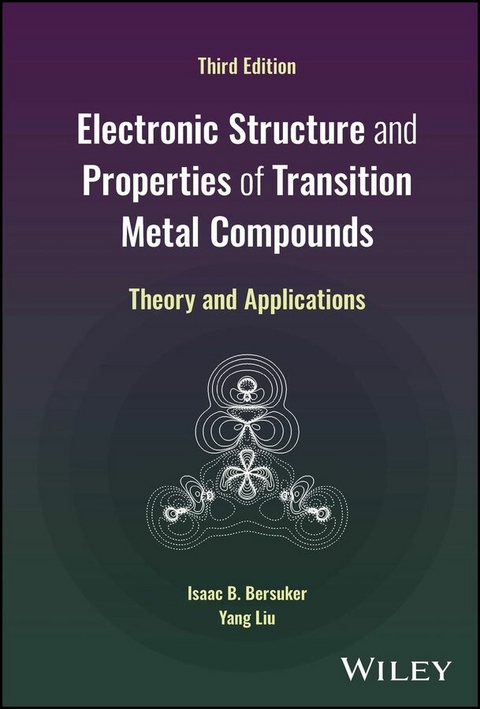
Electronic Structure and Properties of Transition Metal Compounds (eBook)
865 Seiten
Wiley (Verlag)
978-1-394-17890-2 (ISBN)
Presents the latest achievements in the theory of electronic structure and properties of transition metal coordination compounds with applications to a range of chemical and physical problems
Electronic Structure and Properties of Transition Metal Compounds offers a detailed and authoritative account of the theory of electronic structure and the properties of transition metal compounds with applications to various chemical and physical problems.
The fully updated third edition incorporates recent developments and methods in the field, including new coverage of methods of ab initio calculations of the electronic structure of coordination compounds and the application of vibronic coupling and the Jahn-Teller effect to solve coordination chemistry problems. Revised chapters provide up-to-date views on reactivity, chemical activation, and catalysis. New and expanded questions, exercises, and problems in each chapter are supported by new problem-solving examples, illustrations, graphic presentations, and references.
Designed to be intelligible to advanced students, researchers, and instructors, Electronic Structure and Properties of Transition Metal Compounds:
- Provides thorough coverage of the theory underlying the electronic structure and properties of transition metal compounds, including the physical methods of their investigation
- Helps readers understand the origin of observable properties in transition metal compounds and choose a suitable method of their investigation
- Contains numerous problems with solutions and illustrative examples demonstrating the application of the theory to solving specific chemical and physical problems
- Presents a generalized view of the modern state of the field, beginning from the main ideas of quantum chemistry and atomic states to applications to various chemical and physical problems
- Features novel problems never fully considered in books on coordination chemistry, such as relativistic effects in bonding, optical band shapes, and electron transfer in mixed-valence compounds
Electronic Structure and Properties of Transition Metal Compounds: Theory and Applications, Third Edition is an excellent textbook for graduate and advanced undergraduate chemistry students, as well as a useful reference for inorganic, bioinorganic, coordination, organometallic, and physical chemists and industrial and academic researchers working in catalysis, organic synthesis, materials science, and physical methods of investigation.
Isaac B. Bersuker, PhD, DSc, was a Senior Research Scientist and Adjunct Professor of Theoretical Chemistry at the University of Texas at Austin. He is a member of the Academy of Sciences of Moldova and the recipient of numerous awards, including the Medal of Honor (Republic of Moldova), the David Ben-Gurion Medal (Be'er Sheva University), and the Chugaev Medal (Russian Academy of Sciences). Dr. Bersuker has published 425 peer-reviewed papers, authored 15 books and 35 major reviews, and supervised more than 50 PhD theses.
Yang Liu, PhD, is an Associate Professor in the School of Chemistry and Chemical Engineering at Harbin Institute of Technology. She conducted her postdoctoral research with Dr. Issac B. Bersuker and Dr. James E. Boggs at the University of Texas at Austin and with Dr. Dong-Sheng Yang at the University of Kentucky. She has broad research interests in theoretical and computational chemistry, photochemistry, and catalytic chemistry, particularly vibronic interaction and symmetry-related research topics for molecules and solid materials with applications in physics, chemistry, environment, and biology.
Presents the latest achievements in the theory of electronic structure and properties of transition metal coordination compounds with applications to a range of chemical and physical problems Electronic Structure and Properties of Transition Metal Compounds offers a detailed and authoritative account of the theory of electronic structure and the properties of transition metal compounds with applications to various chemical and physical problems. The fully updated third edition incorporates recent developments and methods in the field, including new coverage of methods of ab initio calculations of the electronic structure of coordination compounds and the application of vibronic coupling and the Jahn-Teller effect to solve coordination chemistry problems. Revised chapters provide up-to-date views on reactivity, chemical activation, and catalysis. New and expanded questions, exercises, and problems in each chapter are supported by new problem-solving examples, illustrations, graphic presentations, and references. Designed to be intelligible to advanced students, researchers, and instructors, Electronic Structure and Properties of Transition Metal Compounds: Provides thorough coverage of the theory underlying the electronic structure and properties of transition metal compounds, including the physical methods of their investigation Helps readers understand the origin of observable properties in transition metal compounds and choose a suitable method of their investigation Contains numerous problems with solutions and illustrative examples demonstrating the application of the theory to solving specific chemical and physical problems Presents a generalized view of the modern state of the field, beginning from the main ideas of quantum chemistry and atomic states to applications to various chemical and physical problems Features novel problems never fully considered in books on coordination chemistry, such as relativistic effects in bonding, optical band shapes, and electron transfer in mixed-valence compounds Electronic Structure and Properties of Transition Metal Compounds: Theory and Applications, Third Edition is an excellent textbook for graduate and advanced undergraduate chemistry students, as well as a useful reference for inorganic, bioinorganic, coordination, organometallic, and physical chemists and industrial and academic researchers working in catalysis, organic synthesis, materials science, and physical methods of investigation.
| Erscheint lt. Verlag | 25.3.2025 |
|---|---|
| Sprache | englisch |
| Themenwelt | Naturwissenschaften ► Chemie ► Anorganische Chemie |
| Schlagworte | chemical bonding transition metal compound • crystal stereochemistry transition metal compound reactants • transition metal compound electronic structure • transition metal compound properties • transition metal compound textbook • Vibronic coupling |
| ISBN-10 | 1-394-17890-5 / 1394178905 |
| ISBN-13 | 978-1-394-17890-2 / 9781394178902 |
| Informationen gemäß Produktsicherheitsverordnung (GPSR) | |
| Haben Sie eine Frage zum Produkt? |
 PDF (Adobe DRM)
Kopierschutz: Adobe-DRM
Adobe-DRM ist ein Kopierschutz, der das eBook vor Mißbrauch schützen soll. Dabei wird das eBook bereits beim Download auf Ihre persönliche Adobe-ID autorisiert. Lesen können Sie das eBook dann nur auf den Geräten, welche ebenfalls auf Ihre Adobe-ID registriert sind.
Details zum Adobe-DRM
Dateiformat: PDF (Portable Document Format)
Mit einem festen Seitenlayout eignet sich die PDF besonders für Fachbücher mit Spalten, Tabellen und Abbildungen. Eine PDF kann auf fast allen Geräten angezeigt werden, ist aber für kleine Displays (Smartphone, eReader) nur eingeschränkt geeignet.
Systemvoraussetzungen:
PC/Mac: Mit einem PC oder Mac können Sie dieses eBook lesen. Sie benötigen eine
eReader: Dieses eBook kann mit (fast) allen eBook-Readern gelesen werden. Mit dem amazon-Kindle ist es aber nicht kompatibel.
Smartphone/Tablet: Egal ob Apple oder Android, dieses eBook können Sie lesen. Sie benötigen eine
Geräteliste und zusätzliche Hinweise
Buying eBooks from abroad
For tax law reasons we can sell eBooks just within Germany and Switzerland. Regrettably we cannot fulfill eBook-orders from other countries.
aus dem Bereich