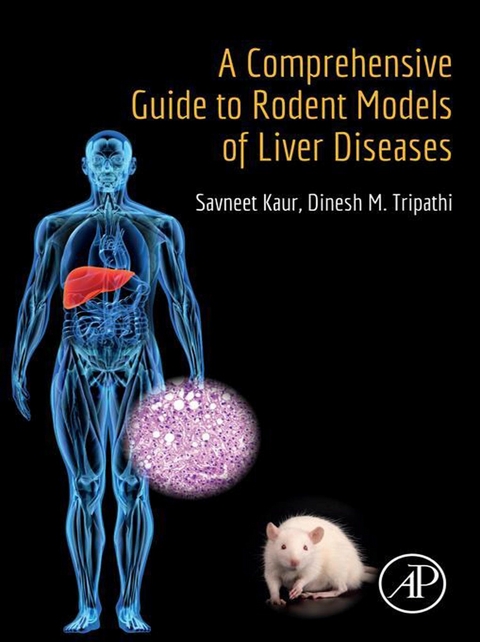
Comprehensive Guide to Rodent Models of Liver Diseases (eBook)
250 Seiten
Elsevier Science (Verlag)
978-0-323-99479-8 (ISBN)
Dr. Savneet Kaur is an Assistant Professor and Scientist-in-charge of the Animal House Facility in the Department of Molecular and Cellular Medicine, Institute of liver and Biliary Sciences (ILBS), New Delhi. She has specialization in experimental hepatology, stem cell biology and angiogenesis. Her lab in ILBS is focused to investigate the role of endothelial cells in liver physiology (regeneration) and pathophysiology (fibrosis cirrhosis and cancer). Dr Savneet has worked on several animal models of liver regeneration and diseases including partial hepactectomy model, chemical-induced liver injury, bile duct ligated model and non-alcoholic fatty liver disease. She has authored papers in peer-reviewed reputed journals and has several contributed book chapters to date.
A Comprehensive Guide to Rodent Models of Liver Diseases provides the why, what, and how of preclinical models of liver disease. These models have not only substantially improved understanding of human liver disease pathogenesis, but also helped in developing and testing newer therapeutics as well as addressed some of the unanswered medical challenges and problems of today.This important reference gives a detailed and in-depth review of the various animal models of human liver disorders. Well-reported animal models several human liver diseases such as fatty liver disease (non-alcoholic and alcoholic) to steatohepatitis, cholestasis, fibrosis, cirrhosis and its complications are described. Preclinical models used for studying liver regeneration and liver failure are also discussed. For each model, the characteristic features, brief protocols, relevance, and limitations are provided.Preclinical models used for studying liver regeneration and liver failure are also discussed. For each model, the characteristic features, updated protocols, relevance, and limitations are provided for consideration. Finally, it provides an overview of the recently developed organoid models of liver pathology. - Presents the characteristic features of each liver disease and their respective animal models- Delivers a summary of protocols available for making each animal model to save time in the lab- Clarifies the precise utility of each animal model and the questions it can or cannot address
| Erscheint lt. Verlag | 15.3.2025 |
|---|---|
| Sprache | englisch |
| Themenwelt | Naturwissenschaften ► Biologie |
| ISBN-10 | 0-323-99479-2 / 0323994792 |
| ISBN-13 | 978-0-323-99479-8 / 9780323994798 |
| Informationen gemäß Produktsicherheitsverordnung (GPSR) | |
| Haben Sie eine Frage zum Produkt? |
 EPUB (Adobe DRM)
Kopierschutz: Adobe-DRM
Adobe-DRM ist ein Kopierschutz, der das eBook vor Mißbrauch schützen soll. Dabei wird das eBook bereits beim Download auf Ihre persönliche Adobe-ID autorisiert. Lesen können Sie das eBook dann nur auf den Geräten, welche ebenfalls auf Ihre Adobe-ID registriert sind.
Details zum Adobe-DRM
Dateiformat: EPUB (Electronic Publication)
EPUB ist ein offener Standard für eBooks und eignet sich besonders zur Darstellung von Belletristik und Sachbüchern. Der Fließtext wird dynamisch an die Display- und Schriftgröße angepasst. Auch für mobile Lesegeräte ist EPUB daher gut geeignet.
Systemvoraussetzungen:
PC/Mac: Mit einem PC oder Mac können Sie dieses eBook lesen. Sie benötigen eine
eReader: Dieses eBook kann mit (fast) allen eBook-Readern gelesen werden. Mit dem amazon-Kindle ist es aber nicht kompatibel.
Smartphone/Tablet: Egal ob Apple oder Android, dieses eBook können Sie lesen. Sie benötigen eine
Geräteliste und zusätzliche Hinweise
Buying eBooks from abroad
For tax law reasons we can sell eBooks just within Germany and Switzerland. Regrettably we cannot fulfill eBook-orders from other countries.
aus dem Bereich