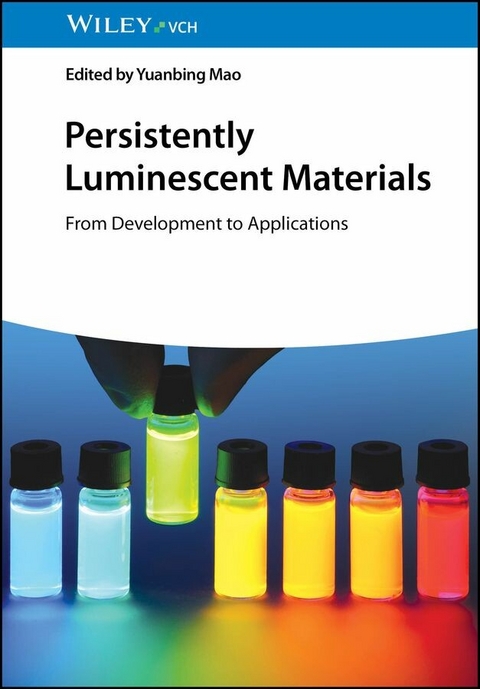
Persistently Luminescent Materials (eBook)
681 Seiten
Wiley-VCH (Verlag)
978-3-527-84475-3 (ISBN)
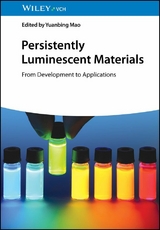
A broad view of the booming field in optical materials based on their applications and potentials.
Persistent luminescence refers to a property of materials in which they retain luminescence for hours or even days without a source of excitation once being charged. Persistently luminescent materials have found a huge range of technological applications, from optical displays to chemical sensing to information storage and security technologies. This growing field of research and development has never been such an important area of materials science.
Persistently Luminescent Materials offers a comprehensive overview of these emerging optical materials and their applications. It presents all major research trends, new information, and novel properties of the major and developing persistently luminescent materials. With detailed information on how to design new materials and create new functionalities, it's a must for researchers and technologists in virtually every major area of industry.
Persistently Luminescent Materials readers will also find:
- Practical applications in phototherapy, biological imaging, displays, and more
- Detailed discussion of topics including sustainability techniques, temperature sensing, sterilization, and optical information storage
- Analysis of how to use persistently luminescent materials to create new theranostic functionalities
Persistently Luminescent Materials is ideal for specialists and professionals in the field, but also for a broader readership seeking a perspective of practical needs related to the applications of optical and perticularly persistently luminescent materials.
Yuanbing Mao, PhD, is the Department Chair of and a professor of Chemistry at the Illinois Institute of Technology (IIT) in Chicago, USA. Having obtained his B.Sc. degree from Xiangtan University, M.Sc. degree from the Institute of Chemistry, Chinese Academy of Sciences, Ph.D. degree from the State University of New York at Stony Brook, and his postdoc training at the University of California at Los Angeles, he spent most of his early academic career working in South Texas before taking up his present appointment at IIT. He has received several awards, including the Department of Defense Young Investigator Award and the Outstanding Mentorship Award from the Council on Undergraduate Research, and is a recipient of the DOE Visiting Faculty Program.
1
Introduction to Persistently Luminescent Materials
Nimai Pathak1,2 and Yuanbing Mao1
1Illinois Institute of Technology, Department of Chemistry, 3101 S Dearborn Street, Chicago, IL 60616, USA
2Bhabha Atomic Research Centre, Radiochemistry Division, Central Avenue Road, Trombay, Mumbai, Maharashtra, 400085, India
1.1 Introduction
The term “persistent luminescence” (hereinafter PersL) generally refers to the glow‐in‐the‐dark or the “afterglow” property of a light emitting material, which continuously emits light lasting for a relatively long time, starting from seconds to even days after ceasing the excitation sources like ultraviolet (UV) or visible light (visible light in rare cases), electron beams, or high energy radiation such as X‐, α‐, β‐, or γ‐rays. It has a rich history which can be traced back as long as 1000 years ago when a Chinese artist Z. Xu painted a cow resting inside a barn with a special “night‐vision” ink imported from Japan. This inexplicable magic was later described by Y. Wen in a Chinese miscellaneous note called “Xiāng Shán Yě Lù” in the ancient Song dynasty (960–1279 CE) [1–3]. There was no scientific evidence about the raw material used for the preparation of this special “night‐vision” ink, but it was possibly sulfide compounds made of calcium from pearl shells and sulfur from volcanic activities [4]. Although most of the literature on persistently luminescent materials (PLMs) were available since the beginning of twenty‐first century (Figure 1.1a and c), a well‐organized report on any such night‐vision PLM substance was first written on Bologna stone by O. Montalbani in the book “De Illuminabili Lapide Bononiensi Epistola” in 1634 and then by F. Licetus in the book “Litheosphorus Sive de Lapide Bononiensi” in 1640 as shown in Figure 1.1b [2, 4]. An orange and reddish afterglow was observed from this stone in the dark after prior illumination by either sunlight or flame and described as “golden light of the Sun.” The stone was first synthesized by the Italian alchemist V. Cascariolo by calcining the mineral barite (BaSO4), found in Bologna, Italy. This marked the beginning of modern luminescence materials. The word “luminescence” was firstly used by E. Wiedemann, a German physicist in 1888, originating from the Latin word lumen with the meaning of light [6].
Figure 1.1 (a) Number of publications on PLMs in the Web of Science. (b) The book “Litheosphorus Sive de Lapide Bononiensi” about the afterglow phenomenon of the Bologna stone written by Fortunius Licetus in 1640 (Bologna, Italy).
Source: Adapted from Yuan [5].
(c) History of the development of PLMs.
Source: Yuan [5]/IOP Publishing.
Limited research was carried out to develop new afterglow materials until the end of the twentieth century. It took ∼400 years to prove that, instead of any “magic” power, the 3d94s1 → 3d10 transition of Cu+ impurities present in the Bologna stone is responsible for reddish‐orange afterglow peaking at ∼610 nm in the year 2012 [6]. For about 130 years, zinc sulfide (ZnS) doped with copper (Cu+) and codoped with cobalt (Co2+) emitting green emission (∼530 nm) was dominating commercial afterglow materials. It was particularly used in the military during World War I and World War II as well as for various civilian purposes such as luminous paints, watch dials, and “glow‐in‐the‐dark” toys, among others [2, 3, 7, 8]. Later on, trace amount of radioactive elements such as radium (Ra), promethium (Pm), or tritium (3H) were introduced into ZnS:Cu+,Co2+ system in order to improve its weak brightness and short persistency of luminescence. Although continuous irradiation by α‐ or β‐rays due to radioactive decay of those radioisotopes helped to improve the light output [4], the use of radioactive materials became a huge public concern in late 1990 owing to their unavoidable health problems and environmental pollution [4, 9]. This resulted in a sharp decrease in the annual sales of watches made of radioactive LPPs. Later, considering the huge potential market of watches based on PLMs, Japanese company Nemoto & Co., Ltd. gave a specific focus on developing radioactive‐free afterglow phosphors. After much trial and error, they finally succeeded in 1996 in developing the new generation PLM of SrAl2O4:Eu2+,Dy3+ with a bright green emission peaking at ∼520 nm and lasted for over 30 hours [10–12]. Since the development of SrAl2O4:Eu2+,Dy3+ PLM, the searching for various other novel PLMs began to speed up around the world.
Most of the PLMs developed before and after the discovery of SrAl2O4:Eu2+,Dy3+ are inorganic in nature as discussed in Section 1.3.2. Molecular organic solid‐state materials with persistent luminescence, originated from room temperature phosphorescence (RTP) and thermally activated delayed fluorescence (TADF), are also becoming increasingly popular. Molecular PLMs (MPLMs) have several advantages over their inorganic counterparts containing transition metals and/or rare earth metals, such as potentially facile tuning of structure, simple processing, and easy fabrication of soft and flexible optical devices. They have shown potential applications in biological imaging, optical recording devices, chemical sensing, and security systems [13–15]. However, many scientific and technical issues still remain to be resolved before their widespread implementations. For instance, their optical properties are highly dependent on their crystalline state and need to be used in the solid state because their solution or amorphous forms show weak persistent luminescence. PersL based on molecular hybrid structures can overcome these limitations because intermolecular interactions such as hydrogen bonding enhance the rigidity of molecular conformations and restrict molecular motions and vibration. This helps to minimize the nonradiative decay of triplet excitons and improve their photoemission lifetimes and quantum efficiencies (QEs) [14]. As studies on MPLMs have been advanced tremendously in recent years, inorganic PLMs (IPLMs) have been investigated more in both research and development. Hence, we have mostly focused discussion on IPLMs with limited examples of MPLMs in this chapter as well as this book.
So far applications of IPLMs such as LumiNova® products are mostly in the areas of decoration, toys, safety signage, watch dials, and displays (Figure 1.2a–f). Continuous efforts have been put into exploring their new applications, such as glow‐in‐the‐dark road markings, bio‐imaging, photocatalysis, AC‐driven light‐emitting diodes (LEDs) with reduced flickering, or pressure sensors to visualize ultrasound beams [18–21]. Research work on these new applications has progressed well while many challenges are still facing as shown in Figure 1.2e. In other words, after the successful development of the bright green emitting SrAl2O4:Eu2+,Dy3+ PLM, research interest and effort on both finding new and efficient PLMs and exploring their potential applications on various advanced fields have been significantly increased as suggested by hundreds of new publications reported yearly on various PLMs as shown in Figure 1.1a. Hence, many review papers, book chapters, and sometimes entire books have been published on PLMs to cover the whole field, focused on a specific class of materials including Eu2+, Cr3+, and Mn2+‐doped PLMs, or targeted specific applications like near‐infrared (NIR) bio‐imaging by researchers worldwide [5, 12, 16, 17, 22–27]. Most of these publications introduce key synthesis methods, characterization methods, physical mechanisms, and applications of this important luminescent materials system. They cover mostly the basics of PersL followed with a concise description of the most relevant applications of related PLMs. To advance PersL and PLMs to the next stage, we dedicate this book to the perspective of practical needs related to the applications of PLMs, which is expected to attract a broader readership, including not just specialists and professionals in the field, but also extending to beginners to this diverse field along with any interested parties to this fascinating field.
Figure 1.2 (a) Examples of LumiNova® products and their practical usages for (b) emergency signage, (c) “night‐vision” luminous paints, and (d) watch dials.
Source: [16]/Nemoto & Co., Ltd.
(e) A summary of various established, in progress, and challenging applications of PLMs.
Source: Poelman et al. [17]/AIP Publishing.
(f) Applications of PLMs based on optically stimulated luminescence.
Source: Adapted from Yuan [5].
With this intention in mind, in this introductory (Chapter 1), we provide a brief description of various PLMs, the basic mechanism involved in PersL...
| Erscheint lt. Verlag | 21.3.2025 |
|---|---|
| Sprache | englisch |
| Themenwelt | Naturwissenschaften ► Chemie |
| Schlagworte | Anti-counterfeiting • biological imaging • Chemical sensing • Excitation Source • functional material • initial excitation • Luminescence • Phototherapy • Security Technology • self-sustaining optical display • transition metal ion activated inorganic material |
| ISBN-10 | 3-527-84475-9 / 3527844759 |
| ISBN-13 | 978-3-527-84475-3 / 9783527844753 |
| Informationen gemäß Produktsicherheitsverordnung (GPSR) | |
| Haben Sie eine Frage zum Produkt? |
 EPUB (Adobe DRM)
Kopierschutz: Adobe-DRM
Adobe-DRM ist ein Kopierschutz, der das eBook vor Mißbrauch schützen soll. Dabei wird das eBook bereits beim Download auf Ihre persönliche Adobe-ID autorisiert. Lesen können Sie das eBook dann nur auf den Geräten, welche ebenfalls auf Ihre Adobe-ID registriert sind.
Details zum Adobe-DRM
Dateiformat: EPUB (Electronic Publication)
EPUB ist ein offener Standard für eBooks und eignet sich besonders zur Darstellung von Belletristik und Sachbüchern. Der Fließtext wird dynamisch an die Display- und Schriftgröße angepasst. Auch für mobile Lesegeräte ist EPUB daher gut geeignet.
Systemvoraussetzungen:
PC/Mac: Mit einem PC oder Mac können Sie dieses eBook lesen. Sie benötigen eine
eReader: Dieses eBook kann mit (fast) allen eBook-Readern gelesen werden. Mit dem amazon-Kindle ist es aber nicht kompatibel.
Smartphone/Tablet: Egal ob Apple oder Android, dieses eBook können Sie lesen. Sie benötigen eine
Geräteliste und zusätzliche Hinweise
Buying eBooks from abroad
For tax law reasons we can sell eBooks just within Germany and Switzerland. Regrettably we cannot fulfill eBook-orders from other countries.
aus dem Bereich