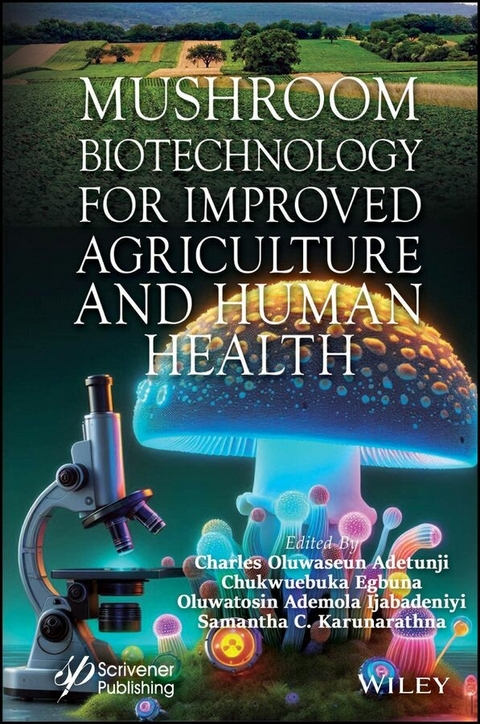
Mushroom Biotechnology for Improved Agriculture and Human Health (eBook)
583 Seiten
Wiley-Scrivener (Verlag)
9781394212675 (ISBN)
The book is essential for those seeking to understand innovative and sustainable solutions to global food insecurity and health challenges, as it offers invaluable insights into the transformative potential of mushroom biotechnology and its applications.
The intervention of microbial biotechnology in various sectors has displayed remarkable growth linked to sustainable innovations and biotechnological utilization of beneficial microorganisms, such as mushrooms, for the benefit of humanity. Recent advancements in mushroom biotechnology will prove successful due to mushrooms' nature as natural problem solvers, including their ability to enhance nutritional values obtained from agricultural crops, sustained health benefits derived from pharmacologically active substances used to manage human diseases, and improve crop production.
This book will serve as one of the first volumes addressing the usefulness of mushroom biotechnology, giving detailed state-of-the-art information on recent advancements and how the industry could maximize profits. The volume will also assist the pharmaceutical and medical sectors by examining the discovery of novel pharmacological and bioactive compounds that could replace the various adverse effects when using synthetic drugs. It presents a simple, adaptable, reproducible methodology that will help researchers and scientists adopt these methodologies for similar projects.
Readers will find that the book:
- Presents recent advances in the application of mushroom biotechnology in various sectors (food, agriculture, and health) for sustainable innovations for optimum benefit of mankind;
- Details applications of mushrooms for sustainable agriculture through their plant growth-promoting attributes and management of pests and diseases in plants and soils;
- Discusses the discovery of novel pharmacological substances from mushrooms for applications in the biomedical sector.
Audience
The book is valuable reference work for scientists and researchers working in the fields of pharmaceutical sciences, agricultural microbiology, plant pathology, botany, agriculture, microbiology, biotechnology, nanotechnology, environmental microbiology, and microbial biotechnology.
Charles Oluwaseun Adetunji, PhD, is a professor in the Department of Microbiology at the Edo University Iyamho, in Edo State, Nigeria. Currently, he is the Director of Intellectual Properties and Technology Transfer and Chairman of the Committee on Research Grants at EUI. He has won several scientific awards and grants from renowned academic bodies such as the Council of Scientific and Industrial Research (CSIR) India. He has published more than 600 papers in peer-reviewed national and international journals as well as more than 50 books, 340 book chapters, and many scientific patents.
Chukwuebuka Egbuna, PhD, is a chartered chemist and academic researcher. He has published numerous articles in international journals of repute and edited over 20 internationally published books. He serves as a reviewer and editorial board member of several journals and a member of the Institute of Chartered Chemists of Nigeria, the Nigerian Society of Biochemistry and Molecular Biology, and the Royal Society of Chemistry. His primary research interests include biochemistry, phytochemistry, pharmacology, nutrition and toxicology, food and medicinal chemistry, and analytical biochemistry.
Oluwatosin Ademola Ijabadeniyi, PhD, is a professor in the Department of Biotechnology and Food Science, Durban University of Technology, South Africa. He has published numerous scientific papers, edited one book, and authored four books. His work in this field has also earned him several awards including an Association of Commonwealth Universities fellowship and an Association of Public Health Libraries Centers for Disease Control fellowship.
Samantha C. Karunarathna, PhD, is a professor at Qujing Normal University, China. He has published over 360 publications and co-authored two books. His current research interests are taxonomy, phylogeny, and domestication of wild edible and medicinal mushrooms.
The book is essential for those seeking to understand innovative and sustainable solutions to global food insecurity and health challenges, as it offers invaluable insights into the transformative potential of mushroom biotechnology and its applications. The intervention of microbial biotechnology in various sectors has displayed remarkable growth linked to sustainable innovations and biotechnological utilization of beneficial microorganisms, such as mushrooms, for the benefit of humanity. Recent advancements in mushroom biotechnology will prove successful due to mushrooms nature as natural problem solvers, including their ability to enhance nutritional values obtained from agricultural crops, sustained health benefits derived from pharmacologically active substances used to manage human diseases, and improve crop production. This book will serve as one of the first volumes addressing the usefulness of mushroom biotechnology, giving detailed state-of-the-art information on recent advancements and how the industry could maximize profits. The volume will also assist the pharmaceutical and medical sectors by examining the discovery of novel pharmacological and bioactive compounds that could replace the various adverse effects when using synthetic drugs. It presents a simple, adaptable, reproducible methodology that will help researchers and scientists adopt these methodologies for similar projects. Readers will find that the book: Presents recent advances in the application of mushroom biotechnology in various sectors (food, agriculture, and health) for sustainable innovations for optimum benefit of mankind; Details applications of mushrooms for sustainable agriculture through their plant growth-promoting attributes and management of pests and diseases in plants and soils; Discusses the discovery of novel pharmacological substances from mushrooms for applications in the biomedical sector. Audience The book is valuable reference work for scientists and researchers working in the fields of pharmaceutical sciences, agricultural microbiology, plant pathology, botany, agriculture, microbiology, biotechnology, nanotechnology, environmental microbiology, and microbial biotechnology.
1
Application of Mushrooms in the Bioremediation of Environmental Pollutants
Isibor Patrick Omoregie1*, Oluwafemi Adebayo Oyewole2, Kayode-Edwards Ihotu1, Agbontaen Osagie David3, Konjerimam Ishaku Chimbekujwo4, Simon Sunday Ameh5, Samuel Adeniyi Oyegbade1 and Charles Oluwaseun Adetunji6
1Department of Biological Sciences, Covenant University, Ota, Ogun State, Nigeria
2Department of Microbiology, Federal University of Technology, Minna, Niger State, Nigeria
3Department of Public Health, University of South Wales, Pontypridd, UK
4Department of Microbiology, Modibbo Adama University, Yola, Adamawa State, Nigeria
5Department of Biochemistry, Federal University of Technology, Minna, Niger State, Nigeria
6Department of Microbiology, Edo State University, Uzairue, Edo State, Nigeria
Abstract
The application of mushrooms in bioremediation involves utilizing certain species of mushrooms to remediate or clean up contaminated environments. Mushrooms possess unique properties that make them effective in breaking down and absorbing various pollutants, including heavy metals, organic compounds, and even oil spills. This process, known as mycoremediation, leverages the abilities of mushrooms to degrade, detoxify, and accumulate harmful substances, such as heavy metals, polyaromatic hydrocarbons, solid wastes, and agricultural wastes, in their tissues. The mycelium (the underground network of fungal threads) plays a pivotal role in this process, as it has the ability to secrete enzymes that break down these pollutants, and it can also absorb and concentrate contaminants. Mycoremediation has been applied to diverse environments, including soil, water bodies, and industrial sites, as a more sustainable and natural approach to remediation compared to traditional methods. However, the efficacy of mycoremediation depends on factors such as mushroom species selection, environmental conditions, and the specific contaminants present. The potential of mushrooms in bioremediation is still being explored, and techniques are being improved for optimal outcomes.
Keywords: Mycoremediation, contaminants, pollutants, fungi, mycelium, environmental cleanup
Introduction
Bioremediation involves the utilization of microorganisms like bacteria and fungi, and plants, along with their enzymes, to restore polluted environments to their natural state. Bacteria that can break down specific soil pollutants, such as chlorinated hydrocarbons, through the process of microbial biodegradation are harnessed within the bioremediation process [1].
Furthermore, bioremediation involves harnessing biological processes to mitigate, and ideally eliminate, the harmful impacts caused by pollutants in specific locations. “In situ” bioremediation refers to when these biological processes are applied at the polluted site itself. On the other hand, if the contaminated material (such as soil and water) is intentionally moved to a different location to enhance biocatalysis, it becomes an “ex situ” case [2]. Although bacteria play a primary role in bioremediation, fungi and their potent oxidative enzymes are crucial for breaking down stubborn polymers and foreign chemicals. Additionally, various plants, whether natural, genetically modified, or in conjunction with rhizosphere microorganisms, are exceptional at eradicating or immobilizing pollutants. Nonetheless, this article solely focuses on bacteria due to the wealth of available genomes, enabling a systems biology approach to address significant environmental challenges [3].
Bioremediation primarily centers on intervention to mitigate pollution, placing it within the realm of biotechnology. It should not be confused with biodegradation, which explores the biological underpinnings of the metabolism of unusual or resistant compounds, mainly by bacteria. Large fungi, known as macrofungi, possess the capacity to gather and disintegrate a diverse range of harmful metals, proving to be an extremely efficient method for rejuvenating compromised environments. Typically, mushrooms employ three effective techniques—biodegradation, bioconversion, and biosorption—to successfully rehabilitate tainted or polluted soils [4].
White-rot fungi, as named due to their distinctive degradation process that causes wood substrates to bleach, employ enzyme secretion to digest wood lignin, resulting in a bleached wood appearance. The white-rot fungi process stands apart from established bioremediation methods like bacterial systems due to its unique natural mechanisms, conferring several advantages in pollutant degradation [5]. Notably, these fungi hold an edge over bacterial systems as they do not necessitate preconditioning to specific pollutants. Unlike bacteria, which require pre-exposure to induce pollutant-degrading enzymes, the degradation potential of white-rot fungi remains uninhibited by this prerequisite in addition to not being limited by concentration thresholds. Numerous strains of white-rot fungi with the capacity to degrade aromatic compounds have been identified. The versatile application of white-rot fungi encompasses bioremediation for polluted soils, heavy metal accumulation, mineralization, bio-deterioration, biodegradation, transformation, and co-metabolism [6].
Phanerochaete chrysosporium, a distinctive fungus, is emerging as the preeminent model for bioremediation. This organism possesses the capacity to degrade an array of substances including lignin macro molecules and various organopollutants such as polycyclic aromatic hydrocarbons (PAHs), polychlorinated biphenyls, dioxins, chlorophenols, chlorolignins, nitroaromatics, synthetic dyes, and diverse pesticides. The study selected robust degraders, including Phanerochaete sordida, Pleurotus ostreatus, Trametes versicolor, Nematolana frowardii, and Irpex lacteus, for examination [7].
P. chrysosporium has been observed to influence the bioleaching of organic dyes. This organism marked the initial discovery of extracellular ligninase enzymes capable of depolymerizing lignin and related compounds in vitro. Notably, P. chrysosporium effectively degrades toxic xenobiotics, including aromatic hydrocarbons, chlorinated organics, insecticides, pesticides, and nitrogen aromatics, with the degradation process involving laccases, polyphenol oxidases, and lignin peroxidases [8].
Trametes versicolor has demonstrated the production of three effective lignolytic enzymes capable of efficiently degrading lignin, polycyclic aromatic hydrocarbons, a mixture of polychlorinated biphenyls, and various synthetic dyes [9]. T. versicolor, along with its enzymes, has exhibited the ability to delignify and bleach kraft pulp [10], as well as proficiently dechlorinate and decolorize effluents from bleached kraft pulp [11]. This promising capability establishes the potential for innovative and environmentally friendly technologies within the pulp and paper industry. Amaral et al. [12] also documented the utilization of T. versicolor as biocatalysts for the decolorization of various industrial dyes and wastewater treatment. Recent investigations have indicated that P. ostreatus possesses the capacity to break down a diverse range of polycyclic aromatic hydrocarbons (PAHs). This ability extends to PAH degradation in non-sterile soil, irrespective of the presence of cadmium and mercury. P. ostreatus has been observed to catalyze the humification process for anthracene, benzo(a) pyrene, and flora in two PAH-contaminated soils originating from a manufactured gas facility and an abandoned electric cooping plant [13].
Lentinus squarrosulus has demonstrated the ability to mineralize soil contaminated with varying concentrations of crude oil, yielding elevated nutrient levels in the treated soil [14].
Unique Characteristics of Fungi
Fungi constitute a diverse group of eukaryotic organisms that play crucial roles in various ecosystems and have significant impacts on human life. They are distinct from plants, animals, and bacteria.
Fungi are made up of eukaryotic cells with well-defined nucleus and organelles. They lack chlorophyll and do not perform photosynthesis like plants. Instead, they are heterotrophic, obtaining nutrients by absorbing organic matter from their environment. Most fungi have a filamentous body structure composed of thread-like structures called hyphae. These hyphae collectively form a mass called a mycelium [15].
Some fungi, like yeast, are unicellular and do not form mycelium. Fungi reproduce both sexually and asexually. Asexual reproduction often involves the production of spores through processes like budding, fragmentation, or sporulation. Sexual reproduction involves the fusion of specialized sexual structures to form spores that carry genetic variation. Fungi are decomposers and play a vital role in nutrient cycling by breaking down complex organic matter into simpler compounds.
They form symbiotic relationships with other organisms, such as mycorrhizal associations with plants, where they help plants absorb nutrients from the soil. Fungi can be pathogenic, causing diseases in plants, animals, and humans. Examples include athlete’s foot, ringworm, and fungal infections in crops. Fungi are used in various industries. Yeast is used in baking and brewing also certain fungi are used to produce antibiotics like penicillin [13].
Fungi are also...
| Erscheint lt. Verlag | 21.3.2025 |
|---|---|
| Sprache | englisch |
| Themenwelt | Naturwissenschaften ► Biologie ► Botanik |
| Schlagworte | Bioactive Compounds • Biotechnology • CRISPR • Cross-Breeding • Genetic Engineering • healthy food • medical sector • mushroom • Mutagenesis • nanotechnology • nutritious • Pharmaceutical • Population • practical application • quality • sustainable agriculture • synthetic drugs • Xenobiotic Degradation |
| ISBN-13 | 9781394212675 / 9781394212675 |
| Informationen gemäß Produktsicherheitsverordnung (GPSR) | |
| Haben Sie eine Frage zum Produkt? |
 EPUB (Adobe DRM)
Kopierschutz: Adobe-DRM
Adobe-DRM ist ein Kopierschutz, der das eBook vor Mißbrauch schützen soll. Dabei wird das eBook bereits beim Download auf Ihre persönliche Adobe-ID autorisiert. Lesen können Sie das eBook dann nur auf den Geräten, welche ebenfalls auf Ihre Adobe-ID registriert sind.
Details zum Adobe-DRM
Dateiformat: EPUB (Electronic Publication)
EPUB ist ein offener Standard für eBooks und eignet sich besonders zur Darstellung von Belletristik und Sachbüchern. Der Fließtext wird dynamisch an die Display- und Schriftgröße angepasst. Auch für mobile Lesegeräte ist EPUB daher gut geeignet.
Systemvoraussetzungen:
PC/Mac: Mit einem PC oder Mac können Sie dieses eBook lesen. Sie benötigen eine
eReader: Dieses eBook kann mit (fast) allen eBook-Readern gelesen werden. Mit dem amazon-Kindle ist es aber nicht kompatibel.
Smartphone/Tablet: Egal ob Apple oder Android, dieses eBook können Sie lesen. Sie benötigen eine
Geräteliste und zusätzliche Hinweise
Buying eBooks from abroad
For tax law reasons we can sell eBooks just within Germany and Switzerland. Regrettably we cannot fulfill eBook-orders from other countries.
aus dem Bereich