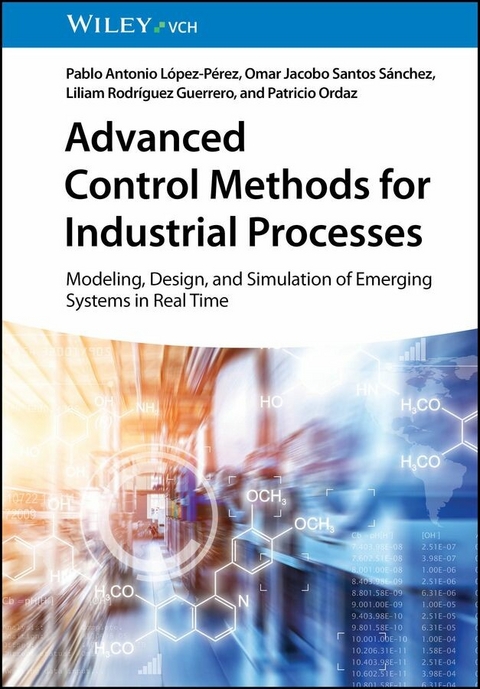
Advanced Control Methods for Industrial Processes (eBook)
575 Seiten
Wiley-VCH (Verlag)
978-3-527-84418-0 (ISBN)
A detailed introduction to mathematical models for new and established control engineers
Control engineering is a system that helps us understand electrical, physical, chemical, and biochemical systems through the use of mathematical modeling, using inputs, outputs, and simulations. These experimental platforms are implemented in most systems of modern advanced control engineering.
Advanced Control Methods for Industrial Processes provides a solid grounding in traditional control techniques. It emphasizes practical application methods alongside the underlying theory and core instrumentation. Each chapter discusses the full profile of the technology covered, from the field layer and control layer to its implementation. It also includes the interfaces for advanced control systems: between controllers and systems theory, between different layers, and between operators-systems. Through an emphasis on the practical issues of components, devices, and hardware circuits, the book offers working principles and operation mechanisms that allow an engineer to put theory into practice for the advanced control techniques.
Advanced Control Methods for Industrial Processes readers will also find:
- A practical overview on advanced control methods applied to real-time and in-silico systems
- Specific parameters, install procedures, calibration and configuration methodologies necessary to conduct the relevant models
- Clear insights into the necessary mathematical models
- Tutorial material to facilitate the understanding of core concepts
Advanced Control Methods for Industrial Processes is an ideal companion for process engineers, control engineers, and chemists in industry.
Pablo Antonio López-Pérez, Universidad Autónoma del Estado de Hidalgo, México.
Omar Jacobo Santos Sánchez, Universidad Autónoma del Estado de Hidalgo, México.
Liliam Rodríguez Guerrero, Universidad Autónoma del Estado de Hidalgo, México.
Patricio Ordaz, Universidad Autónoma del Estado de Hidalgo, México.
Chapter 1
Field Elements of Classic Control Systems
After reading this chapter, you should be able to understand that:
- The chapter mainly compares different classical theories regarding process control.
- We will focus on systems described in terms of ordinary differential equations for linear and nonlinear processes.
- In addition, it must be emphasized that most ideas, methods, and results presented here do extend to this more general setting, which leads to very important technical developments.
1.1 The Principles of Control (Industry 5.0)
Industry 5.0 is a continuation of Industry 4.0 with the objective of introducing humans (human intelligence) as the main axis of industrial production processes. Furthermore, innovation in production processes is human-oriented and highly customizable based on technological advances and high productivity of systems. However, the concept of Industry 5.0 is not accepted so far by corporations and industries but is promoted by researchers because, today, the industrial situation challenges are still congenital to Industry 4.0 and the era of digitalization. Industry 4.0 encourages high manufacturing efficiency and quality, and focuses on near novelty, techno-economic development, and industrial technology progress [1, 2]. Thus, Industry 5.0 is a prolongation and chronological extension of Industry 4.0 [3]. Industry 4.0 has restrictions with regard to industrial sustainability security, as it emphasizes on the productivity and flexibility of manufacturing through digitalization and technologies and integration of data from operations and business activity. The present manufacturing toward evolution of Industry 4.0 operations allows for better-quality productivity through information-driven automation, not only by infrastructure, but also by introducing more advanced monitoring, modeling, sensors, measurements, and control strategies in real time [4, 5]. One of the main advantages of Industry 4.0 is big data, which relates to large sets of processes and manufacturing data collected by sensors and greater visibility of process analytical technologies in the manufacturing operations. The improvements obtained from such a proactive, predictive feed-forward control approach can exceed the incremental yield progresses that corporations seek [6–9]. Furthermore, these data can be used for optimization purposes by applying innovative big data analytics. Machine learning (ML), a branch of artificial intelligence, is one of the ways to accomplish this [10] (see Figure 1.1).
Figure 1.1 The concept of Industry 5.0. Adapted from Borchardt et al. [11].
Technological processes consist of handling, working, refining, combining, and manipulating materials and fluids to produce cost-effective end products. These processes can be precise, demanding, and potentially hazardous. Small changes in a process can have a large impact on the end result [14, 15]. Variations in proportions, temperature, flow, turbulence, and many other parameters are to be carefully and consistently controlled to consistently produce the end product of the desired quality with a minimum of raw materials and energy. Instrumentation provides various indications used to operate a technological process [16–18]. In some cases, the operator records these indications for use in the operation of the process. The information recorded helps the operator evaluate the current condition of the process and take action if the conditions are not as expected. Requiring the operator to take all of the necessary corrective actions is impractical, or sometimes impossible, especially if a large number of indications are to be monitored. For this reason, most technological processes are controlled automatically once they are operating under normal conditions [19, 20]. The main role of process control was to contribute to safety, minimize external perturbation influence, and optimize processes by preserving process variables near the desired values. As the processes become larger in scale-up or behavior complex, the role of process automation has become more important. Today automation has taken over process control purposes, which means that operatives are assisted by a distributed control system, which communicates with the instruments in the real process. Process control is a combination of the statistics and engineering areas that deal with the sensors, designs, and algorithms for controlling a process. The aim of process control is to have it behave in a desired value. This includes the processes that are appealing, more accurate, more reliable, or more economical [21, 22] (see Figure 1.2).
Figure 1.2 The timeline of industrial revolutions. Adapted from Madsen and Berg [12] & Cohen and Singer [13].
In different manufacturing industries, advanced process control systems (APC) have become a nonnegotiable necessity for any manufacturing operation, which allows progress in the automation, understanding, and use of complex systems. APC incorporates a variety of model-based software system technologies, as well as stochastic and metaheuristic systems (see Figure 1.3). Currently, APCs provide supervisory control, bridging the gap between basic controls and overall process improvement, allowing the process to be cost-effective and of sustainable quality and operational safety aligned with Industry 4.0 and 5.0 [26–28].
Figure 1.3 The timeline of industrial revolution’s pyramid of automation. Adapted from López-Pérez et al. [7], Lucizano et al. [23], Wollschlaeger et al. [24], Martinez et al. [25].
1.2 Field Elements of Classic and Modern Control Systems
Modern advanced control techniques are model-based in data and look to apply mathematical optimization tools to optimize the performance based on future predictions and conditions. The necessary components and fields for this background are as follows:
- A dynamic model.
- Estimator that converts measured process variables into estimates of unmeasured states and/or parameters.
- An algorithm that computes the optimal control action based on model predictions (multi-objective optimization function or Pareto and constraint set).
- Methods that restrict the model to be linear.
- Methods that require a very large amount of data to provide any statistical guarantees.
- Methods for uncertainty descriptions are not necessarily accurate or related to physical quantities.
- Improving system performance in terms of functionality, security, energy efficiency, environmental impacts, and costs.
- Virtual sensors in the industry manages to optimize the operational performance, safety, functionality, and reliability of the bioprocess.
- Monitoring, diagnosis, and control could be provided more reliably and robustly using physical sensors.
- Embedded system is any device that is made up of a programmable computer (microprocessor or microcontroller).
- Computer hardware.
- Operating system in real time.
- Efficiency and quality in manufacturing.
- Hyper-competitive manufacturing sector.
- Internet of Things (IoT).
- Human–machine interface and supervisory control and data acquisition (SCADA).
- Basic regulatory control, advanced regulatory control, multivariable, model-based control, constrained economic optimization, multi-unit constrained economic optimization, first principle economic optimization (RTO), steady-state process model, and economic information (e.g., prices and costs) performance Index to be maximized (e.g., profit) or minimized (e.g., cost) [29, 30].
1.2.1 Advantages
- Reducing operational costs to secure tribal knowledge.
- Easy maintenance as it is not a compact system. In the case of breakdowns, the affected component is easily replaced without completely replacing the entire system.
- They have small size, so they easily adapt to any industrial application without requiring a large workspace.
- It is adaptable. Any necessary module can be integrated.
- They consume minimum energy, which causes the battery life to be extended.
- They give high performance in processing data at high speed and in real time.
1.2.2 Disadvantages
- They are specific operating systems.
- The software of an embedded system presents some restrictions such as small amounts of memory (generally, in the order of kB).
- Limited processing capabilities (generally, the speed of the processors does not exceed the order of MHz).
- Limits the consumption of instant energy whether in execution state or not.
- They may present cybersecurity risks because they feature weak encryption.
- Data shared between two devices can be easily intercepted and decrypted.
For example: data acquisition systems and system monitor parameters such as O2, CO2, temperature, flow, humidity, and pH based on the sensors that will collect data and the controllers to correspond to the set points of the variables. The measured data have the potential to practice another improved software tool for the estimation of variables and parameters from process data [31–33].
1.2.3 Why Control and Monitor?
The measurement of variables in processes is a necessary requirement to overcome following concerns:
- To know...
| Erscheint lt. Verlag | 20.3.2025 |
|---|---|
| Sprache | englisch |
| Themenwelt | Naturwissenschaften ► Chemie |
| Schlagworte | CLKF approach • configuration methodology • Control layer • core instrumentation • field layer • In-silico system • Mathematical Modeling • mec • MFC • Microbial Electrolysis Cell • Microbial fuel cell • Non-linear Controller • System Theory • TITO system |
| ISBN-10 | 3-527-84418-X / 352784418X |
| ISBN-13 | 978-3-527-84418-0 / 9783527844180 |
| Informationen gemäß Produktsicherheitsverordnung (GPSR) | |
| Haben Sie eine Frage zum Produkt? |
 EPUB (Adobe DRM)
Kopierschutz: Adobe-DRM
Adobe-DRM ist ein Kopierschutz, der das eBook vor Mißbrauch schützen soll. Dabei wird das eBook bereits beim Download auf Ihre persönliche Adobe-ID autorisiert. Lesen können Sie das eBook dann nur auf den Geräten, welche ebenfalls auf Ihre Adobe-ID registriert sind.
Details zum Adobe-DRM
Dateiformat: EPUB (Electronic Publication)
EPUB ist ein offener Standard für eBooks und eignet sich besonders zur Darstellung von Belletristik und Sachbüchern. Der Fließtext wird dynamisch an die Display- und Schriftgröße angepasst. Auch für mobile Lesegeräte ist EPUB daher gut geeignet.
Systemvoraussetzungen:
PC/Mac: Mit einem PC oder Mac können Sie dieses eBook lesen. Sie benötigen eine
eReader: Dieses eBook kann mit (fast) allen eBook-Readern gelesen werden. Mit dem amazon-Kindle ist es aber nicht kompatibel.
Smartphone/Tablet: Egal ob Apple oder Android, dieses eBook können Sie lesen. Sie benötigen eine
Geräteliste und zusätzliche Hinweise
Buying eBooks from abroad
For tax law reasons we can sell eBooks just within Germany and Switzerland. Regrettably we cannot fulfill eBook-orders from other countries.
aus dem Bereich