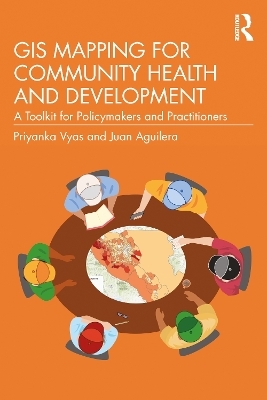
GIS Mapping for Community Health and Development
Routledge (Verlag)
978-1-032-85420-5 (ISBN)
This book explores how maps generated through Geographic Information Systems (GIS) can be used to integrate principles of health equity and environmental justice into community planning and decision-making.
To do this, the book puts forward the 3Ps of GIS mapping: People, Place, and Policy. This book demonstrates how different maps reveal different spatial disparities for each topic, providing alternative lens for addressing socio‑cultural, political, or geographical issues. Using a step-by-step approach, and covering the core concepts by which GIS maps can be interpreted, it builds to provide a comprehensive understanding of what a GIS-generated map may tell us, though crucially also what it may not. Featuring illustrated examples throughout, this book is essentially a tool kit to support a nuanced and holistic perspective on community planning.
It will appeal to policymakers, planners, and public health consultants, as well as students moving toward this field.
Priyanka Vyas is an educator, scientist, an interdisciplinary scholar and a practitioner who brings over a decade of experience at the intersection of public health, GIS, urban planning and policy. Trained as a social scientist, she has applied her training in public administration and public policy to address a variety of issues that have strong implications for public policy decision-making. Her work has focused on place-based differences in health behaviour and outcomes and the role of policy in addressing these gaps. Juan Aguilera is a physician and public health researcher whose work examines how environmental and lifestyle factors—such as heat exposure and air pollution—affect immune, respiratory, and metabolic health. With deep experience in diverse and border-region communities, he uses mapping and data-driven, interdisciplinary approaches to uncover spatial patterns in health risk and resilience. His applied research bridges science and community practice to guide sustainable public health strategies for long-term community health impact.
Preface. Section 1: Place. 1.Mirror, Mirror on the Wall, Which Is the Right Map of All? 2.Looking Inside Versus Outside: Natural Breaks Map. 3.Quartiles, Percentiles, Standard Deviation Maps and More: Who is Above the Mean? Who is Below? Section 2: Policy. 4.Maps as an Outcome of Measures. 5.How Not to Compare Apples with Oranges: Approaches for Area and Point Data. 6.What to Map: Choosing Between Aggregated versus Disaggregated Data, Categories versus Quantitative. 7.Measurements: Are More the Merrier? Section 3: People. 8.Yardstick Competition: Am I Similar to my Neighbors? 9.Do Birds with the Same Feather Flock Together? From Social Marketing to Using Maps for Geographically Targeted Health Intervention.
| Erscheinungsdatum | 16.08.2025 |
|---|---|
| Zusatzinfo | 95 Halftones, color; 95 Illustrations, color |
| Verlagsort | London |
| Sprache | englisch |
| Maße | 156 x 234 mm |
| Gewicht | 270 g |
| Themenwelt | Medizin / Pharmazie ► Medizinische Fachgebiete ► Arbeits- / Sozial- / Umweltmedizin |
| Naturwissenschaften ► Geowissenschaften ► Geografie / Kartografie | |
| Technik ► Bauwesen | |
| ISBN-10 | 1-032-85420-0 / 1032854200 |
| ISBN-13 | 978-1-032-85420-5 / 9781032854205 |
| Zustand | Neuware |
| Informationen gemäß Produktsicherheitsverordnung (GPSR) | |
| Haben Sie eine Frage zum Produkt? |
aus dem Bereich