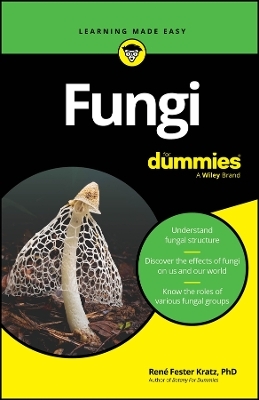
Fungi For Dummies
For Dummies (Verlag)
978-1-394-34483-3 (ISBN)
Fungi For Dummies gives you an in-depth view of the wide world of mycology. With this science-focused yet clear and readable book, you'll dig deep into the science of the fascinating organisms that help this planet thrive. Learn about fungi classifications and structures, their uses in and beyond medicine, their importance to environmental sustainability, and how they have shaped human cultures around the world. Go beyond the typical mushroom field guide and get a thorough introduction to the study of mycology that tracks a typical undergraduate course in the field.
Grasp the basics of mycology, including how fungi grow and how they differ from plants
Discover the role fungi play in ecosystems around the world
Learn to classify the different biological structures that appear in fungi
Know the various fungal groups and their roles in nature and in human endeavors
Perfect for those who want or need to get a grasp on mycology, Fungi For Dummies is an approachable introduction to this essential organism group.
René Fester Kratz, PhD, is a biology instructor at Everett Community College and a member of the North Cascades and Olympic Science Partnership. She’s also the author of Botany For Dummies and Molecular & Cell Biology For Dummies.
Introduction 1
About This Book 1
Foolish Assumptions 2
Icons Used in This Book 2
Beyond the Book 3
Where to Go from Here 3
Part 1: Getting Started with Fungi 5
Chapter 1: Finding the Fungus Among Us 7
Appreciating the Power of Fungi in Nature 8
Exploring How Fungi Form Partnerships with Other Organisms 9
Taking a Close Look at Fungal Structures 9
Unlocking the History of Fungi 10
Discovering the Many Groups of Fungi 11
Making Connections Between Fungi and People 12
Chapter 2: Exploring the Role of Fungi in Nature 13
Why Fungi Aren’t Plants (and Never Were) 14
Absorbing food from others 14
Creating a kingdom for fungi 15
Decomposing the Dead 18
Employing enzymes 19
Recycling carbon 21
Fighting global warming 24
Parasitizing the Living 25
Attacking insects and plants 26
Threatening the survival of amphibians and bats 27
Causing diseases in people 29
Making Connections in Communities 32
Chapter 3: Benefitting from Fungal Relationships 35
Exploring the Wood Wide Web 35
Extending the reach of plant roots 37
We speak for the trees: Ectomycorrhizae 39
Relying on arbuscular mycorrhizae for better plant growth 41
Helping heather grow: Ericoid endomycorrhizae 42
Getting orchids started: Orchidaceous endomycorrhizae 43
Living on the Edge: Lichens 44
Contributing to the partnership 46
Discovering the diversity of lichen shapes 49
Exploring the role of lichens in ecosystems 49
Chapter 4: Examining Fungal Structures 53
Focusing on Fungi from the Cells Up 53
Examining eukaryotic structures 54
Finding out about unique features 60
Starting with Spores 62
Spreading spores 65
Germinating when the time is right 66
Weaving Through the World 67
Growing from the tip 68
Forming mycelia 69
Recognizing Different Species 69
Mapping a mushroom 70
Paying attention to place 73
Chapter 5: Reproducing the Fungal Way 75
Exploring Fungal Reproduction 76
Mitosis 79
Meiosis 84
Identifying Sources of Variation 87
Nonsexual variation 87
Sexual variation 88
Part 2: Diving Deeper Into Fungal Groups 91
Chapter 6: Mapping the Genetics of Fungi 93
Exploring the Genomes of Fungi 93
Examining Fungal Chromosomes 97
Variation in fungal genomes 98
One gene, one enzyme 99
Mapping Chromosomes 101
Genetic mapping in fungi 101
Physical mapping in fungi 104
Chapter 7: Digging Into the Origins of Fungi 107
Writing the Fungal Origin Story 107
Considering aquatic origins 108
Moving to land 109
Discovering Fossil Fungi 110
Looking for Ancestral Groups 111
Making phylogenetic trees 113
Interpreting phylogenetic trees 115
Creating a system 116
Chapter 8: Swimming with Zoosporic Fungi 119
Reproducing with Zoospores 119
Living Off Others with the Opisthosporidia 121
Aphelidea 121
Rozellidea 122
Microsporidia 123
Digesting the Tough Stuff with the Chytridiomycota 124
Discovering the many roles of chytrids in nature 126
Taking a closer look at chytrid life cycles 129
Ruminating with Neocallimastigomycota 131
Attacking Crops with the Blastocladiomycota 132
Chapter 9: Adapting to Life on Land with the Zygomycetous Fungi 133
Uniting the Zygospore-forming Fungi 133
Forming Mycelia with Zoopagomycota 135
Forming Arbuscular Mycorrhizae with the Glomeromycota 136
Getting Familiar with Mucoromycota 137
Spoiling food with Rhizopus 138
Detecting light with Phycomyces 139
Popping your top with Pilobolus 141
Exploring the Life Cycle of the Zygomycetous Fungi 142
Chapter 10: Morels, Yeasts, Mildews, and More: The Ascomycota 145
Discovering the Characteristics of the Ascomycota 145
Examining the different shapes of ascocarps 147
Observing the colors of molds and mildews 148
Growing by Yeast and Hyphae with the Taphrinomycotina 150
Budding with the Saccharomycotina 151
Forming Ascocarps with the Pezizomycotina 152
Looking at the Life Cycle of the Ascomycota 155
Exploring the diversity of asexual reproduction 156
Reproducing sexually with ascospores 157
Chapter 11: Portobellos, Puffballs, Stinkhorns, and More: The Basidiomycota 159
What It Takes to Be a Member of the Club 159
Exploring the life cycle of the basidiomycetes 162
Catapulting spores 163
Recognizing Familiar Fungi in the Agaricomycotina 165
Delving into the diversity of Agaricomycetes 166
Interacting with insects 168
Generating Rusts on Plants with the Pucciniomycotina 171
Forming Smuts on Plants with the Ustilaginomycotina 173
Part 3: Putting Fungi to Use 175
Chapter 12: Fine Dining with Fungi 177
Feeding Ourselves with Fungi 177
Benefitting from diverse fibers 178
Tasting fabulous flavors 181
Foraging to find wild fungi 184
Fermenting with Fungi 186
Using yeast to make beer, wine, and bread 187
Producing sake and soy sauce with aspergillus 190
Using molds to preserve milk as cheese 191
Chapter 13: Spiritual Uses of Fungi 195
Exploring Human Perceptions 195
Sending and receiving signals with neurons 197
Moving across synapses with neurotransmitters 198
Expanding the Mind with Magic Mushrooms 199
Unlocking the power of psilocybin 200
Practicing traditional healing 203
Managing mental health 205
Avoiding dangerous impostors 205
Chapter 14: Using Fungi as Medicine 209
Producing Antibiotics from Fungi 209
Engaging in microbial warfare 211
Identifying useful compounds 211
Continuing the search 213
Exploring Traditional Uses of Fungi 216
Moving from Traditional Knowledge to Western Medicine 220
Fighting cancer 222
Promoting cardiovascular health 223
Controlling diabetes 225
Preventing Dementia 227
Chapter 15: Farming Fungi 229
Growing Mushrooms at Home 229
Choosing a mushroom 230
Deciding on your method 231
Looking at Commercial Production of Fungi 235
Starting life in the laboratory 235
Getting a boost as grain spawn 236
Preparing the substrate 236
Inoculating the substrate 236
Harvesting the crop 237
Part 4: the Part of Tens 239
Chapter 16: Ten Fantastical Fungi Tricks 241
Turning Ants into Zombies 241
Attracting Insects with Rotting Meat 242
Striking Fear in Mushroom Foragers 242
Absorbing Radiation 243
Living Underwater 244
Living Extra Large 245
Exploding into a Cloud of Smoke 245
Glowing in the Dark 246
Growing in an Ant’s Garden 247
Fighting Cancer 248
Chapter 17: Ten Ways We May Use Fungi in the Future 251
Breaking Down Plastics 251
Improving Biofuel Production 253
Using Mycorrhizae as Natural Fertilizer 253
Fighting Infections with New Fungal Compounds 254
Controlling Biofilms in Medical Settings 255
Improving Nerve Function 256
Eating More Fungal Foods 256
Cleaning Up Pollutants 257
Using Fungal Enzymes in Industry 258
Farming for the Future 259
Chapter 18: Ten Resources for Learning More About Fungi 261
The North American Mycological Association 262
Your Local Mushroom Club 262
The U.S Centers for Disease Control and Prevention 263
Fungiwoman 263
Websites 263
Podcasts 264
YouTube 264
Fungi-Friendly Books and Magazines 264
iNaturalist 266
Commercial Suppliers for Growing Fungi 266
Index 267
| Erscheinungsdatum | 18.10.2025 |
|---|---|
| Sprache | englisch |
| Maße | 140 x 213 mm |
| Gewicht | 295 g |
| Themenwelt | Sachbuch/Ratgeber ► Natur / Technik ► Natur / Ökologie |
| Naturwissenschaften ► Biologie ► Botanik | |
| Naturwissenschaften ► Biologie ► Mykologie | |
| ISBN-10 | 1-394-34483-X / 139434483X |
| ISBN-13 | 978-1-394-34483-3 / 9781394344833 |
| Zustand | Neuware |
| Informationen gemäß Produktsicherheitsverordnung (GPSR) | |
| Haben Sie eine Frage zum Produkt? |
aus dem Bereich