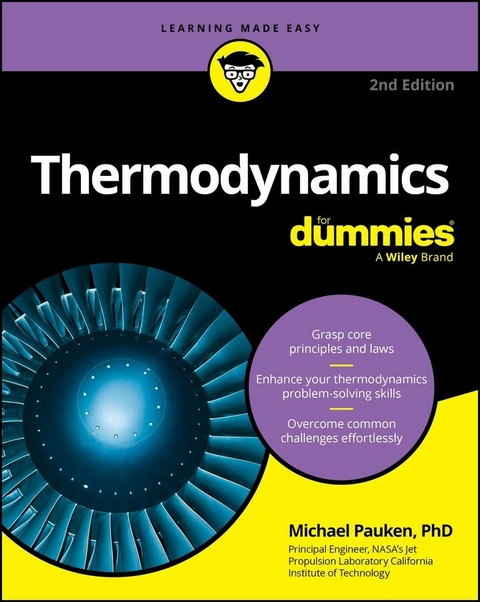
Thermodynamics For Dummies (eBook)
526 Seiten
For Dummies (Verlag)
978-1-394-32350-0 (ISBN)
The thermodynamics knowledge you need to succeed in class-and in your career
Thermodynamics For Dummies, 2nd Edition covers the topics found in a typical undergraduate introductory thermodynamic course (which is an essential course to nearly all engineering degree programs). It also brings the subject to life with exciting content on where (and how!) thermodynamics is being used today (spoiler alert: everywhere!). You'll grasp the basics of how heat and energy interact, thermodynamic properties of reactions and mixtures, and how thermodynamic cycles are used to make things go. This useful guide also covers renewable energy systems, new refrigerant technology, and a more diverse perspective on the history of the field.
Within, you'll:
- Get clear explanations of the laws of thermodynamics, thermodynamic cycles, and beyond
- Read about real-world examples to help you connect with the content
- Practice solving thermodynamic problems to internalize what you've learned
For students looking for resources to demystify thermodynamics, Thermodynamics For Dummies, 2nd Edition is the perfect choice. Become thermodynamically savvy with this accessible guide!
Michael Pauken, PhD, is a principal mechanical engineer at NASA's Jet Propulsion Laboratory. He specializes in spacecraft thermal control systems and interplanetary exploration. He was previously a lecturer in Mechanical Engineering at the California Institute of Technology, teaching courses in thermodynamics and heat transfer.
Introduction
Thermodynamics often stands as a “gateway” course in engineering schools. It can make or break an aspiring engineer’s journey. For some, passing through the gate means continuing with engineering, while for others, it may lead to a change in direction (which isn’t necessarily a bad thing).
The difference between struggling and succeeding often lies in having a great teacher and an engaging book. However, learning styles vary; some students may not connect with “Professor A,” while others may find them to be the best educator they’ve ever had. Similarly, some students grasp concepts from the chosen textbook easily, while others don’t.
It's unfortunate when people give up on something they find difficult. Many subjects aren’t as hard as they initially seem; they just require a moment of clarity for understanding. You can understand thermodynamics. This book can help you through that gate into engineering.
About This Book
Thermodynamics For Dummies, 2nd Edition can help you understand how energy is used in systems we use frequently such as automobiles, refrigerators, water heaters, and power plants. This book is written with you in mind, using relatable examples to help explain concepts. Some of the examples in this book are interconnected providing a cohesive learning experience. For example, when exploring the thermodynamics of a diesel engine in Chapter 11, you read that its energy source is derived from combustion. Later, as you study combustion reactions in Chapter 17, you see exactly how much energy these reactions provide to power a diesel engine.
In engineering schools, thermodynamics is often taught in both mechanical engineering and chemical engineering curriculums. This book comes at thermodynamics from a mechanical engineering perspective. I focus on how energy is used in vehicles, refrigeration, and power plants. Although I cover nonreacting gas mixtures and combustion reactions, I don’t go into chemical equilibrium.
In this second edition of Thermodynamics For Dummies, I updated numerous example problems in each chapter and added new problems for you to solve on your own (complete with answers to check your work). As I set out to update this book, I reflected on the changes that have occurred over the past decade since the first edition was published. While the fundamental laws of thermodynamics remain unchanged, many of their applications have evolved significantly.
For instance, the production of energy from renewable sources has grown tremendously since the early 2000s. Today, wind turbines, electric vehicles, and solar panels are commonplace across the globe. To address this shift, I include a new Chapter 14 that focuses on the thermodynamics of renewable energy systems. Your classroom textbook may not delve deeply into topics such as wind and solar power systems, but this chapter provides a more detailed exploration of these technologies.
Another new feature in this edition is a series of sidebars titled Inspirational Spotlights, which highlight individuals who have made remarkable contributions to the field of thermodynamics. If any of these individuals spark your interest, I encourage you to explore and research their stories further. For example, Chapter 14 features William Kamkwamba, who, inspired by a library book titled Using Energy, constructed a windmill from salvaged parts to generate electricity for his family’s home in Malawi.
Conventions Used in This Book
Every subject has its own language, and thermodynamics is no different. I use the following conventions in this book:
- Whenever I introduce a technical term, I use italics so you can quickly see it and look for an explanation.
- I also use italics to indicate variables in mathematical equations.
- I work all the examples in the metric system, because it’s less confusing than the system of feet, inches, pounds, and so on that is common in the U.S.
- I use boldface for velocity (V) and italics for total volume (V) to distinguish between these two variables.
- I also use boldface to denote the action parts of numbered steps and to highlight key words or phrases in bulleted lists.
What You’re Not to Read
If you want to read this book cover-to-cover, that’s up to you. But if you just want to get an explanation of something you’re stuck on, you can skip the sidebars (they appear in gray-shaded boxes).
Sidebars are tidbits of information that have interesting information related to a topic. You can grasp the fundamentals without reading them, but they do enhance your overall enjoyment because many feature modern day heroes in thermodynamics.
Foolish Assumptions
I assume that you’ve taken an introductory physics class. If so, you may have seen a little bit of thermo already. But if you haven’t had physics, don’t worry; you can probably grasp the concepts in this book anyway.
I also assume you’ve had some calculus. In some parts of thermodynamics, you have to understand how to use an integral (Chapters 8 and 9). You don’t have to be an expert in calculus to follow along because these parts of thermodynamics involve the simplest kinds of equations. Even if you don’t know a thing about calculus, you can still solve almost all the problems in this book using basic algebra.
How This Book Is Organized
I organized this book along the lines of most undergraduate thermodynamic textbooks, which start with the basics and progress to more difficult subjects. Four parts of the book deal directly with thermodynamics, while the fifth part gives you a quick peek at well-known names and processes in thermodynamics. You can follow this book from beginning to end along with your own thermodynamics textbook, or you can just dip into any section and chapter to get help with something you may be stuck on.
Part 1: Getting Started with Thermodynamics
In Part 1, I begin by presenting examples of both natural and engineered thermodynamic systems to help you recognize and relate to the concepts of thermodynamics. After you’re comfortable with these examples, I explain how energy can be used to perform work and how work can be used to transfer energy.
I demonstrate that a thermodynamic system consists of several processes, each with a distinct starting point and endpoint, defined by the properties of the materials involved. Some of the basic properties discussed include temperature, pressure, internal energy, enthalpy, entropy, and specific heat. And yes, I know you’re eager to read about the laws of thermodynamics, so I introduce them here as well.
Part 2: Employing the Laws of Thermodynamics
In this part, I cover the fundamental concepts of the conservation of mass and the conservation of energy. Simply put, these principles state that neither mass nor energy can be created or destroyed, but both can change form. In essence, the total amount of mass and energy at the start of any process equals the total amount at the end. While this idea may seem straightforward, it can get tricky when mass transitions from one state — such as a liquid to a gas — or when energy transforms, such as heat converting to work. I simplify these complexities by demonstrating how to apply the first law of thermodynamics to various systems and processes.
The second law of thermodynamics, often considered the most challenging aspect of thermodynamics, is more approachable than it may seem. At its core, the second law is about the direction of energy flow, which, like a river, moves in one direction: downhill. The idea is that energy begins in a high-energy reservoir, performs some useful work — such as spinning a motor — and then flows into a lower-energy reservoir. Sometimes the energy in this lower reservoir can still be harnessed; other times, it cannot. The abstract concept of entropy captures this behavior, helping you determine whether a process is feasible or not.
Part 3: Planes, Trains, and Automobiles: Making Heat Work for You
Part 3 dives into some of the most fascinating aspects of thermodynamics. If you find yourself feeling stuck as you begin studying the subject, I suggest spending a few minutes exploring this section to discover the exciting applications that await after you mastered the basics. Think of it as window shopping — it may just motivate you to push through and reach the “fun” part of thermodynamics.
In this part, I explain how to apply the first and second laws of thermodynamics to systems such as gasoline and diesel engines, jet engines, electric power plants, refrigerators, and air conditioners. You discover how to calculate the efficiency of these machines and explore ways to make them even better. Intriguing, isn’t it?
Part 4: Handling Thermodynamic Relationships, Reactions, and Mixtures
In Part 4, I cover how gases behave and relate to one another in different situations. Many gases obey a special relationship law called the ideal gas law; others don’t behave that way and are called real gases. Some gas mixtures react with each other, such as the combustion of gasoline vapor in air, and form carbon dioxide and water vapor. Combustion reactions are especially important because they’re...
| Erscheint lt. Verlag | 17.3.2025 |
|---|---|
| Sprache | englisch |
| Themenwelt | Sachbuch/Ratgeber ► Natur / Technik |
| Naturwissenschaften ► Physik / Astronomie | |
| Schlagworte | basic thermodynamics • beginning thermodynamics • Engineering • intro thermodynamics • laws of thermodynamics • renewable energy • Thermodynamic Cycles • thermo dynamics • thermodynamics • thermodynamics book • thermodynamics study • thermodynamics textbook • thermodynamic systems |
| ISBN-10 | 1-394-32350-6 / 1394323506 |
| ISBN-13 | 978-1-394-32350-0 / 9781394323500 |
| Informationen gemäß Produktsicherheitsverordnung (GPSR) | |
| Haben Sie eine Frage zum Produkt? |
 EPUB (Adobe DRM)
Kopierschutz: Adobe-DRM
Adobe-DRM ist ein Kopierschutz, der das eBook vor Mißbrauch schützen soll. Dabei wird das eBook bereits beim Download auf Ihre persönliche Adobe-ID autorisiert. Lesen können Sie das eBook dann nur auf den Geräten, welche ebenfalls auf Ihre Adobe-ID registriert sind.
Details zum Adobe-DRM
Dateiformat: EPUB (Electronic Publication)
EPUB ist ein offener Standard für eBooks und eignet sich besonders zur Darstellung von Belletristik und Sachbüchern. Der Fließtext wird dynamisch an die Display- und Schriftgröße angepasst. Auch für mobile Lesegeräte ist EPUB daher gut geeignet.
Systemvoraussetzungen:
PC/Mac: Mit einem PC oder Mac können Sie dieses eBook lesen. Sie benötigen eine
eReader: Dieses eBook kann mit (fast) allen eBook-Readern gelesen werden. Mit dem amazon-Kindle ist es aber nicht kompatibel.
Smartphone/Tablet: Egal ob Apple oder Android, dieses eBook können Sie lesen. Sie benötigen eine
Geräteliste und zusätzliche Hinweise
Buying eBooks from abroad
For tax law reasons we can sell eBooks just within Germany and Switzerland. Regrettably we cannot fulfill eBook-orders from other countries.
aus dem Bereich