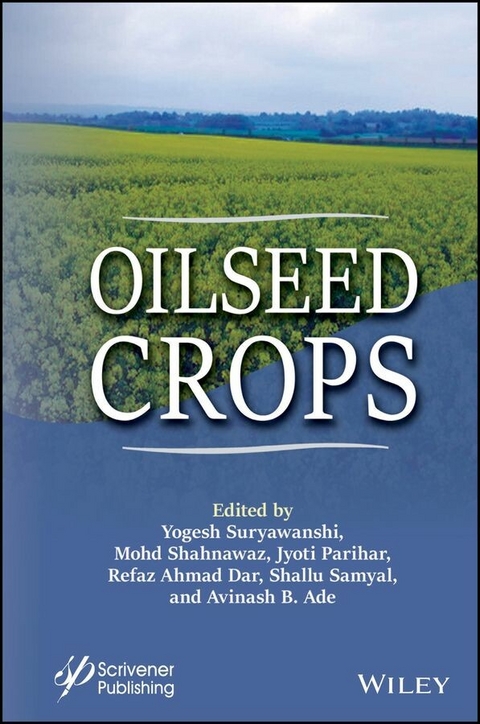
Oilseed Crops (eBook)
786 Seiten
Wiley-Scrivener (Verlag)
978-1-394-18640-2 (ISBN)

Oilseed Crops offers essential insights into sustainable biotechnological advancements that are vital for enhancing oil production and meeting the skyrocketing global demand for food, fuel, and energy.
Plants, particularly oilseed crops, have played a crucial role in biotechnology since the early 20th century, providing sustainable resources for food, fodder, and fuel. The book 'Oilseed Crops' delves into using biotechnological methods to enhance both edible and non-edible oils sustainably. It offers an in-depth look at the global oil plant market, growth influencers, adulteration detection, and yield improvement strategies. Highlighting significant advancements in oilseed research-such as plant-microbe interactions, drought-resistance, and molecular biotechnologies-the book focuses on increasing oil yields and discusses the production of biofuels from non-edible oilseeds to meet rising biofuel demands.
Yogesh Suryawanshi, PhD, is an assistant professor in the Yoga and Naturopathy Department, Vishwakarma University, Pune, India, with over three years of teaching and research experience in seed oil research. He has published over ten research articles in international journals, and his interests include plant biotechnology, plant tissue culture, hydroponic techniques, secondary metabolites, essential and seed oil, FAME identifications, oil variability, TBO's variability, medicinal and aromatic plants.
Mohd Shahnawaz, PhD, is an assistant professor in the Department of Botany, University of Ladakh, Kargil Campus, India, with several years of teaching and postdoctoral research experience. He has published over 20 research articles, nine book chapters, and 11 books of international repute. Additionally, he serves as a reviewer and editor for several international journals and has been awarded a number of research fellowships. His research interests include integrative medicine, ecology, microbiology, plant biotechnology, and bioremediation.
Jyoti Parihar, PhD, is an associate professor and the head of the Department of Pedagogy in Biosciences, Government Post Graduate College of Education, Jammu, India, with over 24 years of undergraduate teaching experience. She has presented her work at various national and international conferences in addition to publishing three book chapters, two edited books, and more than ten research papers in journals of repute. Her research interests include medicinal plant biotechnology, plant secondary metabolites, oilseed crops, and different domains of pedagogy in biosciences.
Refaz Ahmad Dar, PhD, is an assistant professor in the Department of Biotechnology, Government Degree College Beerwah, Budgam, India, with over ten years of teaching experience. He has presented his work in various parts of the country and published dozens of papers, book chapters, and three books of international repute. Additionally, he is a reviewer for several peer-reviewed journals. His research interests focus on microbial biotechnological strategies to enhance the contents of plant secondary metabolites of medicinal plants and oilseed crops.
Shallu Samyal, PhD, is an associate professor and head of the Department of Botany, Government College For Women, Jammu, India, with over 22 years of experience. She has presented at various national and international conferences and has published several book chapters and over ten research papers in journals of repute. Additionally, she is a reviewer for various peer-reviewed journals. Her expertise is in mycology, mycotoxicology, and plant pathology of fruits and dried commodities.
Avinash B. Ade, PhD, is a professor in the Department of Botany, Savitribai Phule Pune University, India, with over 25 years of teaching experience in plant ecology, cytogenetics, genetics, plant pathology, and bioremediation. He serves as a referee for a number of national and international journals and has published over 65 research articles in peer-reviewed international journals, numerous book chapters, and over ten books. His research interests include ecology and cytogenetics with a specialization in plant-microbe interaction and bioremediation.
Oilseed Crops offers essential insights into sustainable biotechnological advancements that are vital for enhancing oil production and meeting the skyrocketing global demand for food, fuel, and energy. Plants, particularly oilseed crops, have played a crucial role in biotechnology since the early 20th century, providing sustainable resources for food, fodder, and fuel. The book Oilseed Crops delves into using biotechnological methods to enhance both edible and non-edible oils sustainably. It offers an in-depth look at the global oil plant market, growth influencers, adulteration detection, and yield improvement strategies. Highlighting significant advancements in oilseed research such as plant-microbe interactions, drought-resistance, and molecular biotechnologies the book focuses on increasing oil yields and discusses the production of biofuels from non-edible oilseeds to meet rising biofuel demands.
1
Sustainable Era of Oilseed Plants: A General Introduction
Prachi Sharad Kakade1,4*, Yogesh Suryawanshi2 and Reshma Bhagwanrao Patil3
1Sir Parshurambhau College, Tilak Road, Pune, Maharashtra, India
2Vishwakarma University, Kondhwa Main Rd, Laxmi Nagar, Betal Nagar, Kondhwa, Pune, Maharashtra, India
3Lal Bahadur Shastri College, Satara, Maharashtra, India
4Comrade Godavari Shamrao Parulekar College of Arts, Commerce and Science, Talasari, Palghar, Maharashtra, India
Abstract
Oilseed crops are grown throughout the world in diverse agroclimatic conditions that extend from the tropical to temperate regions. Oilseed crops are basic but key product trade and commerce globally. The oilseed plants have drawn attention on account of increasing demand for wholesome vegetable oils to suffice the needs of the ever-increasing population, and to provide a wide range of diversified uses having higher-value-added products and derivatives. A growth in the cultivation area along with enhanced production in oilseed crops has received increasing attention in last few decades. Sustainable production of oilseed crops for meeting the demand of mankind which is affordable has become an acute concern. The development and improvement of new varieties of crops carried out using conventional plant breeding techniques can no longer be sustainable to meet the global demand of oilseed production for the accelerating population. Technological advances and scientific-based evidences in crop improvement, conventional techniques, coupled with biotechnological techniques and advancements developed in the “omics” approach, create possibilities to address numerous unresolved challenges relevant to the sustainability of oilseed plants. On the other hand, expanding growing areas for oilseed plants can be impended, and new oilseed plants aligned with skirting land might be utilized.
Keywords: Oilseed plants, stress tolerant varieties, breeding, omics, genomics, genetic manipulation, germplasm
1.1 Introduction
Since time immemorial, oilseed plants have been utilized for the production of oil. A diverse group of approximately 40 oilseed plants pertaining to various families have been recognized to be suitable for human consumption [1]. Although a wide range of oil crops are grown globally under different ecological zones, very few are noteworthily promising in the overall world trade and commerce. European countries such as Russia, Ukraine, Poland, Czech Republic, Slovakia, Germany, France, Austria, Denmark, Great Britain, Spain, and Portugal are the leading producers of oilseeds, accountable for over 50% of the total yield. Other major countries leading in oilseed production are India, China, Pakistan, Uzbekistan, Argentina, USA, Canada, Brazil, Argentina, Paraguay, and Bolivia. Over the years, a substantial production of oil from oilseeds comes from the tropical areas. A development in the global market of oilseeds was witnessed since 2016 which was 20% greater, compared to 2012 [2]. Positive dynamics in the international market of oilseeds have made the price index of the most important oilseeds fare immensely until 2022. The world consumption of vegetable oils has risen from 131 million tons in 2008–09 to over 205 million tons in 2020–21 [3], and is predicted to surpass 246 million tons by 2030 [4]. Of the overall world’s oilseed economy, Glycine max L. (soybean) contributes majorly among the oilseed plants followed by Brassica napus L. (rapeseed/canola), Gossypium hirsutum L. (cotton), Arachis hypogaea L. (peanut), and Helianthus annuus L. (sunflower). The continuously rising demand for vegetable oils has led to the expansion of oilseed and oil production.
Oilseed plants are predominantly cultivated for edible oil. In recent times, oilseeds have drawn attention not only on account of increasing demand for wholesome vegetable oils to suffice the needs of the ever-increasing population, but also provide wide range of diversified uses having higher-value-added products and derivatives. Apart from the use of oil for human consumption, it also serves as a valuable source of livestock feeds because of its high protein content, and applied in the production of pharmaceuticals, detergents, oleochemicals, plasticizers, emulsifiers, etc. [5]. In recent years, numerous reports corroborate the utilization of sunflower, rapeseed, soybean, karanja, bitter almond oil, Moringa oleifera, Garcinia gummi-gutta, and palm oil in the production of biodiesel. Thus, a rise in the cultivation area along with enhanced production in such oilseed crops has received increasing attention in last few decades [6, 7].
As per the United Nations projections, the global population is expected to reach 9.8 billion by 2050. To meet the needs of this growing population, there is a critical need to increase food and oil production by 70%. Ensuring the sustainable production of oilseed crops to meet the demands of humanity at an affordable cost has become a pressing concern. The Australian Government’s Department of the Environment and Heritage defines sustainable production as “industrial processes that convert natural resources into products essential for society in ways that minimize resource and energy usage, waste generation, and the impacts of work practices and waste on communities” [8]. There are numerous constraints in the sustainable production of oilseeds. For centuries, development and improvement of new varieties of crops is carried out using conventional plant breeding techniques, which can no longer be sustainable to meet the global demand of oilseed production for the accelerating population. Oilseed production is a serious impediment predominantly in the developing countries. Natural calamities like floods, famines, and hailstorms, and fluctuations in temperature leading to susceptibility to pests and diseases must be addressed in an attempt to enhance oilseed crop production. Contamination in the soil due to heavy metals has turned out to be a major global challenge. It not just impacts the growth and yield of crops, but also leads to hazardous health effects [9].
Given these circumstances, scientific-based evidences in crop improvement can venture in fulfilling the rising demand of growing population. Improved efficacy in yields and quality of oilseed crop production are subject to judicious employment of latest technologies to accomplish the needs of the present and future. In this respect, to attain the goal of sustainable oilseed production of nutritional and non-food demand, conventional techniques need to be coupled with biotechnological techniques. The advancements developed in the “omics” approach have created possibilities to address numerous unresolved challenges relevant to the sustainability of oilseed plants. On the other hand, expanding growing areas for oilseed plants can be impended, and new oilseed plants aligned with skirting land might be utilized.
1.2 Strategies for Enhancement in Oil Production from Oilseed Plants on Sustainable Basis
1.2.1 Irrigation Techniques
Oilseed crops generally require less water and are mostly cultivated on non-irrigated fields and rain-fed regions. These crops grow efficiently at crucial developmental stages in limited irrigation facilities. Nevertheless, these crops may be affected by moisture stress as a result of irregular rainfall that could lead to poor yields. Augmentation in irrigation facilities of oilseed crops particularly at critical growth stages can stabilized to achieve substantial increase in production.
1.2.2 Moisture Preservation Strategies
Where irrigation techniques are impracticable, implementation of moisture preservation strategies should be carried out for increased oilseed crops productivity and sustainability.
Mulching is a means of agricultural production that amends soil degradation, reduces moisture vaporization, prohibits encrustations, and meliorates water percolation. It not only strengthens water holding capacity, fertility and soil structure, but also arrests weeds and safeguards heat production and nutritive condition of soil. Mulching significantly improves plant height, accumulation of dry matter and brings under control detrimental impact of water stress under developmental stage of plants [10].
1.2.3 Weed Management Practices
Weeds compete with oilseed crops for below-ground resources like water and nutrients and above-ground resources like space and gases, especially in rain-fed regions where water is the crucial decisive component of potential yield of oilseed crops [11]. Considering a 20–60 % decline in the yield of oilseed crops due to weed invasion in the earliest stages of oilseed plant growth and development, effective weed management practices are of great significance. These depend to a great extent on the resources available, valuation of techniques, and climatic conditions. Weed severity can be reduced using preventive (sowing of weed-free seeds, usage of clean equipment, eradication of weeds alongside irrigation channels, caution while transplantation of seedlings/plantlets, utilization of well-decomposed manure, preventing passing of cattle from weed-infested areas, quarantine techniques and use of pre-emergence herbicides and/or curative measures (mechanical, cultural, biological, and chemical) [12].
1.2.4 Selection of Crop and Variety
The selection of crops and their varieties in accordance with environmental...
| Erscheint lt. Verlag | 17.3.2025 |
|---|---|
| Sprache | englisch |
| Themenwelt | Naturwissenschaften ► Biologie |
| Weitere Fachgebiete ► Land- / Forstwirtschaft / Fischerei | |
| ISBN-10 | 1-394-18640-1 / 1394186401 |
| ISBN-13 | 978-1-394-18640-2 / 9781394186402 |
| Informationen gemäß Produktsicherheitsverordnung (GPSR) | |
| Haben Sie eine Frage zum Produkt? |
 EPUB (Adobe DRM)
Kopierschutz: Adobe-DRM
Adobe-DRM ist ein Kopierschutz, der das eBook vor Mißbrauch schützen soll. Dabei wird das eBook bereits beim Download auf Ihre persönliche Adobe-ID autorisiert. Lesen können Sie das eBook dann nur auf den Geräten, welche ebenfalls auf Ihre Adobe-ID registriert sind.
Details zum Adobe-DRM
Dateiformat: EPUB (Electronic Publication)
EPUB ist ein offener Standard für eBooks und eignet sich besonders zur Darstellung von Belletristik und Sachbüchern. Der Fließtext wird dynamisch an die Display- und Schriftgröße angepasst. Auch für mobile Lesegeräte ist EPUB daher gut geeignet.
Systemvoraussetzungen:
PC/Mac: Mit einem PC oder Mac können Sie dieses eBook lesen. Sie benötigen eine
eReader: Dieses eBook kann mit (fast) allen eBook-Readern gelesen werden. Mit dem amazon-Kindle ist es aber nicht kompatibel.
Smartphone/Tablet: Egal ob Apple oder Android, dieses eBook können Sie lesen. Sie benötigen eine
Geräteliste und zusätzliche Hinweise
Buying eBooks from abroad
For tax law reasons we can sell eBooks just within Germany and Switzerland. Regrettably we cannot fulfill eBook-orders from other countries.
aus dem Bereich