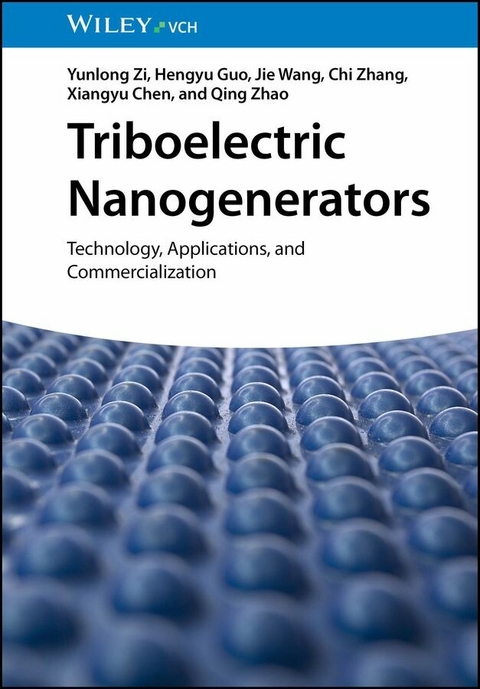
Triboelectric Nanogenerators (eBook)
548 Seiten
Wiley-VCH (Verlag)
978-3-527-83789-2 (ISBN)
Comprehensive resource on the fundamentals, recent research developments, and applications of triboelectric nanogenerators (TENGs)
Triboelectric Nanogenerators delivers a comprehensive overview of a lightweight, low cost, and high-efficiency sustainable mechanical energy harvesting technique that draws from the ambient environment and has high output and extremely flexible structural designs.
The book starts with an introduction on triboelectric nanogenerator technology, then continues to discuss the latest fundamental studies about TENGs, including models of triboelectric effect, the discharge effect, and standardized evaluation. The next part explains new output performance promotion of TENGs for power generation applications, including output promotion through multiple methods, as well as power management and effective energy storage. The last part explores new concepts inspired by the field of TENGs, including applications in sensing, actuation, data science, artificial intelligence (AI), the Internet of Things (IoT), and smart cities.
Written by a team of highly qualified academics with significant research experience in the field, Triboelectric Nanogenerators includes information on:
- Triboelectric charge generation and discharge, highlighting how electrostatic energy is often wasted
- Energy potential of TENGs in comparison to other sources such as lithium-ion batteries and other types of batteries
- Methods to promote and configure output performance, such as through gas environments, liquid-solid interfaces, and electromechanical structures
- High-voltage output from TENGs and its potential for new applications in areas such as breakdown charge triggering, electrospraying, field emissions, and others
Triboelectric Nanogenerators is an essential reference for scientists, engineers, students, and professionals in related fields seeking to understand this exciting energy harvesting technique and gain all of the knowledge needed to help further progress in the field.
Yunlong Zi, Hong Kong University of Science and Technology (Guangzhou), Guangzhou, Guangdong, China.
Hengyu Guo, Chongqing University.
Jie Wang, Beijing Institute of Nanoenergy and Nanosystems (BINN), CAS.
Chi Zhang, Beijing Institute of Nanoenergy and Nanosystems (BINN), CAS.
Xiangyu Chen, Beijing Institute of Nanoenergy and Nanosystems (BINN), CAS.
Qing Zhao is a postgraduate student at Chongqing University.
Introduction of Triboelectric Nanogenerator
I.1 What is a Triboelectric Nanogenerator (TENG)?
To meet the rapidly increased energy demands of the Internet of Things (IoT) and modern smart cities, a new type of energy harvesting technology, nanogenerator, has been invented to provide sustainable power source by collecting energy from the ambient environment. In them, the triboelectric nanogenerator (TENG), which is based on the coupling of triboelectrification and electrostatic induction effects, is focused in recent years [1–6]. This emerging technology was predicted to play a critical role in harvesting low‐frequency energy such as body motion energy and ocean‐wave energy [7–9]. Due to its advantages of lightweight, low cost, and high efficiency, plenty of research has demonstrated the great potential of TENGs on numerous applications [10–13].
The term “nanogenerator” is defined as an emerging type of technology that can convert small‐scale mechanical and thermal energy into electricity. Different from traditional generators, nanogenerator usually utilizes Maxwell's displacement current initiated by the static charges, which were generated by triboelectric, piezoelectric, and pyroelectric effects, to drive effective energy conversion [14, 15]. TENG is the major type of nanogenerator which utilizes the charge generated in triboelectric effect, which is also the most powerful energy harvester in nanogenerators.
I.2 First‐Principle Theoretical Model
Traditionally, it is believed that TENG is operated based coupling effects of triboelectrification and electrostatic induction. Triboelectrification (triboelectric effect) describes the origin of the static charges, while electrostatic induction explains the power generation. However, further theories from fundamental physics are still required to understand the operation of TENG.
Wang demonstrated the first‐principle theoretical models from Maxwell's displacement current [14, 15]. Maxwell's equations are shown below:
Here, D = εE is the electric displacement field, B is the magnetic field vector, E is the electric field, H is the magnetic field strength, J is the current density, and ρ is the volume charge density. The term ∂D/∂t can be also written as JD, as named Maxwell's displacement current. Wang proposed an additional polarization term PS in the electric displacement field due to the static charge generation in nanogenerator, and thus JD can be written as:
Therefore, the volume charge density ρ and current density J can be redefined as ρ′ and J′, respectively:
And they still satisfy the charge conversion and continuation equation:
Through this displacement current as the driving force in nanogenerators, the conduction current can be driven on the external load, forming a complete loop. And then, the output characteristics of TENGs can be further discussed in theoretical models such as Displacement Current Theory model [16, 17], quasi‐electrostatic model [18–20], and Distance‐Dependent‐Electric‐Field (DDEF) mode [21–23], which can be used to calculate electric potential and power generation accurately.
I.3 Equivalent Circuit Models and Basic Operation Modes
I.3.1 Equivalent Circuit Models
As stated above, the TENG is operated based on the additional displacement current term, originating from the static charge generated from triboelectric effect. The maintained opposite static charge in triboelectric surfaces determines the inherent capacitive behavior of the TENG. At the open‐circuit condition, the potential difference VOC accumulated between electrodes originates from the additional polarization term PS, as a function of the displacement x of the moving part in TENG. In the meanwhile, if we assume no charge generation in TENG, the device can be treated as a pure capacitor with capacitance C determined by x as well. So in the generalized case, the output voltage V and the charge transfer Q between electrodes are determined by the equivalent circuit of a voltage source VOC(x) in parallel with a capacitor C(x) as shown in Figure I.1a, with the governing equation described by: [2, 24]
Figure I.1 Equivalent circuit models and basic operation modes of TENGs. (a) Basic equivalent circuit of TENG.
Source: Reproduced with permission of [2], 2015 © Elsevier.
(b–e) The theoretical models of contact‐separation (CS), lateral‐sliding (LS), single‐electrode (SE), freestanding triboelectric‐layer (FT) modes TENGs. (f) The EDAEC method for quantitatively analysis of all modes of TENG.
Source: Reproduced with permission of [26], 2019 © Royal Society of Chemistry.
In short‐circuit condition, full charge transfer (QSC) can be obtained as driven by the voltage source, and hence: [25]
From such the V‐Q‐x relationship, we can derive the lumped parameter equivalent circuit mode, which can be used to predict characteristics of TENGs in different modes.
TENG has four basic operation modes: contact‐separation (CS), lateral sliding (LS), single electrode (SE), and freestanding triboelectric layer (FT), with detailed structures shown in Figure I.1b–e. In them, SE and FT modes can be further divided into SE contact (SEC), SE sliding (SES), sliding FT (SFT), and contact FT (CFT) modes, depending on whether they are triggered by contact separation or sliding motions. These modes have their own equivalent circuit models available for simulations and theoretical calculations. Here, a universal method for quantitative analysis of all modes of TENG is used for analysis, as shown in Figure I.1f [26]. This method is based on the edge approximation‐based equivalent capacitance (EDAEC). The equivalent capacitance models are used to demonstrate charge distributions on each electrode. Due to contact electrification, static triboelectric charges – Qtribo,χ will be dispersed on the dielectric surface χ after contacting the metal electrodes. According to charge conservation, the metal electrodes would have the same amount of opposite‐sign charges in total [27–29]. By defining the charges distributed on electrodes 1 and 2 as Q1 and Q2, respectively, the relation can be given below:
Under short‐circuit conditions, two electrodes would have the same potential. For simplicity, the two electrodes and the dielectric surface can be defined as node 1, 2 and surface χ (can be different letters for different surfaces), with capacitance between them as Cχ1,total and Cχ2,total, respectively, as shown in Figure I.1. Therefore, the following equation can be obtained.
Thus, the short‐circuit equilibrium charges Q1 and Q2 on electrodes 1 and 2, respectively, are given as: [30]
Sum symbol ∑ is used here to indicate the charge contributions from different surfaces. And then:
From the equations above, the working mechanism of TENGs can be easily illustrated. When the distance between surface a and electrode 2 is zero the capacitance across them would be much larger than that across electrode 1 (Cχ2,total ≫ Cχ1,total). Most of the positive tribo‐charges would be attracted to electrode 2. Q2 is close to Qtribo and Q1 is approximately zero. On the other hand, when the distance is quite large, the capacitance across surfaces a and electrode 2 would be much smaller than that across electrode 1 instead (Cχ1,total ≫ Cχ2,total). So Q1 is close to Qtribo and Q2 is approximately zero. Thus, QSC(x) can be calculated by the difference between Q1(x) and Q1(0) or between Q2(x) and Q2(0), and the total capacitance C(x) = Cχ1,totalCχ2,total/(Cχ1,total + Cχ2,total). According to this EDAEC method the charge distributed on each electrode could then be quantitatively calculated.
I.3.2 CS Mode TENG
CS mode TENG was the original type TENG demonstrated in early‐stage studies [1, 3]. Based on triboelectric materials used, the CS‐mode TENG can be divided into two types: dielectric/dielectric contact and dielectric/metal contact. However, since there is no fundamental difference in operation mechanism between these two types, we just take the dielectric/metal contact type as an example, with...
| Erscheint lt. Verlag | 17.3.2025 |
|---|---|
| Sprache | englisch |
| Themenwelt | Naturwissenschaften ► Chemie |
| Schlagworte | Elektronische Materialien • Materialwissenschaften |
| ISBN-10 | 3-527-83789-2 / 3527837892 |
| ISBN-13 | 978-3-527-83789-2 / 9783527837892 |
| Informationen gemäß Produktsicherheitsverordnung (GPSR) | |
| Haben Sie eine Frage zum Produkt? |
 EPUB (Adobe DRM)
Kopierschutz: Adobe-DRM
Adobe-DRM ist ein Kopierschutz, der das eBook vor Mißbrauch schützen soll. Dabei wird das eBook bereits beim Download auf Ihre persönliche Adobe-ID autorisiert. Lesen können Sie das eBook dann nur auf den Geräten, welche ebenfalls auf Ihre Adobe-ID registriert sind.
Details zum Adobe-DRM
Dateiformat: EPUB (Electronic Publication)
EPUB ist ein offener Standard für eBooks und eignet sich besonders zur Darstellung von Belletristik und Sachbüchern. Der Fließtext wird dynamisch an die Display- und Schriftgröße angepasst. Auch für mobile Lesegeräte ist EPUB daher gut geeignet.
Systemvoraussetzungen:
PC/Mac: Mit einem PC oder Mac können Sie dieses eBook lesen. Sie benötigen eine
eReader: Dieses eBook kann mit (fast) allen eBook-Readern gelesen werden. Mit dem amazon-Kindle ist es aber nicht kompatibel.
Smartphone/Tablet: Egal ob Apple oder Android, dieses eBook können Sie lesen. Sie benötigen eine
Geräteliste und zusätzliche Hinweise
Buying eBooks from abroad
For tax law reasons we can sell eBooks just within Germany and Switzerland. Regrettably we cannot fulfill eBook-orders from other countries.
aus dem Bereich