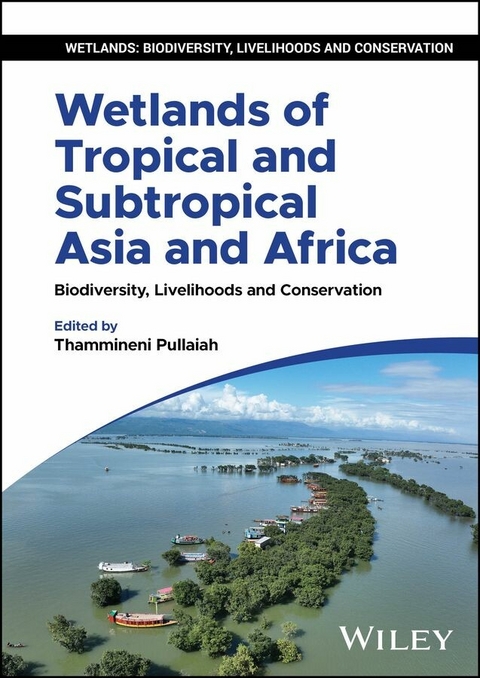
Wetlands of Tropical and Subtropical Asia and Africa (eBook)
984 Seiten
Wiley (Verlag)
978-1-394-23525-4 (ISBN)
A comprehensive survey of exemplary wetlands that highlights their importance for local livelihoods as well as for global biodiversity
Covering 17 different regions, Wetlands of Tropical and Subtropical Asia and Africa provides detailed information on some of the world's most important wetlands and wetland types across those countries, as well as their current and potential biological resources. Each wetland is analyzed by a regional expert.
Written with UN sustainable development goals in mind, Wetlands of Tropical and Subtropical Asia and Africa includes information on:
- Recommendations for the sustainable management of wetlands in the Asian and African tropics
- The importance of sustaining local economic livelihoods in each wetland region by providing food resources as well as recreational opportunities
- Wetland ecosystem services including carbon sequestration, water filtration, nutrient retention, and flood mitigation
- Threats to the integrity of each wetland region as well as management strategies and practical conservation and restoration measures
Wetlands of Tropical and Subtropical Asia and Africa is an essential reference on the subject for ecologists, conservation scientists, hydrologists, and environmental and water resource managers. Governmental agencies and professionals in fisheries, agriculture, and rural development will also find value in the book.
Thammineni Pullaiah is Professor of Botany (Retired), Department of Botany, Sri Krishnadevaraya University, India. He was President of the Indian Botanical Society, President of the Indian Association for Angiosperm Taxonomy, and a member of the Species Survival Commission of the International Union for Conservation of Nature (IUCN). He has authored 65 books, edited 40 books, and published over 340 research papers.
A comprehensive survey of exemplary wetlands that highlights their importance for local livelihoods as well as for global biodiversity Covering 17 different regions, Wetlands of Tropical and Subtropical Asia and Africa provides detailed information on some of the world s most important wetlands and wetland types across those countries, as well as their current and potential biological resources. Each wetland is analyzed by a regional expert. Written with UN sustainable development goals in mind, Wetlands of Tropical and Subtropical Asia and Africa includes information on: Recommendations for the sustainable management of wetlands in the Asian and African tropicsThe importance of sustaining local economic livelihoods in each wetland region by providing food resources as well as recreational opportunitiesWetland ecosystem services including carbon sequestration, water filtration, nutrient retention, and flood mitigationThreats to the integrity of each wetland region as well as management strategies and practical conservation and restoration measures Wetlands of Tropical and Subtropical Asia and Africa is an essential reference on the subject for ecologists, conservation scientists, hydrologists, and environmental and water resource managers. Governmental agencies and professionals in fisheries, agriculture, and rural development will also find value in the book.
List of Contributors
Ouéda Adama
Laboratoire de Biologie et Ecologie animales (LBEA), UFR/SVT
Université Joseph KI‐ZERBO (Burkina Faso) Ouagadougou, Burkina Faso
Adeyemi Ojutalayo Adeeyo
Institute of Nanotechnology and Water Sustainability
Florida, South Africa
Adebola Rashidat Adewale
Department of Fisheries
Faculty of Science, Lagos State University
Lagos, Nigeria
Gordon N. Ajonina
Cameroon Wildlife Conservation Society
CWCS Coastal Forests
Mangrove & Marine Programme
Yaoundé, Cameroon
Institute of Fisheries and Aquatic Sciences
University of Douala (Yabassi)
Douala, Cameroon
Shehu Akintola
Department of Fisheries
Faculty of Science Lagos State University
Lagos, Nigeria
Mercy Adewumi Alabi
Department of Microbiology
School of Life Sciences
University of KwaZulu‐Natal
Durban, South Africa
Al‐Jubaer
Institute of Remote Sensing and GIS
Jahangirnagar University
Dhaka, Bangladesh
Thiri Dae We Aung
Biodiversity and Nature Conservation Association
Yangon, Myanmar
Taïbou Ba
Department of Education, Science, Technology & Innovation African Union Commission
Addis Ababa, Ethiopia
Nitin Bassi
Council on Energy, Environment and Water (CEEW)
New Delhi, India
Andleeb Batool
Department of Zoology
Government College University
Lahore, Pakistan
Nard Bennas
Faculty of Sciences
Abdelmalek Essaâdi University
Tetouan, Morocco
Gnansounou S. Constant
Laboratoire de Biomathématiques et d’Estimations Forestières
Faculté des Sciences Agronomiques
Université d’Abomey‐Calavi
Cotonou, République du Bénin
Christopher J. Curtis
Department of Geography, Environmental Management and Energy Studies
University of Johannesburg
Johannesburg, South Africa
Akodékou A. David
Laboratoire de Biomathématiques et d’Estimations Forestières
Faculté des Sciences Agronomiques
Université d’Abomey‐Calavi Cotonou
République du Bénin
Abdoul Aziz Diouf
Ecological Monitoring Center
Research & Development Program
Dakar, Senegal
Thomas E. Efole
Institute of Fisheries and Aquatic Sciences
University of Douala (Yabassi)
Douala, Cameroon
Mohamed El Haissoufi
Polydisciplinary Faculty of Taza
Sidi Mohamed Ben Abdellah University
Fez, Morocco
Isa Olalekan Elegbede
Department of Fisheries
Faculty of Science Lagos State University
Lagos, Nigeria
Department of Environmental Science
National Open University of Nigeria
Abuja, Nigeria
Department of Environmental Planning Brandenburg University of Technology
Cottbus, Germany
Abdeslam Ennabili
Superior School of Technology
Sidi Mohamed Ben Abdellah University
Fez, Morocco
Mathieu Gueye
Department of Botany and Geology Laboratory of Botany, IRL 3189 Environnement
Santé et Société, IFAN Ch. A. Diop
Dakar, Senegal
Saiba Gupta
Council on Energy, Environment and Water (CEEW)
New Delhi, India
Ibrahim Mohammed Hashim
Sudanese Wildlife Society
Khartoum, Sudan
Dassou G. Hospice
Département de Biologie Végétale
Laboratoire des Sciences du Végétal et Pharmacopée, Ecole Doctorale des Sciences de la Vie et de la Terre
Université d'Abomey‐Calavi, Cotonou République du Bénin
Amira M. Hotaiba
Department of Environmental Sciences
Faculty of Science
Alexandria University, Alexandria, Egypt
Mohamed Elmekki Ali Elbadawi Hussien
Department of Wildlife
University of Sinnar, Suki, Sudan
Kaboré Idrissa
Laboratoire de Biologie et Ecologie animales (LBEA), UFR/SVT
Université Joseph KI‐ZERBO (Burkina Faso)
Ouagadougou, Burkina Faso
Emily Osa Iduseri
Department of Environmental Science
National Open University of Nigeria
Abuja, Nigeria
Sheikh Tawhidul Islam
Institute of Remote Sensing and GIS
Jahangirnagar University
Dhaka, Bangladesh
Ayushi Kashyap
Council on Energy
Environment and Water (CEEW)
New Delhi, India
Abdelmajid Khabbach
Faculty of Sciences, Sidi Mohamed Ben Abdellah University
Fez, Morocco
Jasper Knight
School of Geography, Archaeology and Environmental Studies
University of the Witwatersrand
Johannesburg, South Africa
Bramley Jemain Lemine
Department of Chemical Engineering Cape Peninsula University of Technology
Bellville, South Africa
Department of Water Science
University of Western Cape
Bellville, South Africa
Mohamed Libiad
Faculty of Sciences, Abdelmalek Essaâdi University
Tetouan, Morocco
Mauro Lourenco
National Geographic Okavango Wilderness Project, Wild Bird Trust
Johannesburg, South Africa
A.H. Magdon Jayasuriya
EML Consultants PLC
Pitakotte, Sri Lanka
Rodgers Makwinja
Department of Geography, Environmental Management and Energy Studies
University of Johannesburg
Johannesburg, South Africa
Department of Fisheries, Ministry of Natural Resources & Climate Change
Lilongwe, Malawi
Thomas Marambanyika
Department of Geography Environmental Sustainability and Resilience Building Midlands State University
Gweru, Zimbabwe
Sawadogo Yabyouré Marc‐Florent
Laboratoire de Biologie et Ecologie animales (LBEA)
UFR/SVT, Université Joseph KI‐ZERBO (Burkina Faso)
Ouagadougou, Burkina Faso
Paterne Arnaud Bernard Mingou
Department of Botany and Geology, Laboratory of Botany IFAN Ch. A. Diop Dakar, Senegal
Krishna Prosad Mondal
Institute of Remote Sensing and GIS
Jahangirnagar University
Dhaka, Bangladesh
Titus A.M. Msagati
Institute of Nanotechnology and Water Sustainability
Florida, South Africa
Maryam Mukhtar
Department of Zoology
University of the Punjab
Lahore, Pakistan
Oshneck Mupepi
Department of Geography Environmental Sustainability and Resilience Building
Midlands State University
Gweru, Zimbabwe
Tatenda Musasa
Institute of Water Studies, Faculty of Natural Sciences
University of the Western Cape
Cape Town, South Africa
Department of Geography Environmental Sustainability and Resilience Building
Midlands State University
Gweru, Zimbabwe
Naseeba Mustafavi
Department of Zoology
Government College University
Lahore, Pakistan
Thet Zaw Naing
Myanmar Bird and Nature Society
Yangon, Myanmar
Mishal Nawaz
Department of Zoology
Government College University
Lahore, Pakistan
Barthelemy Ndongo
Department of Rural Engineering
Faculty of Agronomy & Agricultural Sciences, National Focal Point of Ramsar Convention
University of Dschang
Dschang, Cameroon
Tinyiko Rivers Nkuna
Department of Earth Science
Faculty of Science Engineering and Agriculture
University of Venda
Limpopo, South Africa
Yaa Ntiamoa‐Baidu
Centre for Biodiversity Conservation Research
University of Ghana
Accra, Ghana
Department of Animal Biology and Conservation Science
University of Ghana
Accra, Ghana
Abdul Rahamon Olodo
Department of Environmental Planning
Brandenburg University of Technology
Cottbus, Germany
Kehinde Moyosola Ositimehin
Department of Environmental Studies
Ohio University, Athens
OH, USA
Asia Parveen
Department of Zoology
Government College University
Lahore, Pakistan
Kelvin S.‐H. Peh
School of Biological Sciences
University of Southampton
Southampton, UK
Syed Hafizur Rahman
Department of Environmental Sciences
Jahangirnagar University
Dhaka, Bangladesh
Dania Razzaq
Department of Zoology
Government College University
Lahore, Pakistan
Konaté Sidiki Roland
Laboratoire de Biologie et Ecologie animales (LBEA), UFR/SVT
Université Joseph KI‐ZERBO (Burkina Faso)
Ouagadougou, Burkina Faso
Glèlè Kakaï Romain
Laboratoire de Biomathématiques et d’Estimations Forestières
Faculté des Sciences Agronomiques
Université d’Abomey‐Calavi CotonouRépublique du Bénin
Abdulwakil Olawale Saba
Department of Fisheries
Faculty of Science Lagos State University
Lagos, Nigeria
Soumic Samad
Research Consultant, Remote Sensing Division, Center for Environmental and Geographic Information Services (CEGIS)
Dhaka,...
| Erscheint lt. Verlag | 13.3.2025 |
|---|---|
| Sprache | englisch |
| Themenwelt | Naturwissenschaften ► Biologie ► Ökologie / Naturschutz |
| Naturwissenschaften ► Geowissenschaften ► Geologie | |
| Schlagworte | African wetlands • Asian wetlands • tropical wetlands • wetland biological resources • wetland integrity • wetland livelihoods • wetland resources • wetlands and climate change • wetlands biodiversity • wetlands conservation • wetland types |
| ISBN-10 | 1-394-23525-9 / 1394235259 |
| ISBN-13 | 978-1-394-23525-4 / 9781394235254 |
| Informationen gemäß Produktsicherheitsverordnung (GPSR) | |
| Haben Sie eine Frage zum Produkt? |
 EPUB (Adobe DRM)
Kopierschutz: Adobe-DRM
Adobe-DRM ist ein Kopierschutz, der das eBook vor Mißbrauch schützen soll. Dabei wird das eBook bereits beim Download auf Ihre persönliche Adobe-ID autorisiert. Lesen können Sie das eBook dann nur auf den Geräten, welche ebenfalls auf Ihre Adobe-ID registriert sind.
Details zum Adobe-DRM
Dateiformat: EPUB (Electronic Publication)
EPUB ist ein offener Standard für eBooks und eignet sich besonders zur Darstellung von Belletristik und Sachbüchern. Der Fließtext wird dynamisch an die Display- und Schriftgröße angepasst. Auch für mobile Lesegeräte ist EPUB daher gut geeignet.
Systemvoraussetzungen:
PC/Mac: Mit einem PC oder Mac können Sie dieses eBook lesen. Sie benötigen eine
eReader: Dieses eBook kann mit (fast) allen eBook-Readern gelesen werden. Mit dem amazon-Kindle ist es aber nicht kompatibel.
Smartphone/Tablet: Egal ob Apple oder Android, dieses eBook können Sie lesen. Sie benötigen eine
Geräteliste und zusätzliche Hinweise
Buying eBooks from abroad
For tax law reasons we can sell eBooks just within Germany and Switzerland. Regrettably we cannot fulfill eBook-orders from other countries.
aus dem Bereich