Bird Watching For Dummies (eBook)
586 Seiten
For Dummies (Verlag)
978-1-394-29731-3 (ISBN)
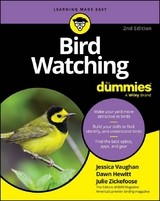
Birds are everywhere. Why not start really watching them?
Sometimes, all it takes is a 'spark bird' to open the door. A bird, seen well, so unexpectedly beautiful and interesting that it cracks you wide open. Bird Watching For Dummies is a spark book, teaching you all you need to know about this fun, affordable, and accessible hobby. It gently guides as you explore your local habitats, learn to recognize more and more species, and reap the many mental health benefits of connecting to the outdoors and all the wonders it holds. This book gets you started, teaching you how to identify birds by sight and sound, find birdwatching hotspots, and get the birds to come to your own backyard. You'll learn about the latest gear, the best field guides and online apps that will jump-start your bird identification skills. Into photography? This book has your back, with tips on getting good photos for identification and aesthetic purposes. Find out how to join a local bird club, find a field trip or a group tour to rainforest, desert, seacoast, mountains or prairie. Every habitat has its own special birds, and when the birding bug bites, you'll want to see them all.
- Get started with bird watching or take your hobby to the next level
- Improve your skills with tips for identifying birds by sight and sound
- Understand bird behavior and learn gardening tips that will bring the birds to you
- Choose field guides, binoculars, apps, and other tools of the trade
Bird Watching For Dummies will teach beginners and novices how to start bird watching, sharpen their bird watching skills, and expand their knowledge.
The Editors of BWD - BWD has been North America's premier magazine for bird watchers since 1978. Filled with informative and fun articles about birds, birders, birding destinations, and more, BWD brings you birds in a way you've never seen before. Beautiful photography and fascinating articles by renowned experts will deepen your knowledge, expand your appreciation, and inspire you to look up!
Chapter 1
Birds and the People Who Love Them
IN THIS CHAPTER
Organizing birds into families and species
Organizing humans into birders or bird watchers
Connecting with your spark bird
Discovering where the birds are
Do you ever look up, see a bird in flight, and find yourself wondering what kind of bird it is? You stare at it — noting its color, its shape, the spread of its wings. You watch it flit from branch to branch and fly away. And you wonder. Maybe you describe the bird to a family member or friend who may know what it is. Or you hop online and search for birds in your area to see if you can find its picture. Or you wait, hoping to see it again just to appreciate the bird’s beauty and song. That’s bird watching. And you’re already a bird watcher. Isn’t that easy?
Unk! Ragnar See Bird!
Bird watching is an activity that comes naturally to us humans. Our ancestors watched birds — you can find their sightings painted on cave walls. Birds helped determine the seasons and were thought to predict the weather. And they provided meat for the evening feeding frenzy.
Today, bird watching (or birding) is a hobby enjoyed by millions and millions of (somewhat more advanced) people. Why? Because birds are fun to look at, birds are beautiful, many birds sing beautiful songs, and bird behavior is fascinating. Besides, today when folks want meat for their evening feeding frenzies, they can shop at supermarkets and leave the birds alone.
Yet birds still foretell the changing seasons by their northward and southward migrations. And birds sometimes have feeding frenzies of their own just before or after a blast of bad weather. So, if you want to throw out your calendar and the local meteorologist, go right ahead. You won’t need either in your cave — and you’ll still have the birds.
Wings and feathers and flight, oh my!
Research indicates that birds are living examples of the dinosaurs that once roamed Earth. One of the earliest-known birds is Archaeopteryx, discovered from fossilized remains found in Bavaria in 1851 (see Figure 1-1).
FIGURE 1-1: Archaeopteryx — a prehistoric bird in full glide.
Archaeopteryx existed about 140 million years ago and had skeletal characteristics identical to those of small dinosaurs that lived during that same time. This creature also had a toothed jaw and feathers that allowed Archaeopteryx to glide from place to place (although its main mode of transport was likely running).
Because of these features, research suggests that Archaeopteryx is one link between dinosaurs and the creatures today that are considered birds. Even though this creature didn’t have the specialized bones and flight muscles that true birds have, Archaeopteryx is considered by many to be one branch of the evolutionary tree from which all birds may have descended. The link between Archaeopteryx and birds is a greatly debated subject that gets evolutionary scientists very worked up. So, it’s best to leave this one to the folks in the white lab coats. But one thing Archaeopteryx and birds have in common that seems to give them kinship is feathers. Because, at its most basic, a bird is a creature that has feathers (see Figure 1-2) — the only type of creature that has feathers.
FIGURE 1-2: Feathers of a northern mockingbird — if it ain’t got feathers, it’s not a bird.
These feathers — along with lightweight, air-filled bones acquired through evolution — allow most birds to fly. Feathers are really highly evolved scales, like those found on reptiles such as snakes and lizards. (You can see the remnants of their reptilian ancestry on most birds’ scaly legs and feet.) Besides promoting flight, feathers (also called plumage) regulate birds’ temperature and provide physical protection while giving birds their shape and color.
Here’s a bonus obscure fact for you: A small songbird has more than 1,000 feathers on its body. A large swan, plucked by some patient soul, was found to have more than 25,000 feathers. Figure 1-3 shows a mute swan ruffling some of its 25,000 feathers.
FIGURE 1-3: Feathers help keep birds, such as this mute swan, comfortable, mobile, and beautiful.
Breaking down bird terms
Without getting too technical, you need to understand two terms that bird watchers use a lot when referring to birds: family and species. Although an ornithology professor will likely cringe, here are Dummies-approved definitions for the two terms:
- A species of bird is defined as a group of individuals that have similar appearance, similar behavior, similar vocalizations, and that interbreed freely to produce fertile (able to breed successfully) young. When you identify a bird, you determine what species it is.
- A family of birds is made up of species that are very similar, but don’t interbreed. You can find a more scientific definition of a bird family, but most bird watchers use this term to mean a group of birds that look, sound, and act in a similar way. For example, there are lots of different sparrow species, most of which belong to the sparrow family.
Remember both terms handily because you often hear them used when bird watchers try to identify a bird. If you see a small bird zipping through your flower garden, you may know what family it belongs to (hummingbird). Later, when you get a good look at the bird, you can identify its species (ruby-throated hummingbird).
Each species of bird has two types of names: a common name and a Latin name.
- The common name of a bird is the one that you’re most likely to know. Common names, such as American robin, are the currency of bird watching.
- The Latin or scientific name, Turdus migratorius in the case of the American robin, is made up of two parts: the genus (Turdus) and the species (migratorius). Genus and species are two parts of the scientific classification system used to name all living creatures. Think of them as you would the first and last names of a person. Latin names are used to clarify the classification of birds and to help bird watchers and ornithologists (bird scientists) avoid confusion over regional and international differences in bird names. Just because they’re Latin, don’t let them scare you off. You won’t be getting a pop quiz! And most bird watchers you encounter won’t be fluent in the Latin names of birds, so you needn’t be, either.
Chapter 4 takes a closer look at the terms species, genus, and family, and how a basic understanding of bird groupings can help you become more familiar with your field guide and, ultimately, identify birds.
Bird Watching: From Guns to Binoculars
People’s fascination with birds naturally made them want to get a closer look. Until late in the 19th century (that’s the 1800s), the only accepted method of identifying a bird was to have it in your hand. And given the fact that very few birds hopped happily onto the palm, the quickest way to get a bird in the hand was to kill it and hold it there. From rocks to spears, and later, arrows, slingshots, and shotguns, once you had the bird in your hand, getting a good look at it was easy (but not very easy on the bird!).
Shotgun bird identification fell into deserved disfavor in 1934 when Roger Tory Peterson, generally considered the father of modern bird watching, published the first modern field guide. Combining black-and-white illustrations of all the birds found in the eastern half of North America with descriptive text for each species, Roger Tory Peterson’s easy-to-use system of identifying birds was based upon a concept known as a field mark — a distinctive characteristic or visual clue that’s a key to identifying a bird. Birds thus became identifiable by their most obvious features (the red crest of a cardinal, the long, pointed tail of the pintail duck) with the help of magnifying optics.
No longer are birds identified over the sights of a shotgun — now, the magnified view of the bird as seen through binoculars is all that’s needed. Unlike the low-powered opera glasses of 60 years ago, binoculars today are so advanced that, if the conditions are right, you can see the eyelashes on an egret. (Unless you know already, you’ll have to guess whether or not egrets have eyelashes.) Once separated from the shotgun, the popularity of bird watching soared, and the birds breathed a collective sigh of relief.
TAXONOMY: FROM DINOSAURS TO CHICKADEES
The method used to organize birds — that is, to decide which birds are related, which are closely related, and which are not closely related — is called taxonomy. Taxonomy has nothing to do with the Internal Revenue Service (though it can be a taxing exercise); rather, taxonomy is the method by which birds are placed in the evolutionary tree.
As birds evolved, they did so in many ways, just like a bush grows many branches from the ground, with each branch growing more branches, and so on. The birds that most closely resemble their ancient ancestors are considered the oldest of our birds and are found in the front of bird watchers’...
| Erscheint lt. Verlag | 11.3.2025 |
|---|---|
| Sprache | englisch |
| Themenwelt | Sachbuch/Ratgeber ► Natur / Technik ► Naturwissenschaft |
| Naturwissenschaften ► Biologie | |
| Technik | |
| Schlagworte | audubon society • bird calls • bird gifts • Birding • birding dummies • birding gifts • bird lover gift • bird watcher gift • bird watchers • Bird Watching • books on bird watching • gifts for birdwatchers • how to bird watch • nature lover gift |
| ISBN-10 | 1-394-29731-9 / 1394297319 |
| ISBN-13 | 978-1-394-29731-3 / 9781394297313 |
| Informationen gemäß Produktsicherheitsverordnung (GPSR) | |
| Haben Sie eine Frage zum Produkt? |
 EPUB (Adobe DRM)
Kopierschutz: Adobe-DRM
Adobe-DRM ist ein Kopierschutz, der das eBook vor Mißbrauch schützen soll. Dabei wird das eBook bereits beim Download auf Ihre persönliche Adobe-ID autorisiert. Lesen können Sie das eBook dann nur auf den Geräten, welche ebenfalls auf Ihre Adobe-ID registriert sind.
Details zum Adobe-DRM
Dateiformat: EPUB (Electronic Publication)
EPUB ist ein offener Standard für eBooks und eignet sich besonders zur Darstellung von Belletristik und Sachbüchern. Der Fließtext wird dynamisch an die Display- und Schriftgröße angepasst. Auch für mobile Lesegeräte ist EPUB daher gut geeignet.
Systemvoraussetzungen:
PC/Mac: Mit einem PC oder Mac können Sie dieses eBook lesen. Sie benötigen eine
eReader: Dieses eBook kann mit (fast) allen eBook-Readern gelesen werden. Mit dem amazon-Kindle ist es aber nicht kompatibel.
Smartphone/Tablet: Egal ob Apple oder Android, dieses eBook können Sie lesen. Sie benötigen eine
Geräteliste und zusätzliche Hinweise
Buying eBooks from abroad
For tax law reasons we can sell eBooks just within Germany and Switzerland. Regrettably we cannot fulfill eBook-orders from other countries.
aus dem Bereich