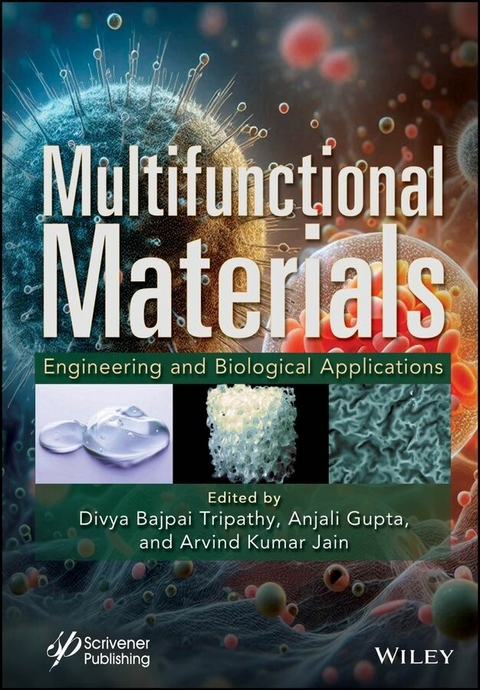
Multifunctional Materials (eBook)
531 Seiten
Wiley-Scrivener (Verlag)
978-1-394-23415-8 (ISBN)
This comprehensive book is essential for anyone looking to deepen their understanding of advanced materials and their transformative impact across multiple disciplines, from cutting-edge technologies to innovative solutions in engineering and biology.
Multifunctional Materials: Engineering and Biological Applications is a comprehensive guide on advanced materials, a class of materials that exhibit novel properties, high performance, and unique functionalities that make them suitable for a wide range of applications. These materials are typically engineered at the molecular or atomic level, allowing precise control over their structure and properties. The field of advanced materials is vast, covering a range of material types and applications.
This volume covers topics on the chemistry, properties, and applications of advanced materials. The study of advanced materials involves multiple disciplines, including materials science, chemistry, physics, and engineering. Advances in this field have led to the development of new and improved technologies, such as high-efficiency solar cells, lightweight and strong materials for aerospace applications, and new drug delivery systems for disease treatment.
The volume:
- Demonstrates materials synthesis and characterization of multifunctional materials;
- Examines properties and functionalities of multifunctional materials, such as mechanical, electrical, and thermal properties, as well as other functional properties;
- Outlines multifunctional materials applications, including their use in biomedical devices, aerospace and defense systems, and consumer electronics;
- Provides a comprehensive overview of this rapidly evolving field, covering topics related to materials science, engineering, and technology.
Audience
Researchers, industry scientists and engineers, academics, and postgraduate students working in the fields of materials chemistry, applied chemistry, nanotechnology, chemical technology, polymer science and engineering, and industrial chemistry.
Divya Bajpai Tripathy, PhD, is a professor in the Department of Chemistry, School of Basic and Applied Sciences, Galgotias University, Greater Noida, India, with over 12 years of teaching experience. She has more than 60 research publications and one filed patent to her credit. She is working on a research project funded by the Government of India's Department of Science and Technology as a principal investigator. She has guided 12 Masters research students and five doctorate students are registered under her supervision.
Anjali Gupta, PhD, is a professor in the Department of Chemistry, School of Basic and Applied Sciences, Galgotias University, Greater Noida, India, with over 12 years of teaching experience. She has published nine patents and over 50 research papers in reputed international journals and conferences. Her areas of research include bioorganic chemistry, synthetic chemistry, and in-silico screening and synthesis of naturally occurring bioactive analogs.
Arvind Kumar Jain, PhD, is a professor of Basic and Applied Sciences and Dean of Student Welfare at IILM University, Greater Noida, India. He has published nine patents and over 50 research papers in national and international journals and conference proceedings. In addition to his written work, he has delivered many invited talks at the national and international level. His main research areas include nanotechnology, analytical chemistry, and organic synthetic chemistry.
This comprehensive book is essential for anyone looking to deepen their understanding of advanced materials and their transformative impact across multiple disciplines, from cutting-edge technologies to innovative solutions in engineering and biology. Multifunctional Materials: Engineering and Biological Applications is a comprehensive guide on advanced materials, a class of materials that exhibit novel properties, high performance, and unique functionalities that make them suitable for a wide range of applications. These materials are typically engineered at the molecular or atomic level, allowing precise control over their structure and properties. The field of advanced materials is vast, covering a range of material types and applications. This volume covers topics on the chemistry, properties, and applications of advanced materials. The study of advanced materials involves multiple disciplines, including materials science, chemistry, physics, and engineering. Advances in this field have led to the development of new and improved technologies, such as high-efficiency solar cells, lightweight and strong materials for aerospace applications, and new drug delivery systems for disease treatment. The volume: Demonstrates materials synthesis and characterization of multifunctional materials; Examines properties and functionalities of multifunctional materials, such as mechanical, electrical, and thermal properties, as well as other functional properties; Outlines multifunctional materials applications, including their use in biomedical devices, aerospace and defense systems, and consumer electronics; Provides a comprehensive overview of this rapidly evolving field, covering topics related to materials science, engineering, and technology. Audience Researchers, industry scientists and engineers, academics, and postgraduate students working in the fields of materials chemistry, applied chemistry, nanotechnology, chemical technology, polymer science and engineering, and industrial chemistry.
| Erscheint lt. Verlag | 10.3.2025 |
|---|---|
| Sprache | englisch |
| Themenwelt | Naturwissenschaften ► Chemie ► Organische Chemie |
| Schlagworte | Aerospace • Biocatalysis • Bioengineering • biomedical • biopolymers • bioremediation • biosensors • multifunctional • Nanocomposites • nanotechnology • optoelectronics • Polymer Emulsions • Supra-Molecular Polymers • Surface Science • Tissue engineering |
| ISBN-10 | 1-394-23415-5 / 1394234155 |
| ISBN-13 | 978-1-394-23415-8 / 9781394234158 |
| Informationen gemäß Produktsicherheitsverordnung (GPSR) | |
| Haben Sie eine Frage zum Produkt? |
 PDF (Adobe DRM)
Kopierschutz: Adobe-DRM
Adobe-DRM ist ein Kopierschutz, der das eBook vor Mißbrauch schützen soll. Dabei wird das eBook bereits beim Download auf Ihre persönliche Adobe-ID autorisiert. Lesen können Sie das eBook dann nur auf den Geräten, welche ebenfalls auf Ihre Adobe-ID registriert sind.
Details zum Adobe-DRM
Dateiformat: PDF (Portable Document Format)
Mit einem festen Seitenlayout eignet sich die PDF besonders für Fachbücher mit Spalten, Tabellen und Abbildungen. Eine PDF kann auf fast allen Geräten angezeigt werden, ist aber für kleine Displays (Smartphone, eReader) nur eingeschränkt geeignet.
Systemvoraussetzungen:
PC/Mac: Mit einem PC oder Mac können Sie dieses eBook lesen. Sie benötigen eine
eReader: Dieses eBook kann mit (fast) allen eBook-Readern gelesen werden. Mit dem amazon-Kindle ist es aber nicht kompatibel.
Smartphone/Tablet: Egal ob Apple oder Android, dieses eBook können Sie lesen. Sie benötigen eine
Geräteliste und zusätzliche Hinweise
Buying eBooks from abroad
For tax law reasons we can sell eBooks just within Germany and Switzerland. Regrettably we cannot fulfill eBook-orders from other countries.
aus dem Bereich