


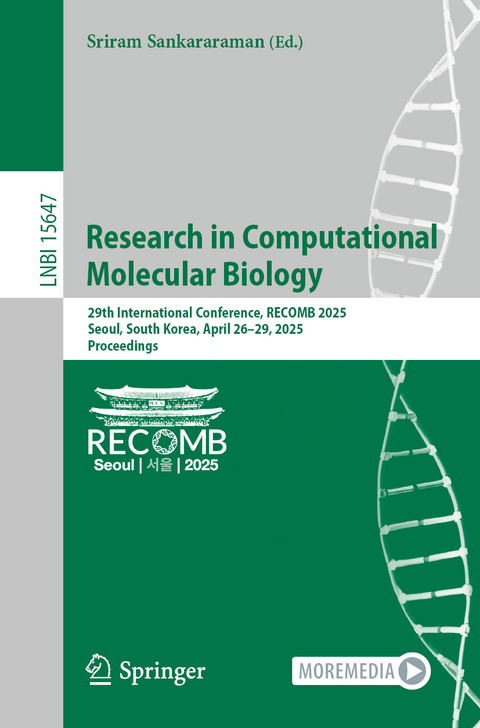
Research in Computational Molecular Biology
Springer International Publishing (Verlag)
978-3-031-90251-2 (ISBN)
This book constitutes the proceedings of the 29th Annual International Conference on Research in Computational Molecular Biology, RECOMB 2025, held in Seoul, South Korea, during April 26 29, 2025.
The 14 full papers and 41 short papers were carefully reviewed and selected from 339 submissions. They focus on advances in computational biology and applications in molecular biology and medicine. The conference aims at bridging the computational, mathematical, statistical, and biological sciences, and bringing together researchers, professionals, students and industrial practitioners from all over the world for interaction and exchange of new developments in all areas of bioinformatics and computational biology.
Orientation-Aware Graph Neural Networks for Protein Structure Representation Learning.- Active Learning for Protein Structure Prediction.- Sequence-based TCR-Peptide Representations Using Cross-Epitope Contrastive Fine-tuning of Protein Language Models.- DualGOFiller: A Dual-Channel Graph Neural Network with Contrastive Learning for Enhancing Function Prediction in Partially Annotated Proteins.- Detecting antimicrobial resistance through MALDI-TOF mass spectrometry with statistical guarantees using conformal prediction.- Hierarchical Spatio-Temporal State-Space Modeling for fMRI Analysis.- A Phylogenetic Approach to Genomic Language Modeling.- Dynamic Programming Algorithms for Fast and Accurate Cell Lineage Tree Reconstruction from CRISPR-based Lineage Tracing Data.- Old dog, new tricks: Exact seeding strategy improves RNA design performances.- Scalable and Interpretable Identification of Minimal Undesignable RNA Structure Motifs with Rotational Invariance.- An Exact and Fast SAT Formulation for the DCJ Distance.- Improved pangenomic classification accuracy with chain statistics.- Dynamic -PBWT: Dynamic Run-length Compressed PBWT for Biobank Scale Data.- Prokrustean Graph: A substring index for rapid k-mer size analysis.- Rag2Mol: Structure-based drug design based on Retrieval Augmented Generation.- Rewiring protein sequence and structure generative models to enhance protein stability prediction.- Learning a CoNCISE language for small molecule binding and function.- An adversarial scheme for integrating multi-modal data on protein function.- Decoding the Functional Interactome of Non-Model Organisms with PHILHARMONIC.- The tree labeling polytope: a unified approach to ancestral reconstruction problems.- ScisTree2: An Improved Method for Large-scale Inference of Cell Lineage Trees and Genotype Calling from Noisy Single Cell Data.- OMKar: optical map based automated karyotyping of genomes to identify constitutional disorders.- TarDis: Achieving Robust and Structured Disentanglement of Multiple Covariates.- devider: long-read reconstruction of many diverse haplotypes.- Pharming: Joint Clonal Tree Reconstruction of SNV and CNA Evolution from Single-cell DNA Sequencing of Tumors.- GEM-Finder: dissecting GWAS variants via long-range interacting cis-regulatory elements with differentiation-specific genes.- Learning multi-cellular representations of single-cell transcriptomics data enables characterization of patient-level disease states.- cfDecon: Accurate and interpretable methylation based cell type deconvolution for cell-free DNA.- Inferring cell differentiation maps from lineage tracing data.- Alignment-free estimation of read to genome distances and its applications.- ML-MAGES: A machine learning framework for multivariate genetic association analyses with genes and effect size shrinkage.- TX-Phase: Secure Phasing of Private Genomes in a Trusted Execution Environment.- Hyper-k-mers: efficient streaming k-mers representation.- Characterizing the Solution Space of Migration Histories of Metastatic Cancers with MACH2.- Causal Disentanglement of Treatment Effects in Single-cell RNA Sequencing through Counterfactual Inference.- Integration and querying of multimodal single-cell data with PoE-VAE.- ralphi: a deep reinforcement learning framework for haplotype assembly.- GeneCover: A Combinatorial Approach for Label-free Marker Gene Selection.- Joint imputation and deconvolution of gene expression across spatial transcriptomics platforms.- ScatTR: Estimating the Size of Long Tandem Repeat Expansions from Short-Reads.- Learning Latent Trajectories in Developmental Time Series with Hidden-Markov Optimal Transport.- Unified integration of spatial transcriptomics across platforms.- Tree reconstruction guarantees from CRISPR-Cas9 lineage tracing data using Neighbor-Joining.- mcRigor: a statistical method to enhance the rigor of metacell partitioning in single-cell data analysis.- TissueMosaic enables cross-sample d
| Erscheinungsdatum | 27.04.2025 |
|---|---|
| Reihe/Serie | Lecture Notes in Bioinformatics | Lecture Notes in Computer Science |
| Zusatzinfo | XXIV, 440 p. 113 illus., 107 illus. in color. |
| Verlagsort | Cham |
| Sprache | englisch |
| Maße | 155 x 235 mm |
| Themenwelt | Mathematik / Informatik ► Informatik ► Theorie / Studium |
| Informatik ► Weitere Themen ► Bioinformatik | |
| Mathematik / Informatik ► Mathematik ► Computerprogramme / Computeralgebra | |
| Naturwissenschaften ► Biologie | |
| Schlagworte | algorithms • Bioinformatics • Computational Biology • machine learning • Statistical Models |
| ISBN-10 | 3-031-90251-3 / 3031902513 |
| ISBN-13 | 978-3-031-90251-2 / 9783031902512 |
| Zustand | Neuware |
| Informationen gemäß Produktsicherheitsverordnung (GPSR) | |
| Haben Sie eine Frage zum Produkt? |
aus dem Bereich


