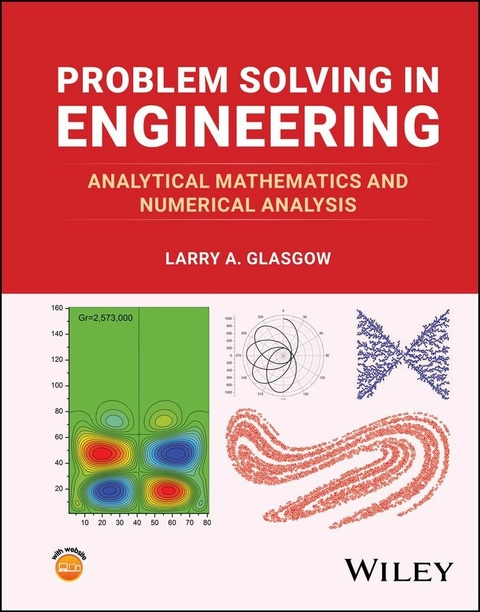
Problem Solving in Engineering (eBook)
557 Seiten
Wiley (Verlag)
978-1-394-17999-2 (ISBN)
Bring mathematical principles to bear on engineering problems with this updated text
The evolution of industrial processes has resulted in greater emphasis upon analytical and numerical problem solving. Process improvement through experimentation is impractical and consequently engineers must rely upon computational and technical analysis. Furthermore, the ease with which time-series data can be collected and processed has made harmonic signal interpretation routine. Thus, the ability of engineers to analyze, model, compute, and interpret process phenomena is crucial to professional practice.
Problem Solving in Engineering meets these needs with a foundational introduction to mathematical techniques in applied sciences and engineering. Incorporating examples from a range of scientific fields, it communicates principles that can be adapted to many hardware-software combinations. Now fully updated to reflect the latest research and applications, it remains an essential tool for engineers and applied scientists everywhere.
Readers of the second edition will also find:
- Extensive time devoted to problem formulation
- Detailed discussion of integro-differential equations and the processing and analysis of time-series data
- The use of vorticity transport for the solution of momentum, heat, and mass transfer problems in two dimensions
- Examples and problems drawn from aviation, telegraphy, structural failures, railroad operation, chemical processes, automatic process control, seismology, neutron diffusion, gravitation, and quantum theory
- Many additional narrative-type exercises written to appeal to students who find problems in context better suited to their learning style
- Solutions manual available for qualified instructors
Problem Solving in Engineering is ideal for advanced undergraduate, graduate students, and technical professionals in the physical sciences, specifically chemical, civil, biochemical, electrical, and mechanical engineering, as well as physics, chemistry, and biology.
Larry A. Glasgow began his teaching career at Kansas State University in 1978 and taught nearly all of the classes the department of chemical engineering offers, earning numerous teaching awards throughout his 38-year long career before retiring in 2016. Glasgow's research areas of focus concern the interaction of turbulence with fluid-borne entities in multi-phase processes, including flocculation, aggregate breakage and aggregate deformation. In addition, he has investigated bubble formation, coalescence and breakage in aerated reactors, the effects of energetic interfacial phenomena upon cells in culture, and the impulsive distribution of small particles in air-filled chambers. Glasgow has also authored multiple publications, as well as two books: Transport Phenomena: An Introduction to Advanced Topics (2010), and Applied Mathematics for Science and Engineering (2014).
Bring mathematical principles to bear on engineering problems with this updated text The evolution of industrial processes has resulted in greater emphasis upon analytical and numerical problem solving. Process improvement through experimentation is impractical and consequently engineers must rely upon computational and technical analysis. Furthermore, the ease with which time-series data can be collected and processed has made harmonic signal interpretation routine. Thus, the ability of engineers to analyze, model, compute, and interpret process phenomena is crucial to professional practice. Problem Solving in Engineering meets these needs with a foundational introduction to mathematical techniques in applied sciences and engineering. Incorporating examples from a range of scientific fields, it communicates principles that can be adapted to many hardware-software combinations. Now fully updated to reflect the latest research and applications, it remains an essential tool for engineers and applied scientists everywhere. Readers of the second edition will also find: Extensive time devoted to problem formulationDetailed discussion of integro-differential equations and the processing and analysis of time-series dataThe use of vorticity transport for the solution of momentum, heat, and mass transfer problems in two dimensionsExamples and problems drawn from aviation, telegraphy, structural failures, railroad operation, chemical processes, automatic process control, seismology, neutron diffusion, gravitation, and quantum theoryMany additional narrative-type exercises written to appeal to students who find problems in context better suited to their learning styleSolutions manual available for qualified instructors Problem Solving in Engineering is ideal for advanced undergraduate, graduate students, and technical professionals in the physical sciences, specifically chemical, civil, biochemical, electrical, and mechanical engineering, as well as physics, chemistry, and biology.
| Erscheint lt. Verlag | 27.2.2025 |
|---|---|
| Sprache | englisch |
| Themenwelt | Naturwissenschaften ► Chemie |
| Technik | |
| Schlagworte | algebraic equations • algorithm • Data Interpretation • Finite Difference Method • integro-differential equations • model development • ordinary and partial differential equations • quadrature • time series data |
| ISBN-10 | 1-394-17999-5 / 1394179995 |
| ISBN-13 | 978-1-394-17999-2 / 9781394179992 |
| Informationen gemäß Produktsicherheitsverordnung (GPSR) | |
| Haben Sie eine Frage zum Produkt? |
 PDF (Adobe DRM)
Kopierschutz: Adobe-DRM
Adobe-DRM ist ein Kopierschutz, der das eBook vor Mißbrauch schützen soll. Dabei wird das eBook bereits beim Download auf Ihre persönliche Adobe-ID autorisiert. Lesen können Sie das eBook dann nur auf den Geräten, welche ebenfalls auf Ihre Adobe-ID registriert sind.
Details zum Adobe-DRM
Dateiformat: PDF (Portable Document Format)
Mit einem festen Seitenlayout eignet sich die PDF besonders für Fachbücher mit Spalten, Tabellen und Abbildungen. Eine PDF kann auf fast allen Geräten angezeigt werden, ist aber für kleine Displays (Smartphone, eReader) nur eingeschränkt geeignet.
Systemvoraussetzungen:
PC/Mac: Mit einem PC oder Mac können Sie dieses eBook lesen. Sie benötigen eine
eReader: Dieses eBook kann mit (fast) allen eBook-Readern gelesen werden. Mit dem amazon-Kindle ist es aber nicht kompatibel.
Smartphone/Tablet: Egal ob Apple oder Android, dieses eBook können Sie lesen. Sie benötigen eine
Geräteliste und zusätzliche Hinweise
Buying eBooks from abroad
For tax law reasons we can sell eBooks just within Germany and Switzerland. Regrettably we cannot fulfill eBook-orders from other countries.
aus dem Bereich