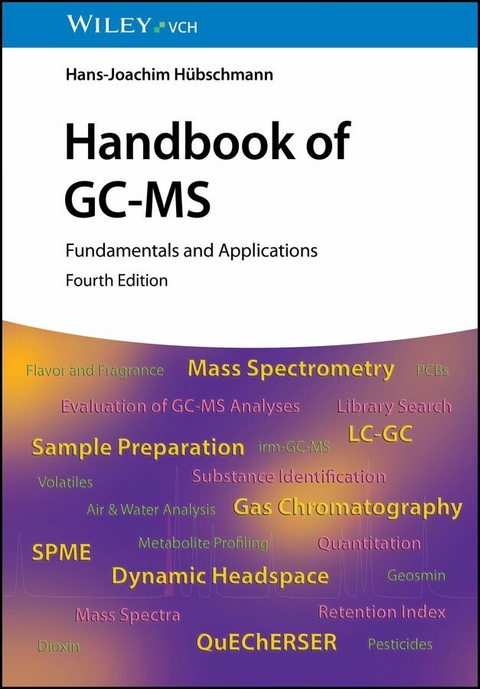
Handbook of GC-MS (eBook)
Wiley-VCH (Verlag)
978-3-527-84762-4 (ISBN)
Essential handbook for all analytical scientists and laboratories using GC-MS, covering both the fundamental and practical aspects of this analytical technique
From essentials to applications, Handbook of GC-MS:Fundamentals and Applications is a comprehensive reference and training compendium on the popular and evolving technique of GC-MS (gas chromatography/mass spectrometry), guiding readers through the most used sample preparation methods for GC-MS and method development, with many practical indications supporting the design of optimized analyses, and providing practical approaches to data processing, compound identification, and quantification.
The text details both a solid background and principles of operation, as well as a broad range of current real-life examples taken from laboratories in environmental, food, pharmaceutical, and forensic analysis. It also features a glossary of more than 300 terms, and a comprehensive substance index that facilitates finding a specific application.
This timely Fourth Edition covers the latest developments in automated sample preparation techniques and instrumentation, also with the focus on Green Analytical Chemistry. This comprehensive handbook presents GC-MS applications in various fields, with coverage of the well-known QuEChERS pesticide extraction, solid phase extraction and solid phase microextraction, static and dynamic headspace analysis, liquid/liquid extraction, outgassing, and thermal desorption, including pyrolysis. Single and triple quadrupole, Orbitrap, time-of-flight, magnetic sector, ion mobility and isotope ratio MS are discussed with their advantages and limitations.
Sample topics covered in Handbook of GC-MS: Fundamentals and Applications include:
- Sample inlet systems for hot needle, liquid band injection with large volume and LC-GC application, carrier gas saving, choice of columns, septa and injection port liners
- Optimization of the GC method with carrier gas flow, effect of oven temperature ramp rates, fast GC, and multi-dimensional gas chromatography
- Ionization processes, electron and chemical ionization, resolution power in mass spectrometry, reading and interpreting mass spectra
- Extraction of mass spectra, manual spectrum subtraction, deconvolution of mass spectra, retention index, and library search of mass spectra
- Typical mass spectra of common analyte groups like pesticides, persistent organic pollutants, drugs; explosives; and of frequently occurring impurities
- Quantification using external and internal standards and standard addition methods. Determination of the limits of detection and quantitation.
- Applications covering food, water, flavor and fragrance, metabolomics, forensic and material analysis
The Handbook of GC-MS: Fundamentals and Applications is an essential reference for the daily GC-MS practice and application of new methods. It serves as an excellent introduction for newcomers as well as an educational resource about this analytical technique. Analytical chemists, chromatographers, environmental chemists, food chemists, and pharmaceutical chemists will find it of high practical use.
Hans-Joachim Hübschmann, PhD, graduated as Certified Food Chemist from the Technical University in Berlin, Germany. In 2002 he joined Thermo Fisher Scientific in Bremen, Germany, and held different international positions in inorganic and isotope ratio mass spectrometry and high-resolution GC-MS and GC-MS/MS. In 2015 he established the independent consulting agency HANS Analytical Solutions. In his current capacity Hans-Joachim is serving private and industrial laboratories and international analytical instrument companies for green and automated methods development as well as trainings.
1
Introduction
“Food safety is a fundamental need for life, and ideally, humans would be trusted to follow the moral imperative set into laws designed to protect our ecosystem and produce safe food for consumption. However, human nature and past transgressions have demonstrated that testing is needed to verify good agricultural and food safety practices.”
Steven J. Lehotay, 2024
USDA Agricultural Research Service, Wyndmoor, PA, USA
Detailed knowledge of the chemical processes in plants, animals, and in our environment with air, water, and soil, about the safety of food and products, has been made possible only through the power of modern instrumental analysis. In an increasingly short time span, more and more data are being collected. The detection limits for organic substances are down in the attomole region, and counting individual molecules per unit time has already become a reality. In food safety and environmental analysis, we achieve measurements at the level of background contamination. However, samples subjected to chemical trace analysis carry high matrix. With the demand for decreasing detection limits by legal regulations, in the future effective sample preparation and separation procedures in association with highly selective detection techniques will be of critical importance for analysis. In addition, the number of substances requiring detection is increasing, and with the broadening possibilities for analysis, so is the number of samples. Even there is the concern of “the inadequacy of current regulations in effectively controlling food contact materials (FCM)” for food safety (Diaz-Galiano et al., 2024). The increase in analytical sensitivity is exemplified with the persistent organic pollutants (POPs) in the case of the “dioxins” with 2,3,7,8-tetrachlorodibenzodioxin (TCDD), the most potent cancer-promoting and teratogenic congener of the polychlorinated dibenzodioxins (PCDDs), still continuously analyzed as contamination in food and feed (Table 1.1).
Capillary gas chromatography with mass spectrometry detection (GC-MS) is today the most important analytical method in organic chemical analysis for the determination of individual low molecular substances in complex mixtures. Mass spectrometry (MS) as the detection method gives the most meaningful data, arising from the direct determination of the substance molecule or of fragments. The results of MS are therefore used as a reference for other indirect detection processes and finally for confirmation of the facts. The complete integration of MS and gas chromatography (GC) into a single GC-MS system has shown itself to be synergistic in every respect.
Table 1.1 Sensitivity progress in mass spectrometry.
| Year | Instrumental technique | Limit of detection (pg) |
|---|
| 1967 | GC-FID (packed column) | 500 |
| 1973 | GC-MS (quadrupole, packed column) | 300 |
| 1976 | GC-MS-SIM (magnetic instrument, capillary column) | 200 |
| 1977 | GC-MS (magnetic sector instrument) | 5 |
| 1983 | GC-HRMS (double focusing magnetic sector MS) | 0.15 |
| 1984 | GC-MSD/SIM (quadrupole mass selective detector) | 2 |
| 1986 | GC-HRMS (double focusing magnetic sector MS) | 0.025 |
| 1989 | GC-HRMS (double focusing magnetic sector MS) | 0.010 |
| 1990 | GC-HRMS required for PCDD/Fs by the US EPA | Method 1613 Rev.A |
| 1992 | GC-HRMS (double focusing magnetic sector MS) | 0.005 |
| 2006 | GC×GC-HRMS (using comprehensive GC) | 0.0003 |
| 2010 | Cryogenic zone compression (t-CZC) GC-HRMS | 0.0002 |
| 2011 | t-CZC GC-HRMS reports low attogram levels in serum (Patterson, 2011; Patterson et al., 2011) | <0.0001 |
| 2014 | GC-MS/MS EU approval for PCDD confirmation in food | EU No. 589/2014 |
| 2017 | GC-Orbitrap reports U.S. EPA 1613 compliance | 0.0001 |
| 2018 | GC-MS/MS reports low femtogram sensitivity | 0.0006 |
| 2018 | APGC-MSMS reports attogram LODs in fly ash | 0.0001 |
APGC, atmospheric pressure gas chromatography; t-CZC, time controlled cryogenic zone compression; FID, flame ionization detector; GC, gas chromatography; HRMS, high resolution mass spectrometry; LOD, limit of detection; MS, mass spectrometry; MS/MS triple quadrupole analyzer; MSD, mass selective detector; SIM, selected ion monitoring; and US EPA, United States Environmental Protection Agency.
It was Fred W. McLaffert who pioneered the technique of coupling a gas chromatograph with a mass spectrometer with Roland Gohlke at Dow Chemical Co., developing a GC-Time-of-Flight (TOF)-MS instrument “capable of rapidly characterizing organic chemical mixtures boiling below 350 °C” (Gohlke 1959). Still at the beginning of the 1980s, MS was considered to be expensive, complicated, and time-consuming or personnel-intensive. At the beginning of the 1990s, MS became more widely recognized and furthermore an indispensable detection method for GC. There is now hardly a GC laboratory which is not equipped with a GC-MS system. The simple construction, clear function, and an operating procedure, which has become easy because of modern computer systems, have resulted in the fact that GC-MS is widely used alongside traditional spectroscopic methods. The universal detection technique, together with high selectivity and very high sensitivity, has made GC-MS indispensable for a broad spectrum of applications. With recent developments, even higher selectivity is provided by the structure selective MS/MS and the elemental formula providing accurate mass technologies for modern multi-residue methods with short sample preparation and clean-up steps. Benchtop GC-MS systems have completely replaced in many applications the stand-alone GC with selective detectors. GC-MS/MS has found its way to routine replacing many single quadrupole systems today, and accurate mass detection follows on its heels.
The control of the chromatographic separation process still contributes significantly to the exploitation of the analytical performance of the GC-MS system (or according to Koni Grob: “Chromatography takes place in the column!”). The analytical prediction capabilities of a GC-MS system are, however, dependent upon mastering the spectrometry. The evaluation and assessment of the data are leading to increasingly greater challenges with decreasing detection limits and the increasing number of compounds sought or found. As quantification is the main application in trace analysis today, the appropriate data processing requires additional measures for confirmation of results provided by mass spectrometric methods.
The high performance of GC lies in the separation of substance mixtures and providing the transient signals for data deconvolution. With the introduction of fused silica columns, GC has become the most important and powerful separation method of analyzing complex mixtures of products. GC-MS accommodates the current trend toward multi-methods or multi-component analyses (e.g. of pesticides, environmental contaminations, fragrances, drugs, and beyond) in an ideal way. Even isomeric compounds, which are present, for example, in essential oils, metabolic profiling, polychlorinated biphenyls (PCBs), or dioxins, are separated by GC, while in many cases their mass spectra are indistinguishable. The high efficiency as a routine process is achieved through the high speed of analysis and the short turnaround time and thus guarantees high productivity with a high sample throughput. Adaptation and optimization for different tasks only require a quick change of column. In many cases, however, and here, the analyst relies on the explanatory power of the mass spectrometer, one type of medium polar column can be used for different applications by adapting the sample injection technique and modifying the method parameters.
The area of application of GC and GC-MS is limited to substances that are volatile enough to be analyzed by GC. The further development of column technology in recent years has been very important for application to the analysis of high boiling compounds. Temperature-stable phases now allow elution temperatures of up to 500 °C for stable compounds. A pyrolizer in the form of a stand-alone sample injection system extends the area of application to involatile substances by separation and detection of thermal decomposition products. A typical example of current interest for GC-MS analysis of high boiling compounds is the determination of polyaromatic hydrocarbons, which has become a...
| Erscheint lt. Verlag | 6.3.2025 |
|---|---|
| Sprache | englisch |
| Themenwelt | Naturwissenschaften ► Chemie |
| Schlagworte | dispersive liquid/liquid micro-extraction • Gas Chromatography • Green Analytical Chemistry • Mass Spectrometry • Pyrolysis • QuEChERS • sample preparation • solid phase micro-extraction • static and dynamic headspace • Thermal Desorption |
| ISBN-10 | 3-527-84762-6 / 3527847626 |
| ISBN-13 | 978-3-527-84762-4 / 9783527847624 |
| Informationen gemäß Produktsicherheitsverordnung (GPSR) | |
| Haben Sie eine Frage zum Produkt? |
 EPUB (Adobe DRM)
Kopierschutz: Adobe-DRM
Adobe-DRM ist ein Kopierschutz, der das eBook vor Mißbrauch schützen soll. Dabei wird das eBook bereits beim Download auf Ihre persönliche Adobe-ID autorisiert. Lesen können Sie das eBook dann nur auf den Geräten, welche ebenfalls auf Ihre Adobe-ID registriert sind.
Details zum Adobe-DRM
Dateiformat: EPUB (Electronic Publication)
EPUB ist ein offener Standard für eBooks und eignet sich besonders zur Darstellung von Belletristik und Sachbüchern. Der Fließtext wird dynamisch an die Display- und Schriftgröße angepasst. Auch für mobile Lesegeräte ist EPUB daher gut geeignet.
Systemvoraussetzungen:
PC/Mac: Mit einem PC oder Mac können Sie dieses eBook lesen. Sie benötigen eine
eReader: Dieses eBook kann mit (fast) allen eBook-Readern gelesen werden. Mit dem amazon-Kindle ist es aber nicht kompatibel.
Smartphone/Tablet: Egal ob Apple oder Android, dieses eBook können Sie lesen. Sie benötigen eine
Geräteliste und zusätzliche Hinweise
Buying eBooks from abroad
For tax law reasons we can sell eBooks just within Germany and Switzerland. Regrettably we cannot fulfill eBook-orders from other countries.
aus dem Bereich